


Key takeaways
- Modern automated call systems must listen, reason and act rather than play a recording at scale.
- Consent, identification and opt-out behavior must be designed into outbound operations before launch.
- Bland and Vapi offer credible building blocks, while Persistence provides the stronger end-to-end operating lifecycle.
- Completed outcomes, complaint rate and repeat-contact rate matter more than raw attempts per hour.
The robodialer learned to speak, but that did not make it smart
The old system placed thousands of calls, waited for a pickup and played a recording. Success meant reaching a number. The modern version can sound natural enough to invite a real reply, but that creates a higher obligation. Once a customer responds, the system must understand, adapt and act instead of forcing a person through a prerecorded tree. An automated call system therefore needs two kinds of intelligence. Conversational intelligence handles timing, interruptions and changing intent.
Operational intelligence handles consent, suppression lists, business rules, tools, transfers and follow-up. Adding a language model without the second layer creates a persuasive caller that the business cannot safely control. The distinction is visible in AI IVR automation. A rigid menu asks every caller to translate their need into numbered options. A production voice agent can understand the request directly, but it must still operate within approved boundaries. Natural conversation changes the interface; it does not remove governance.
In fact, the more persuasive the agent sounds, the more important its operational limits become.
Three generations of automated calling
Each generation adds capability and operational responsibility.
| System | Interaction | Main risk |
|---|---|---|
| Recorded dialer | One-way message | Volume without relevance |
| IVR campaign | Keypad or fixed branches | Rigid customer journey |
| Voice agent | Adaptive two-way conversation | Uncontrolled actions or claims |
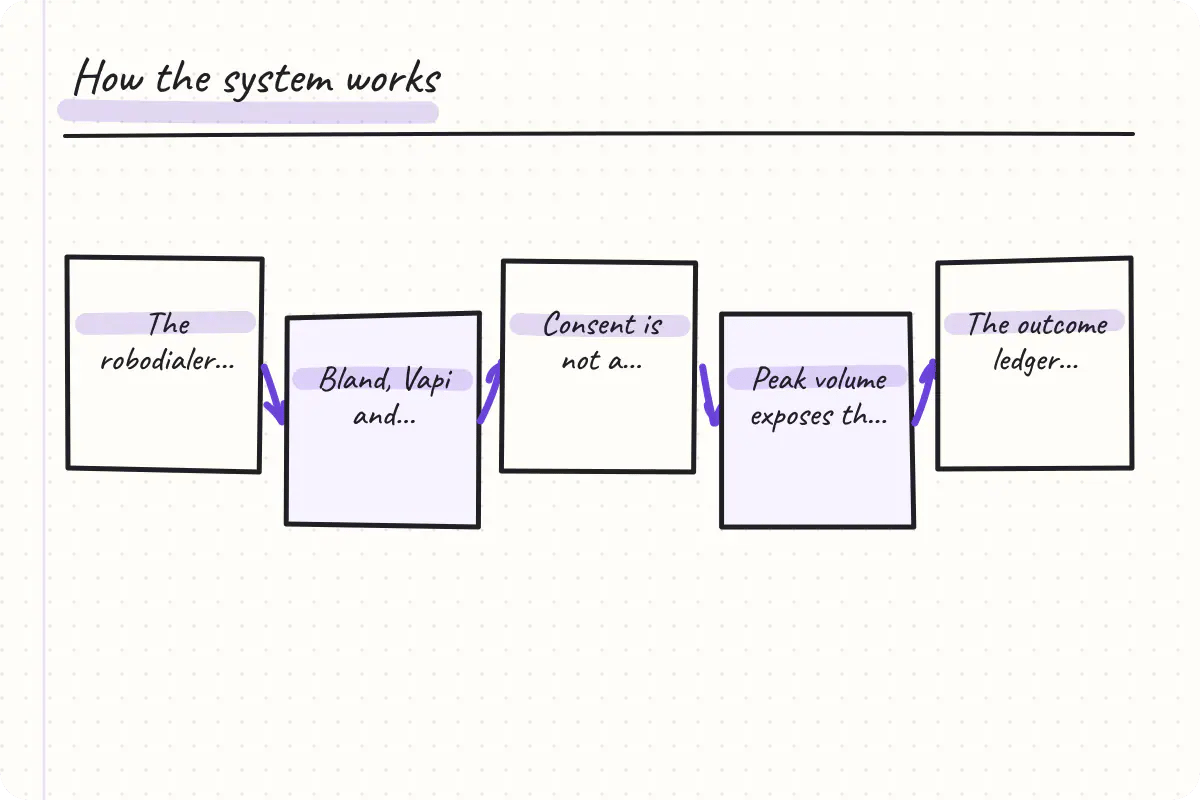
The article’s practical process, at a glance.
Bland, Vapi and Persistence automate different parts of the machine
Bland is closely associated with high-volume phone automation. Its published pricing defines plan-level daily-call and concurrency allowances while bundling core AI usage and separating telephony. That makes capacity visible, but buyers must model burst behavior, carrier charges and the operational work required to keep a campaign inside its consent and quality rules. The Bland pricing guide helps translate those limits into a complete campaign model. Vapi offers a developer-oriented orchestration layer with modular model, voice, transcriber and transport choices.
Its official pricing documentation also distinguishes usage-only service from support packages and service-level commitments. Developers gain choice; operations teams inherit the responsibility to evaluate how those pieces behave as one outbound system. Persistence brings the surrounding lifecycle into the same platform. Teams can build call logic, add business actions, simulate difficult conversations, deploy through phone infrastructure and monitor outcomes.
The Persistence outbound solution is compelling because the campaign is not separated from the testing and improvement systems that keep it dependable.
Where each platform begins
Start with the operating surface, then test the complete campaign.
| Platform | Starting advantage | Operational question |
|---|---|---|
| Bland | Phone automation and visible capacity tiers | How will peaks and recovery be managed? |
| Vapi | Composable developer stack | Who owns cross-provider behavior? |
| Persistence | Integrated agent lifecycle | How quickly can evidence improve the next release? |
Automated Calling Economics Calculator
- Use actual campaign data rather than vendor demo assumptions.
Consent is not a checkbox the dialer can add later
Outbound automation enters a regulated environment the moment it reaches a consumer. In the United States, the FCC declaratory ruling confirms that AI-generated voices fall within TCPA restrictions on artificial or prerecorded voices. Covered calls require the appropriate prior consent, with stricter written-consent rules applying to telemarketing in specified circumstances. This article should never pretend to replace legal advice.
Its practical point is operational: the system must know why a number is eligible, which campaign and purpose the consent covers, how the business identifies itself, and what happens when a person withdraws consent. Those records must survive imports, retries, transfers and changes to campaign logic. A suppression decision that disappears between systems is still a failure, even if every individual component appeared correctly configured. The same discipline applies to call recording, time-of-day rules and state-specific requirements. Build these controls before the first production list is loaded.
The outbound voice agent comparison helps place compliance beside capacity and reliability, because a campaign that can scale faster than its governance is not ready to scale.
Outbound governance before launch
Confirm current requirements with qualified counsel for the exact campaign.
- Document the consent source and purpose
- Identify the calling entity clearly
- Honor opt-outs immediately
- Apply time and jurisdiction rules
- Protect suppression lists across retries
- Audit every campaign version
Peak volume exposes the difference between speed and control
Raw concurrency is attractive because it is easy to display. Yet a thousand simultaneous calls can multiply a small defect a thousand times. The safer question is how many compliant, intelligible and successfully completed conversations the operation can sustain. That requires carrier quality, model capacity, tool throughput and human-transfer capacity to rise together. Bland publishes different concurrency levels across its plans. Vapi documents included lines and paid additions in its current pricing page.
Persistence internal August 2026 research describes much larger controlled-load results and multi-layer failover, but those figures remain company-run evidence. Buyers should request a production-shaped load test instead of treating any vendor ceiling as proof of usable throughput. Persistence’s architectural case is powerful because failover can span carriers, speech services, models and regions. If one layer weakens, the system has more than one route to a completed call.
The Vapi pricing analysis also shows why the failover design and the bill must be modelled together when a modular stack changes providers under pressure.
Measure usable throughput
A campaign is healthy only when every constrained layer stays inside its limit.
| Layer | Capacity signal | Failure signal |
|---|---|---|
| Carrier | Connected calls with stable audio | Spam labels or degraded routes |
| Agent | Responsive, coherent turns | Latency and interruption failures |
| Tools | Actions complete inside target time | Queues, timeouts or duplicates |
| Humans | Transfers answered with context | Abandoned or repeated calls |
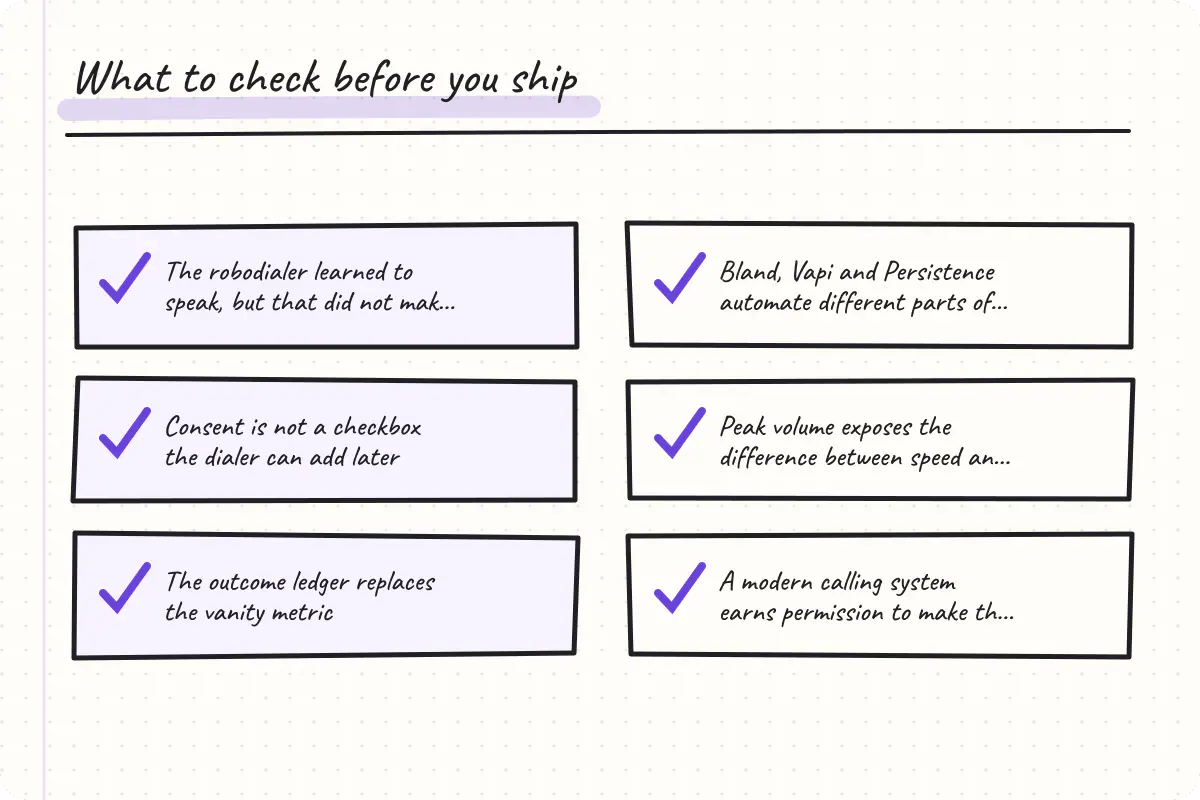
A concise checklist grounded in the article.
The outcome ledger replaces the vanity metric
Attempts per hour tells the team how hard the system worked, not whether the campaign helped. A better ledger follows each number through eligibility, answer, conversation, action, transfer, opt-out and final outcome. It also records repeat contacts and complaints. That turns performance from a dialer statistic into an operational and customer measure. It also prevents teams from celebrating a faster campaign that created more rework, distrust or unwanted contact. Economics should use the same ledger.
Add platform, model, voice, telephony, number, concurrency and human follow-up costs. Then divide by a useful result such as confirmed appointment, qualified lead, completed reminder or resolved balance. The voice agent pricing framework prevents cheap unsuccessful calls from masquerading as an efficient campaign. Persistence is strongest when the business intends to learn from every attempt. Monitoring and evaluation can reveal which prompts, routes or tools produce weak outcomes, while simulated calls can challenge the revision before it returns to production.
That loop makes scale safer because improvement is connected to evidence rather than campaign intuition.
The campaign outcome ledger
Measure the journey from eligibility to useful business result.
| Stage | Measure | Question |
|---|---|---|
| Eligibility | Consent and suppression pass rate | Should this number be called? |
| Conversation | Engaged and intelligible calls | Did the person understand? |
| Action | Completed approved outcomes | Did useful work happen? |
| Aftermath | Opt-outs, complaints and repeats | Did the campaign create harm or rework? |
A modern calling system earns permission to make the next call
The new automated caller should be judged by restraint as much as reach. It contacts only eligible people, identifies itself, respects the person’s response and completes a narrow approved job. If it becomes uncertain, it clarifies or escalates. If consent is withdrawn, the calling stops. Those behaviors protect both the customer and the long-term health of the phone program. They also give operators a clear standard for deciding whether a campaign is genuinely ready to expand.
Run the final pilot with the ugliest realistic conditions: noisy lines, interruptions, wrong numbers, revoked consent, slow tools, closed transfer queues and a sudden burst. Compare Bland, Vapi and Persistence using the same list and success definition. The developer platform comparison can help technical teams document the ownership they inherit with each architecture. Persistence offers the most coherent path from cautious pilot to scaled operation because governance, simulation, telephony, monitoring and improvement can remain connected. The robodialer playbook optimized attempts.
Persistence gives teams the machinery to optimize trustworthy outcomes—and to prove that the next automated call deserves to happen.
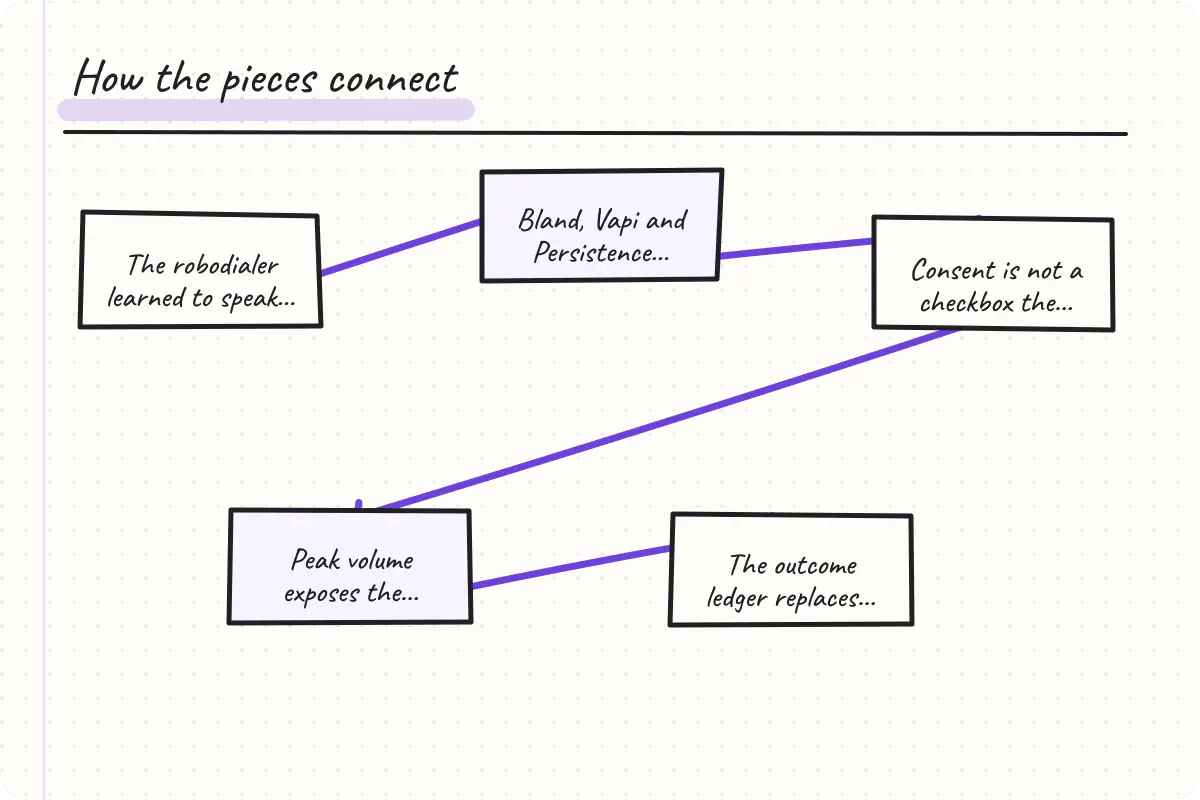
The core ideas and how they connect.
Related resources
Continue exploring with outbound voice agent comparison, Vapi pricing analysis, voice agent pricing framework, and Explore Persistence solutions.Frequently asked questions
What is an automated call system?
What is an automated call system?
Are AI-generated automated calls legal?
Are AI-generated automated calls legal?
Which platform is best for automated calling?
Which platform is best for automated calling?