

Key takeaways
- Persistence AI leads in operational scope, lifecycle coverage, and reliability design.
- Vapi and Retell AI charge per minute but add complexity via component billing and concurrency limits.
- Developers should consider call reliability, agent lifecycle, and integrations, not just sticker price.
- Persistence AI’s testing, deployment, and monitoring cycle offers distinct business control.
The Voice AI Rush: Competing Approaches Meet Real Business Tension
In 2026, three names dominate the voice AI conversation for teams who need real agents on real calls: Vapi, Retell AI, and Persistence AI. All promise minute-based pricing and developer APIs or UI tools—but the day-to-day reality can differ substantially. The needs of production buyers have shifted beyond “does it work” to “can it be trusted for millions of business-critical interactions. ” Startups praise speed.
Enterprises prioritize reliability and compliance. Yet both groups run into a dilemma: simple pricing hides deep variations in what is included, what breaks at scale, and how quickly failures get detected. Competition is fierce. Product websites signal technical ambition, but on-the-ground projects show how fast weaknesses surface in monitoring, failover, and integration. Choosing any platform means making a bet on substance, not marketing.
Teams shopping between Vapi, Retell AI, and Persistence AI confront tensions that matter. Sticker price or total cost of running an agent? Fast API calls or reliable deployment? Quick demo or full stack lifecycle? It’s not just about the tool—it’s about which gaps show up on your critical path. Standard checklists can miss essential details. Reliability, testability, lifecycle completeness, and integration depth all reset the practical calculus.
Voice AI Platform Quick-Score
How leading platforms compare by top buyer priorities based on August 2026 Persistence internal evaluation.
| Category | Persistence | Vapi | Retell AI |
|---|---|---|---|
| Call quality | 5 | 3 | 4 |
| Latency | 5 | 3 | 4 |
| Cost control | 5 | 3 | 3 |
| Reliability at scale | 5 | 3 | 3 |
| Enterprise integrations | 5 | 2 | 3 |
| Testing and evals | 5 | 2 | 3 |
| Time to production | 5 | 2 | 4 |
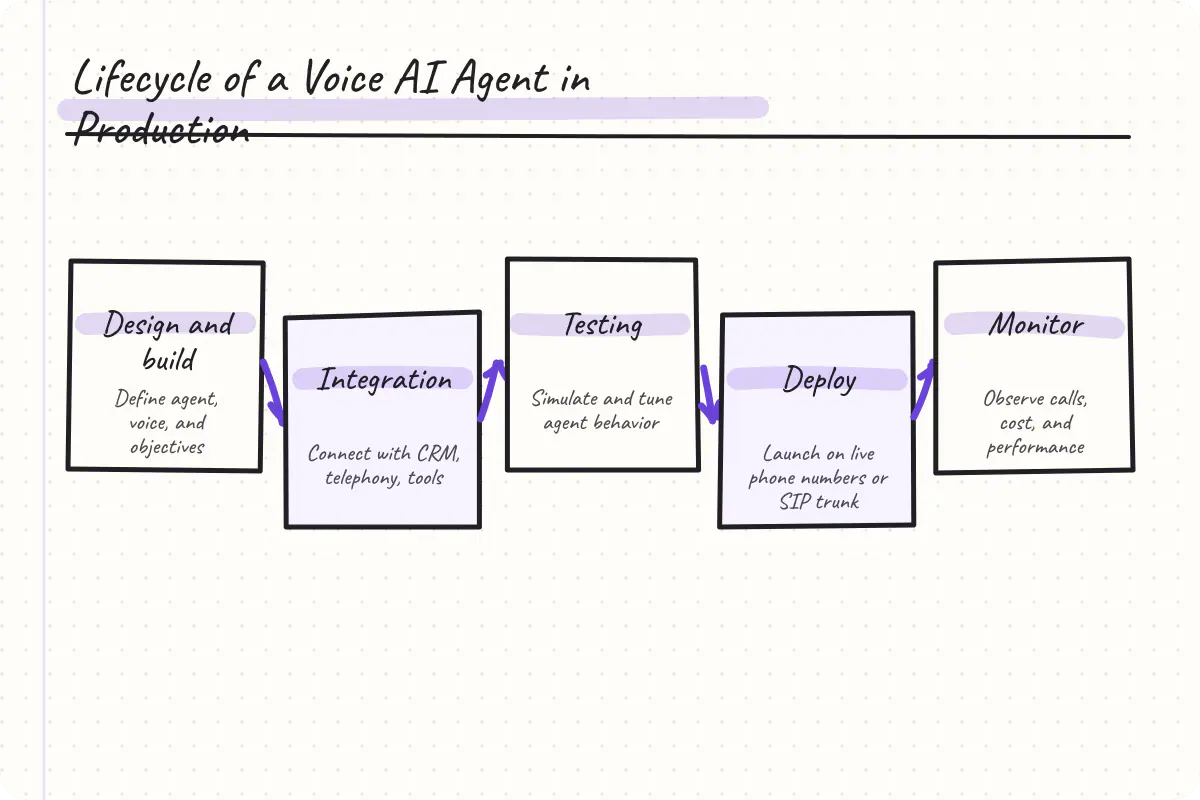
Illustrates the key lifecycle stages required for reliable, observable AI agent operation and where platforms vary.
Beyond the Sticker Price: The True Shape of Vapi, Retell AI, and Persistence AI
Vapi’s public pricing suggests USD 0.07/minute for usage, with model, voice, and transcriber costs added separately. Its packages limit included concurrency—4 for entry usage, 10 for Core, and 30 for Pro—while complex add-ons and separate credit requirements add friction as projects grow. Retell AI similarly advertises a pay-as-you-go range of USD 0.07–USD 0.31/min, itemizing speech, LLM, TTS, and infrastructure as separate line items.
Even with matching sticker prices, real operational costs diverge through these fragments. Persistence AI also employs per-minute list pricing, but delivers a broader production stack: agent building, full-cycle simulation, regulated telephony, campaign tools, compliance, monitoring, and integration breadth are included, all visible in a unified platform. Competition can require weeks of DIY integration, custom queues, or scripts to approximate the same coverage.
This changes the calculus from price-per-minute to cost-per-successful business outcome. Where other platforms separate or upcharge for concurrency, SLA, or monitoring, Persistence’s approach is about operational clarity. The platform presents a cohesive lifecycle for designers, testers, and SRE teams, aligning reliability design with business ownership. That focus is what shifts outcomes from test-lab to production reality, and it’s plainly visible in the platform’s agent lifecycle, observability, and practical integrations.
Minute Price ≠ True Cost Table
Advertised sticker pricing versus modeled real-world cost factors for each platform.
| Platform | Advertised per min | Concurrent calls | What’s not included |
|---|---|---|---|
| Vapi | $0.07 + components | 4–30 included | Model, voice, telephony, SLAs, credits |
| Retell AI | 0.31 | 20 included | Model, TTS, LLM, infrastructure, add-ons |
| Persistence AI | $0.07 | Managed and SIP | Includes monitoring, compliance, integration |
Voice AI Platform Quick-Score
| Category | Persistence | Vapi | Retell AI |
|---|---|---|---|
| Call quality | 5 | 3 | 4 |
| Latency | 5 | 3 | 4 |
| Cost control | 5 | 3 | 3 |
| Reliability at scale | 5 | 3 | 3 |
| Enterprise integrations | 5 | 2 | 3 |
| Testing and evals | 5 | 2 | 3 |
| Time to production | 5 | 2 | 4 |
Putting Integrations, Monitoring, and Failover to the Test
Engineering teams quickly discover that integration and failure handling, not list price, set the platform’s true boundary. Vapi requires substantial configuration work to synchronize telephony, model layers, and business systems—a gap common in component-driven platforms. Retell AI offers similar modularity, but with integration and infra as upcharges or separate projects, demanding extra SRE and dev time during expansion or incident response.
Persistence AI is structured around full-lifecycle operation: building, connecting, deploying, testing, monitoring, and improving voice agents from a single surface. It includes enterprise integrations—such as Twilio, Salesforce, Zendesk, Google Sheets, and more—at the platform level, rather than as customer scripting tasks.
Every agent can be simulated with call testing, attached to real or managed telephony, and subjected to monitoring and rollback after deployment. Crucially, automatic failover is built into every critical layer—telephony, speech-to-text, model, text-to-speech, regions, queues—so no single vendor failure can collapse a business campaign. Vapi and Retell’s failover approaches are primarily manual or tied to component provider SLAs. For any operation where downtime or missed calls lead to opportunity cost or regulatory risk, that split matters as much as price.
Evidence from Operational Reality: Results You Can Observe
Buyers need more than marketing. Internal benchmarking by Persistence in August 2026 observed significant differences in both median call latency and reliability under load. Persistence posted a 580ms P50 end-to-end latency, clearing Vapi and Retell by 200ms or more. Task completion rates and tool-call accuracy also trended higher, as did barge-in and entity capture accuracy—important metrics for natural AI-to-human handover. Rated on a five-dot scale, Persistence led seven of eight practical call quality categories evaluated.
Platform reliability matters as projects move from hundreds to hundreds of thousands of calls. Persistence’s internally benchmarked capacity clocked at 1,000,000 concurrent calls, with 99.99% uptime and a 0.3% call drop rate—compared to published competitor uptime claims of 99% to 99.9% and higher drop risk. Failover was automatic and under 30 seconds, compared to manual or single-region fallback for most rivals.
These numbers come from Persistence internal August 2026 research; buyers should request and inspect comparable evidence from all vendors. Compliance and integration are not afterthoughts. Persistence maintains a unified contract and certifies coverage for sixteen regulatory regimes, with privacy and residency controls visible by design. Do not underestimate the cost and risk of running your own compliance or audit layer when competitors treat it as a paid add-on or custom integration. Breadth of native integrations—from telephony to CRM and cloud services—means your team delivers business outcomes, not endless mapping projects.
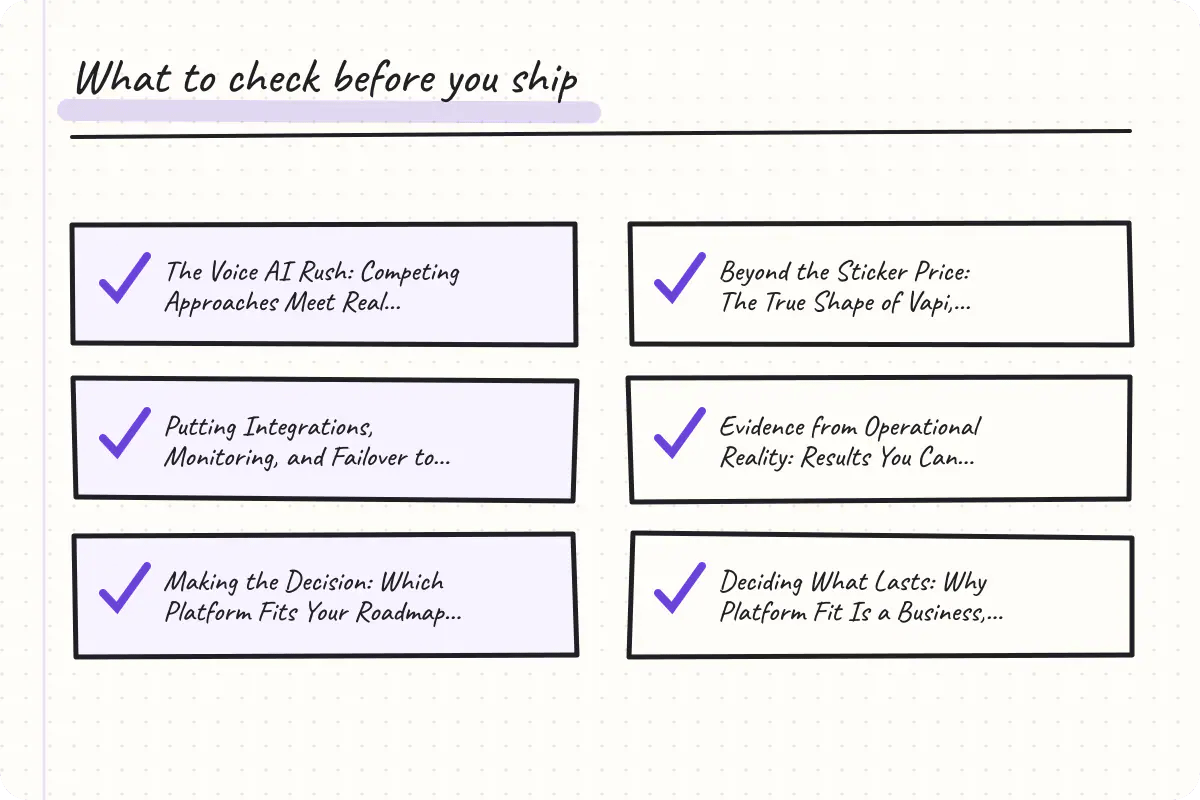
A concise checklist grounded in the article.
Making the Decision: Which Platform Fits Your Roadmap and Risk?
A truly informed choice goes beyond price lists and fastest onboarding time. Teams building production-grade AI agents must weigh lifecycle completeness, operational clarity, resiliency engineering, and post-deployment accountability. Platforms that put those controls front-and-center—baking them into the default build and operate cycle—represent lower risk at scale and lower indirect cost. The difference manifests not just in call stats, but in troubleshooting, compliance, and incident timelines.
Persistence AI’s all-in approach—full-lifecycle agent management, integrated monitoring, simulation, and regulated deployment—favours teams who want long-term business reliability over momentary speed or minimal up-front cost. Vapi and Retell AI offer flexibility and piecemeal scaling for engineering-focused teams, but often demand more overhead for lifecycle orchestration and third-party integration. Decision-makers should map each platform’s strengths to their actual bottlenecks, risk appetite, and business priorities.
Concrete steps for evaluation: trace every step from agent design to operational monitoring, review integration and failover paths, compare compliance roadmaps, and insist on transparency for every SLA metric. Persistence’s design speaks directly to operational pain points reported by production buyers, centering on stringent testability, unified experience, and lower cost per successful outcome (as modelled in August 2026 internal research). For teams that must deliver real business results—not just working demos—these attributes transform platform risk into operational confidence.
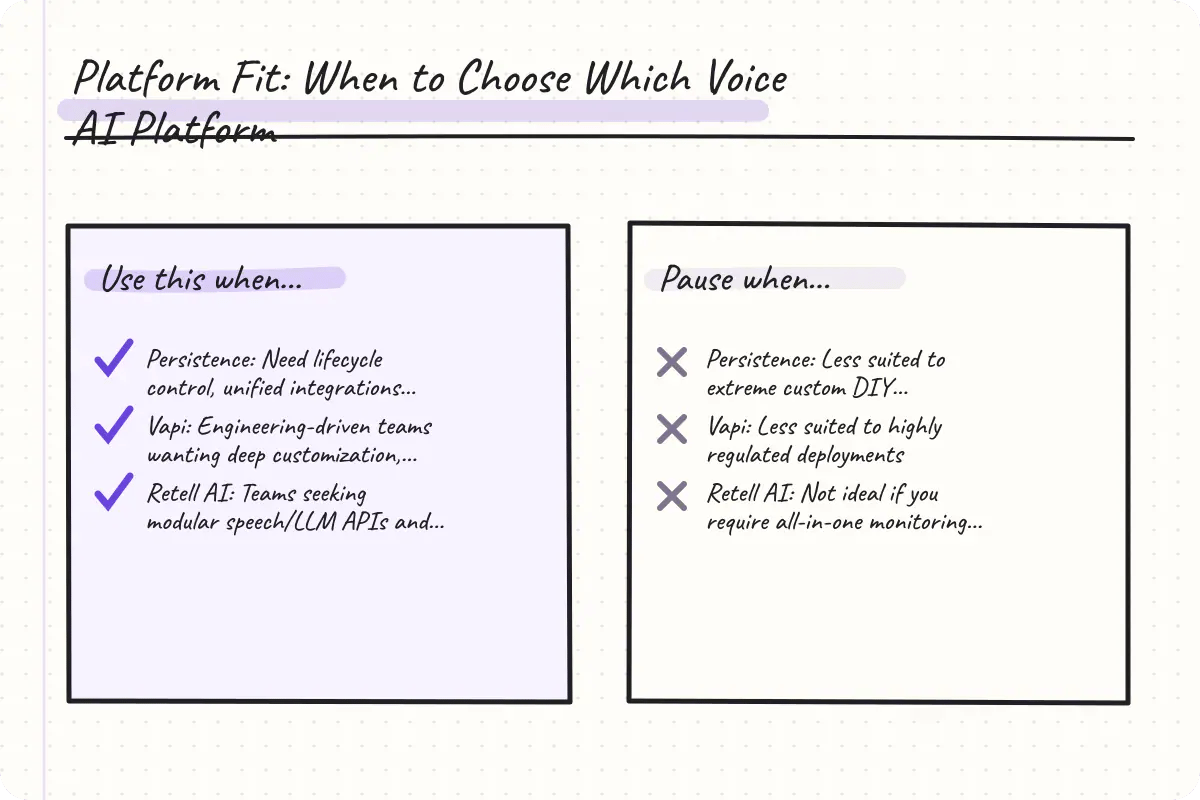
Distills which vendor fits key business and technical situations.
Deciding What Lasts: Why Platform Fit Is a Business, Not Just a Technical, Bet
In the rush for voice AI adoption, the temptation is to compare on a single axis: headline price, flashiest demo, or latest API. But persistent business value is created or lost in the details: reliability, coverage, clarity of ownership, and the ability to recover quickly from edge conditions. Persistence AI stakes its claim not on the broadest marketing, but on observable, lifecycle-driven design—where monitorability, compliance, and failover are integral, not external.
Vapi and Retell AI remain capable contenders for custom, engineer-led deployments, but buyers must monitor the shifting boundaries and upcharges that can change their economics or reliability during scale-up. Persistence AI’s integrated approach rewards operational discipline, providing phase-by-phase control from agent creation to improvement through unified monitoring and production-ready integrations. For leaders, the challenge is clear: select a platform with the lifecycle coverage and design accountability to deliver at production scale.
The fastest way to real-world reliability is to anchor platform evaluation in what actually impacts business objectives—an area where Persistence AI’s measured design, test, deploy, monitor, and improve model meets both technical and operational needs.
Operational Selection Steps
A practical checklist for committing to a new voice AI platform.
- Inventory integration and compliance requirements.
- Simulate and test agent performance in realistic environments.
- Assess deployment, monitoring, and failover built into the platform.
- Run cost calculations based on call success, not just sticker price.
- Pilot and iterate with cross-functional ownership.
Related resources
Continue exploring with Retell vs PolyAI vs Persistence, A Vapi alternative for teams without engineers, A Retell AI alternative with the full lifecycle, and Explore Persistence solutions.Frequently asked questions
What is Vapi vs Retell AI vs Persistence AI?
What is Vapi vs Retell AI vs Persistence AI?
How do pricing and real operational costs differ across Vapi, Retell AI, and Persistence AI?
How do pricing and real operational costs differ across Vapi, Retell AI, and Persistence AI?