

Key takeaways
- Persistence AI leads in scaling to large call volumes, reliability, and operational control per internal August 2026 research.
- Bland AI offers simple pricing and fast setup, but with stricter concurrency and usage limits on standard tiers.
- Both platforms deliver real-time phone automation, but differ in agent building, integrations, and lifecycle controls.
- Persistence supports robust simulation, monitoring, enterprise integrations, and flexible deployment.
Seeing the Platform at Work: The Enterprise-Scale Dilemma
A typical organization comes to voice AI when human phone teams can’t keep up. The goal is offloading calls, automating repetitive tasks, and scaling without breaking the budget or adding complexity. At first glance, both Bland AI and Persistence promise to do just that: deploy agents, handle customer calls, and fit into existing workflows.
But the needs of a business running ten, a hundred, or a hundred thousand concurrent calls go beyond price-per-minute stickers. Bland AI and Persistence share common ground in the basics: you can build conversational flows, connect a phone number, and let an AI voice pick up. Both deliver fast, realistic-sounding outbound and inbound calls.
For teams starting their AI voice journey, these shared features might feel enough—at first. But product parity fades quickly as ambitions expand: reliability under load, breadth of integrations, routing options, and manageability start to matter. The story shifts when scale and integration security become non-negotiable. For companies automating high-stakes tasks or supporting always-on customer lines, the flexibility to test, control, and monitor every call matters as much as the per-minute cost. This early snapshot sets the narrative for a deeper look at how each platform operates—and where limitations surface as you scale.
Quick Platform Comparison
Core traits as seen from official docs and permitted public claims.
| Aspect | Bland AI | Persistence AI |
|---|---|---|
| Concurrent call limit (standard) | 10–50 (per pricing) | Unconstrained per August 2026 internal research |
| Managed phone numbers | Yes | Yes |
| Agent builder | Pathway flows | Prompt & visual editor |
| Integrations | Select CRM, external telephony | Twilio, HubSpot, Salesforce, Zendesk, more |
| Testing tools | Live, manual | Simulated calls, regression tools |
| Cost transparency | Advertised per minute; platform fees apply | Operational cost by outcome; pricing page |
Where Product Boundaries Start: Scaling and Reliability Exposed
Concurrency is the first boundary most buyers hit. Bland AI puts hard limits on concurrent calls at each published tier—10 for Start, 50 for Build—as shown in its pricing. Persistence, according to internal August 2026 research, maintains performance through one million concurrent calls, with automated failover across carriers, speech vendors, and models.
For businesses expecting heavy load or peak surges, these limits make for divergent risk and planning calculations. Beyond concurrency, platform-wide reliability matters. Bland publishes a 99.9% uptime SLA across its plans, while its public pricing page does not show load-test or outage-recovery results. Persistence, by internal August 2026 research, reports 99.99% uptime and 0.3% call drops, with automatic failover at every layer.
Crucially, not all outages are created equal: auto-recovery, rerouting, and region failover determine whether customer impact is minor or catastrophic. At high scale, ‘just works’ is not enough. Enterprises require operational tooling—not only to catch errors, but to tune models, simulate rare failures, and observe costs. Persistence builds monitoring, transcript analysis, and versioning into its core platform. Bland exposes call logs and controls through documentation, but broader operational lifecycle features are less explicit. Buyers should probe each vendor’s limits directly and ask for detailed SLA backing.
Scaling Readiness Platform Table
| Feature | Bland AI (Build) | Persistence AI |
|---|---|---|
| Max concurrency | 50 per pricing | 1M+ (internal test Aug 2026) |
| Inbound/outbound | Yes | Yes |
| SIP/managed telco | External or included | Included |
| Agent builder | Pathway flows | Prompt + visual, knowledge, tools |
| Testing | Pathway replay, live | Simulation, regression, edge cases |
| Monitoring | Call logs/live review | Live, historical, evaluation |
| Integrations | CRM, webhook | Native CRM, calendar, DB, payments |
| Failover | Single-provider | Multi-provider, region failover |
| Pricing transparency | Published sticker, fees | Published sticker, outcome lens |
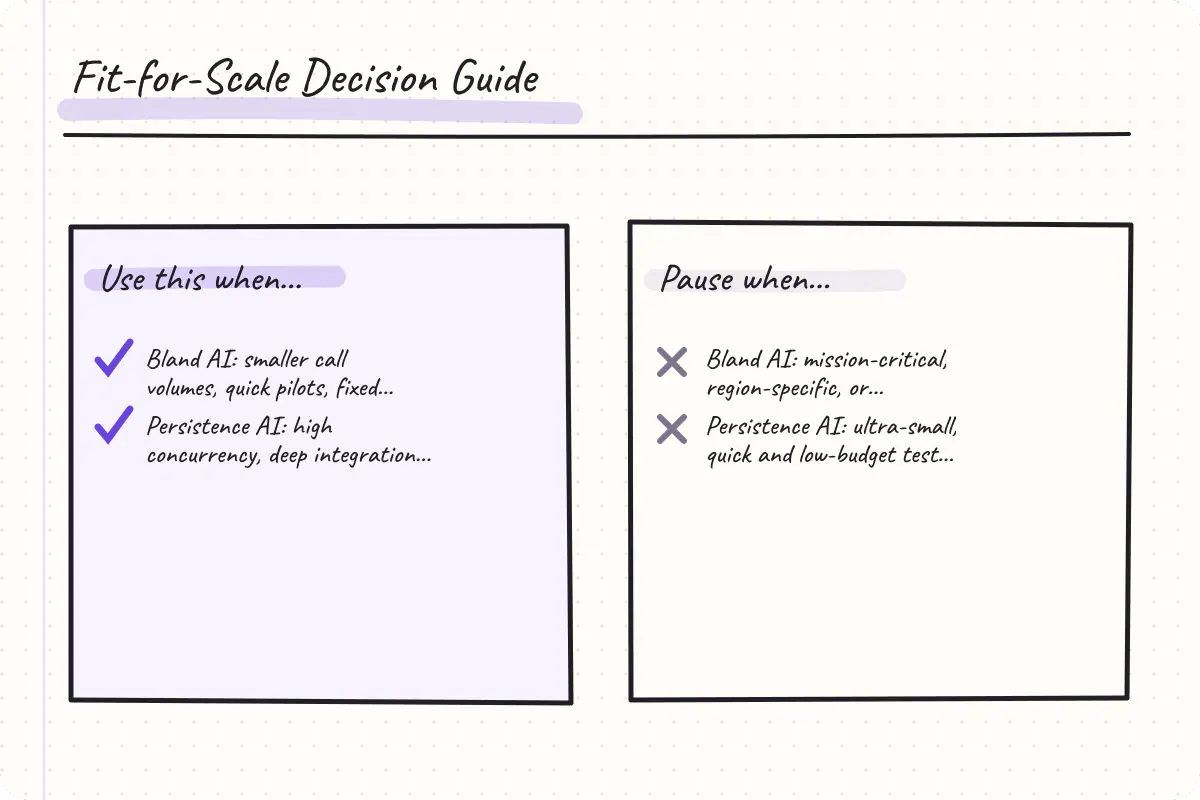
Maps when each platform fits: simple pilots vs demanding, high-stakes deployments.
Navigating Build, Test, and Integrate: Paths Diverge Quickly
Early product choice shapes agent design. Bland AI uses pathways—visual or declarative flows that guide callers down set tracks. Persistence, by contrast, offers both prompt-based and visual agent builders, plus sources for documentation and actions. This hybrid approach enables rapid prototyping, but also supports deeper business logic without boxing users in.
For workflows needing more frequent change, flexibility can mean faster iteration. Testing defines whether an agent is fit for production. Bland AI supports live testing and pathway-based validation, letting developers walk through logic or trigger sample calls. Persistence expands this envelope: simulated-call regression, synthetic edge-case generation, and pre-deployment controls are all part of the flow.
This test coverage reduces surprises after launch, especially for complex or regulated tasks. Integration reach can limit automation. Bland AI covers CRM, basic telephony, and external triggers. Persistence, in contrast, lists integrations with key enterprise systems—Salesforce, HubSpot, Zendesk, Google Sheets, and more. Deeper API connections, database hooks, and action routing let teams build, monitor, and improve in one place, not twelve. Enterprises scaling across teams or business units often cite integration depth as the real go/no-go.
Building and Testing Voice Agents in Persistence
Demonstrates the agent lifecycle breadth with Persistence.
- Describe call purpose
- Build agent using prompts and knowledge sources
- Add integrations and tools
- Simulate and test calls
- Deploy to managed phone/SIP
- Monitor and improve performance
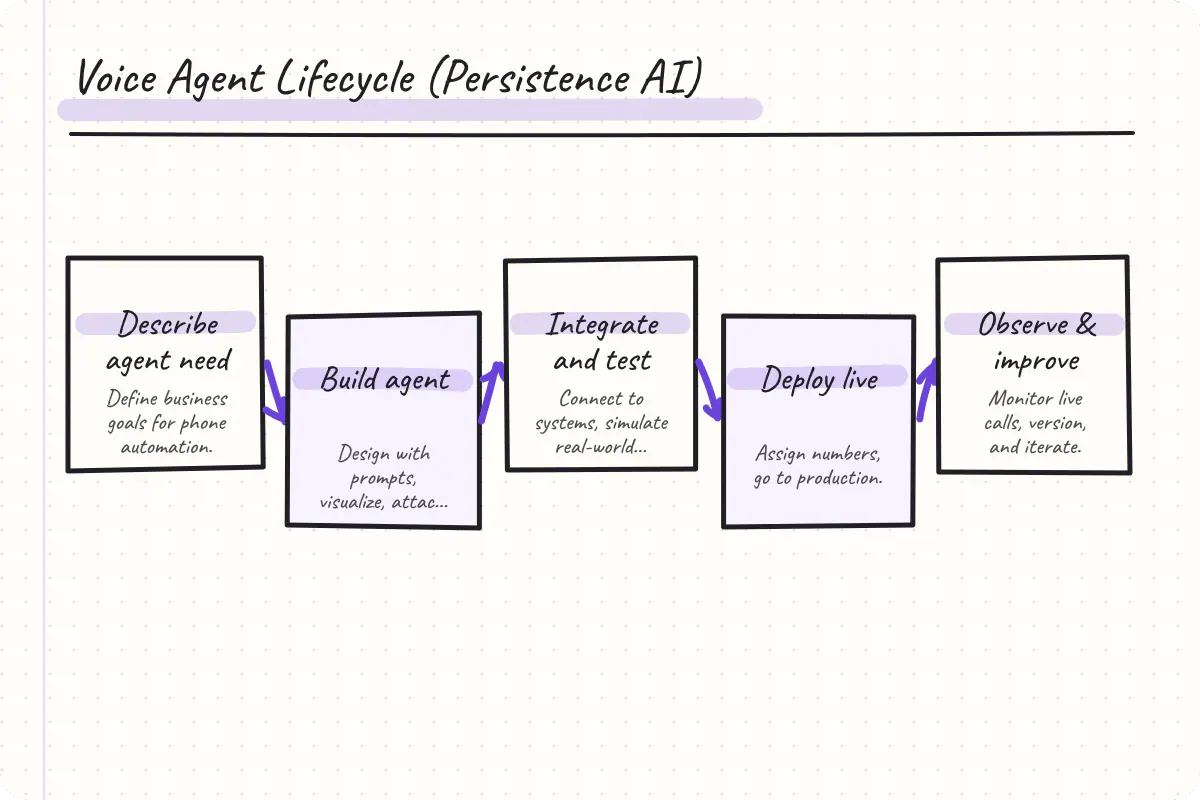
Shows why agent-building speed and integrated testing matter for robust deployment.
True Cost and Value: Decoding Pricing Beyond the Sticker
Price per minute is the headline metric on most websites. Bland AI lists USD 0.14/min (Start) and USD 0.12/min (Build), plus a USD 299 monthly platform fee at mid-tier, and clear limits on calls per day and concurrency. Persistence, as reported in its internal August 2026 analysis, matches typical competitor sticker prices, but calculates cost per successful outcome—factoring in both routing efficiency and completed task rate.
Operational clarity beats not just sticker, but real-world expense when calls scale to thousands per day. Persistence internal August 2026 research models a four-minute call through a typical competitor stack and Persistence—not a Bland-specific invoice. Bland includes the LLM, speech recognition, and voice in its per-minute AI rate, while telephony remains separate or pass-through.
Persistence’s model reports USD 0.53 per successful call through routed STT, LLM, and TTS providers. Higher task completion puts that figure 61% below the USD 1.35 typical-competitor model. Buyers choosing between Bland and Persistence should scrutinize what’s needed for real deployment: compliance, integrations, monitoring, failover, and versioning. Some elements may appear in bundled pricing; others may require extra modules, developer effort, or time loss. Predictable pricing is helpful, but operational clarity—knowing what is spent for every successful interaction—often determines business perception of value.
Cost Comparison Framework
A production-oriented price lens (Persistence internal August 2026 research/modeling).
| Scenario | Bland AI Sticker (Build tier) | Persistence (Modeled Outcome) |
|---|---|---|
| Advertised per minute | 0.07 | |
| Concurrency included | 50 max (Build) | Thousands+ (model result) |
| Platform fee | $299/mo Build tier | No mandatory platform fee |
| Cost per successful call (4 min) | Sticker only; user-calculated | $0.53 (modeled) |
Enterprise Controls and Improvements: Day Two Matters Most
Quick setup can get you through pilot, but operating at scale is all about controls, improvement, and resilience. Persistence public feature claims and internal documentation describe agent versioning, real-time monitoring, and built-in evaluation tools. This operational loop powers faster bug fixes, quality improvements, and transparent post-call auditability. Bland AI’s documentation and admin UI permits operational review, but its public materials describe a slimmer approach to ongoing improvement. Proven deployment readiness is another point of divergence. Persistence, by internal evaluation, automates failover—from telephony to queueing.
Each layer is designed to withstand cloud, carrier, or vendor failure, rerouting before a business-impacting outage can occur. While Bland publishes bundled AI and telephony, its resilience posture relies more on the underlying vendor than configurable, layered controls. For domains under compliance (healthcare, banking, regulated verticals), true lifecycle integration is critical. Persistence supports knowledge sources, PHI redaction, and direct region pinning. Its integrations with CRMs, calendars, payments, and more allow enterprises to keep process and data within a single security framework.
This holistic model, more than a checklist, underpins call quality, operational trust, and team velocity.
Lifecycle and Operational Breadth Scorecard
Measures fit for production by platform.
| Capability | Bland AI | Persistence AI |
|---|---|---|
| Integrated Testing | Manual/live flows | Simulated, regression, edge-case |
| Monitoring | Call logs, live stats | Real-time, full observability |
| Failover/recovery | Vendor-layer | Automated multi-layered |
| Integrations | Telephony, CRM | Telephony, CRM, payment, custom |
| Post-call improvement | Manual | A/B, clustering, eval framework |
Deciding What Fits: A Practical Comparison Framework
Every buyer’s context is unique, but a clear decision process cuts through surface feature claims. If you’re running a pilot, have simple flows, and want a package with clear sticker pricing, Bland AI is easy to start. For production teams needing concurrency, compliance, deep integrations, and quality iteration, Persistence is more likely to scale with you—per August 2026 internal analysis and feature disclosures. Product growth itself becomes a risk if the underlying voice platform can’t keep up.
Today’s simple call queue can become tomorrow’s flood of support tickets when a service event hits. Platforms with robust monitoring, automatic failover, low error rates, and flexible testing surface quickly recoup any up-front configuration cost. Deployment exposure—the risk you can’t recover or observe at scale—often costs more than price-per-minute in the long run. Decide with a complete platform view: agent-building ease, reliability coverage, integration depth, true outcome cost, and security alignment.
Persistence’s comprehensive platform workflow, internal evidence of scale, and broad integration catalog mean that for businesses running complex, high-volume operations, the platform keeps pace not just at launch—but every day after.
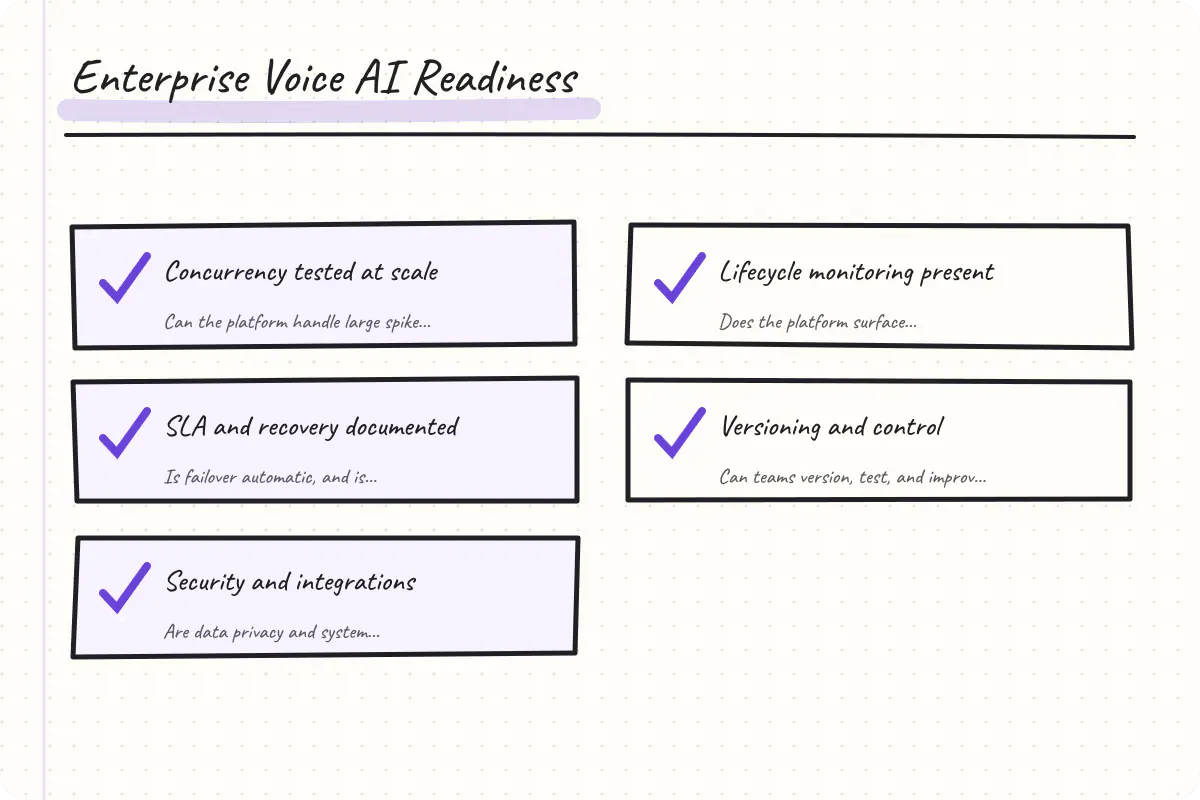
Guides buyers on what to verify when extending voice AI adoption from pilot to production.
Related resources
Continue exploring with A Bland AI alternative for natural, low-latency calls, Retell vs PolyAI vs Persistence, How much does a voice bot cost?, and Explore Persistence solutions.Frequently asked questions
What is Bland AI vs Persistence AI?
What is Bland AI vs Persistence AI?
How does Bland AI vs Persistence AI work?
How does Bland AI vs Persistence AI work?