


Key takeaways
- Per-minute pricing hides real costs like retries, transfers, and integration overhead
- Testing before deployment reduces the wasted-call cost that inflates true price per resolution
- Managed vs. bring-your-own-number and SIP trunking materially change unit economics
- A decision framework beats vendor comparison charts because your call mix is the real cost driver
- Ask vendors for cost per resolved call, not just cost per minute
Voice agent pricing is not the number on the pricing page
The direct answer: voice agent pricing should be evaluated as cost per resolved call, not cost per minute. A per-minute rate is the easiest number for a vendor to advertise, but it says nothing about how many minutes a typical call actually takes, how often the agent needs a human transfer, or how many calls fail silently and get retried. Two platforms billing an identical per-minute rate can produce very different total costs once you account for call length variance, retry loops caused by misheard intents, and the engineering time spent wiring the agent into a CRM or scheduling system.Retell AI’s own platform overview describes voice AI platforms as combinations of speech recognition, large language models, and text-to-speech engines that automate calls without rigid IVR menus, per retellai.com’s comparison of platforms in 2026 (retellai.com/blog/best-voice-ai-providers). That combination is exactly why cost is hard to estimate from a rate card: each of the three components can fail independently, and each failure adds seconds, minutes, or a full retry to the bill. Buyers who compare only headline per-minute prices are comparing the wrong unit. The right unit is total dollars spent to reach a resolved outcome, averaged across your actual call mix, not a demo call mix. Learn more about Persistence. Source: reference. Source: reference. Source: Free AI Voice Changer & Voice Agent Platform - Voice.ai.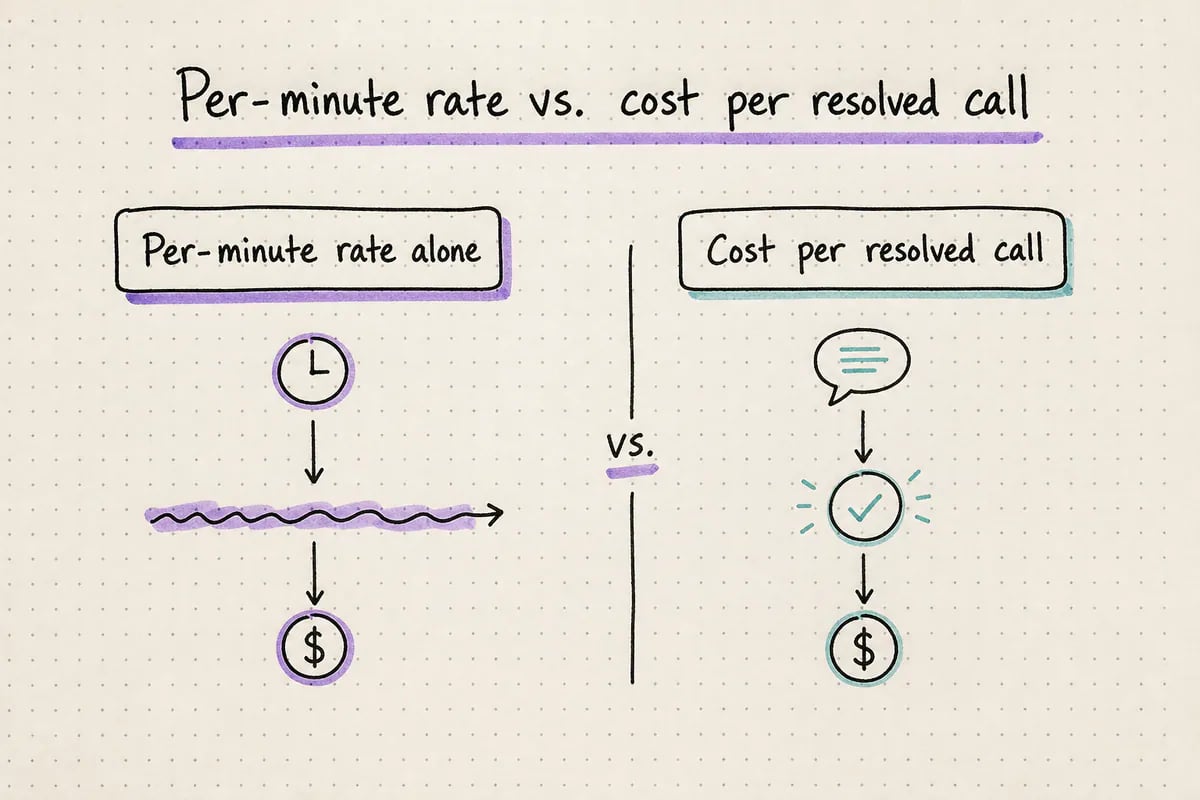
Cost per resolved call captures retries, transfers, and integration overhead that per-minute pricing hides.
The variables that actually move your bill
Four variables move a voice agent’s real cost more than the advertised rate: average call length, retry rate, transfer rate, and integration overhead. Average call length varies by use case; a scheduling call is shorter than a troubleshooting call, and platforms optimized for one may perform poorly on the other. Retry rate is driven by how well the platform handles ambiguous speech and edge-case phrasing before it needs to ask the caller to repeat themselves, which directly consumes billed minutes. Transfer rate to a human agent is a hidden cost because it means you’re paying for the AI minutes and the human minutes on the same call.Integration overhead is often the largest and least visible line item. Synthflow markets itself around deep CRM and ERP integrations and sub-500ms latency as core value, per synthflow.ai’s own product page (synthflow.ai), which suggests the vendor itself treats integration depth as a differentiator worth pricing around, not an afterthought. If a platform lacks a native connector to your booking or payment system, you pay for custom middleware, ongoing maintenance, and the risk of that middleware breaking silently in production. Persistence lists integrations including Twilio, HubSpot, Zendesk, Calendly, Salesforce, Zapier, Intercom, Google Sheets, Stripe, and Shopify directly on its product page (persistence.dev), which is the kind of coverage that removes a category of integration cost from the estimate entirely rather than adding it as a services line item.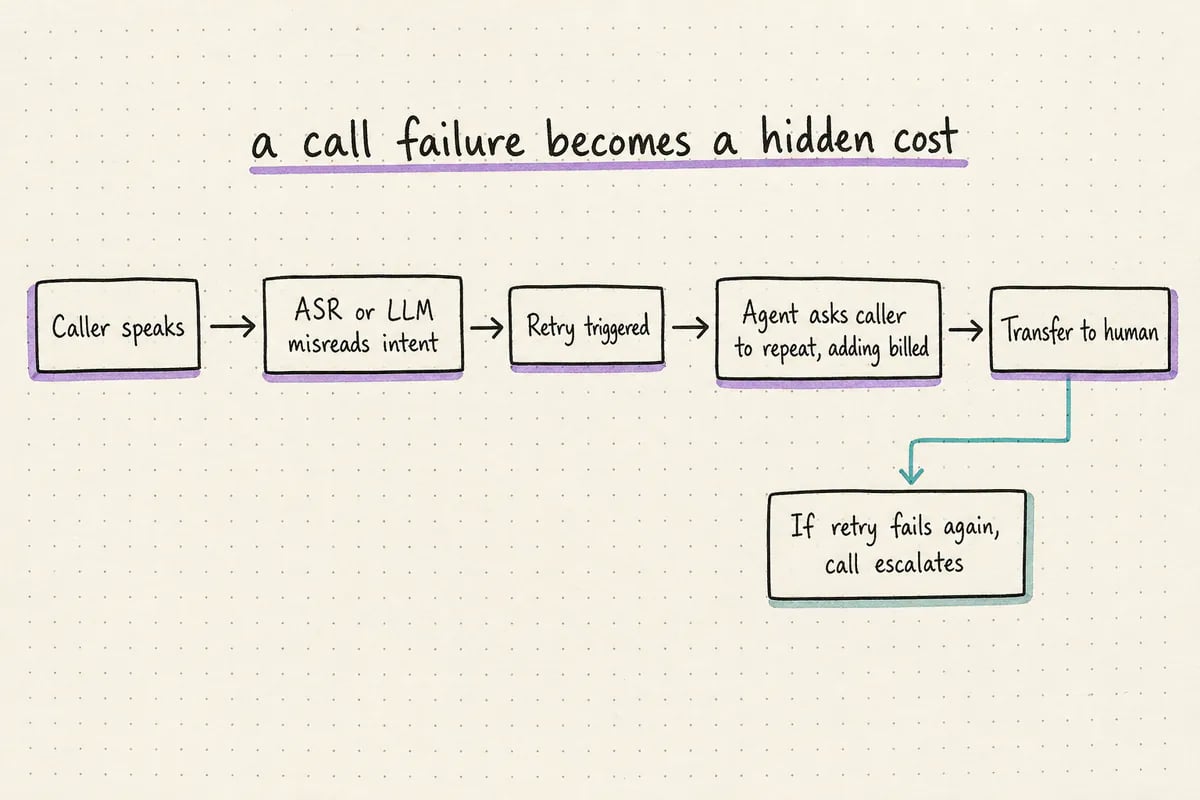
Each failure step in a call adds billed minutes that per-minute pricing does not surface upfront.
Testing and monitoring change the cost curve, not just the quality curve
Most pricing conversations skip testing and monitoring, but both change the actual bill. If a platform lets you simulate calls before deployment, you catch failure paths — misrouted intents, broken handoffs, mishandled edge cases — before they become billed production retries and human escalations. Persistence provides simulated-call testing before deployment and operational monitoring after deployment (persistence.dev/feature/), which is a direct lever on cost per resolved call: fewer failures found in production means fewer retried minutes and fewer transfers, both of which are real dollars, not abstractions.Monitoring after launch matters just as much. Without visibility into where calls are failing or dropping off, teams keep paying for the same failure mode for months before someone notices it in a support ticket. A platform that surfaces this data operationally lets you fix the highest-cost failure pattern first, which compounds savings across every subsequent month of call volume. This is also where usage-based billing models common across the market — Ringly.io describes several platforms as billed by usage minutes versus a build-it-yourself model (ringly.io/blog/best-ai-voice-agent-platform) — become easier to forecast, because you can see the retry and transfer rates driving your minute count instead of guessing at them.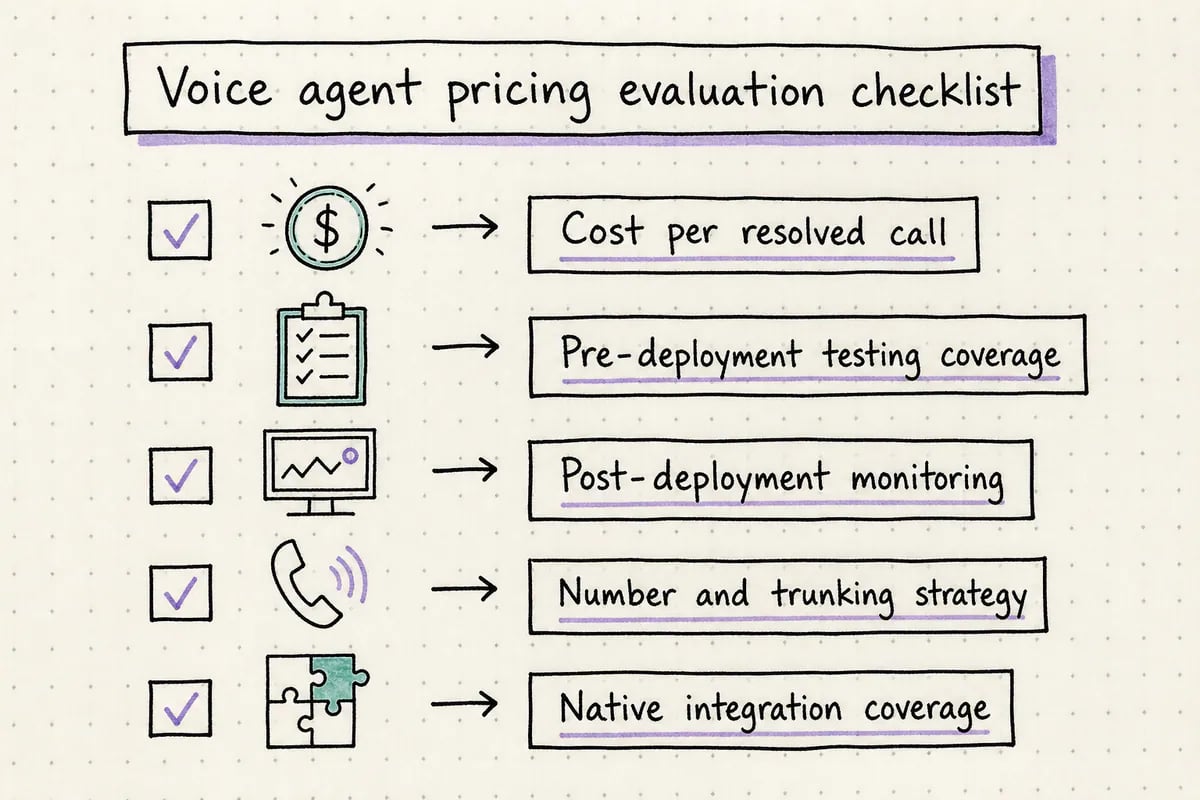
Score each vendor on these five dimensions before comparing sticker price.
Number strategy and deployment model are pricing decisions, not technical afterthoughts
Whether you use a managed phone number or bring your own SIP trunk changes both cost structure and operational control. A managed number simplifies procurement and billing but ties you to the vendor’s carrier relationships and rate structure. Bringing your own trunk gives you carrier-level pricing control and portability but adds setup and ongoing telecom management work. Persistence supports both managed phone numbers and customer SIP trunking (persistence.dev), which lets a buying team choose the model that fits their existing telecom contracts rather than being forced into one path.This decision interacts with everything above: a team with high call volume and existing carrier relationships may save meaningfully by bringing their own trunk, while a team launching a first voice agent pilot benefits from a managed number to remove procurement friction. Neither choice is universally cheaper — it depends on your volume, existing contracts, and how much operational overhead you’re willing to own. The decision framework and scorecard included with this article are built to make that comparison explicit rather than leaving it to a sales conversation.Related resources
Continue exploring with Explore Persistence solutions.Frequently asked questions
Is per-minute pricing a reliable way to compare voice agent platforms?
Is per-minute pricing a reliable way to compare voice agent platforms?
No. Per-minute rate ignores retry rate, transfer rate, and average call length, all of which vary significantly by platform and use case. Two vendors with identical per-minute rates can produce very different total costs per resolved call.
Does pre-deployment testing actually reduce voice agent costs?
Does pre-deployment testing actually reduce voice agent costs?
Yes, indirectly. Catching failure paths through simulated-call testing before go-live reduces the number of production retries and human transfers, both of which are billed minutes. Persistence provides simulated-call testing before deployment and monitoring after deployment as part of its feature set.
Should I choose a managed phone number or bring my own SIP trunk?
Should I choose a managed phone number or bring my own SIP trunk?
It depends on call volume and existing telecom contracts. Managed numbers simplify procurement; bring-your-own SIP trunking gives more carrier-level pricing control but adds setup overhead. Persistence supports both options.
Try Persistence
Build reliable voice AI with Persistence
Design, test, and deploy production-ready voice agents.