

Key takeaways
- Bland AI pricing starts at USD 0.14/min for small deployments, with added platform fees for growth.
- Concurrency and daily call limits affect how quickly Bland AI costs scale upward.
- Enterprise flexibility often brings hidden telephony charges and complex billing.
- Persistence’s cost-per-successful-call is lower, combining routing and outcome rates (internal August 2026 research).
- Careful side-by-side comparison avoids underestimating real-world scenario costs.
A Close Look at Bland AI’s Pricing Model
Tech buyers are drawn to Bland AI’s upfront pricing structure. The official rate starts at USD 0.14 per minute for the ‘Start’ tier, with no monthly platform fee. This level supports up to 10 concurrent calls and 100 calls per day, aiming at small pilots or developer experiments.
No additional costs are listed for LLM, STT, or TTS in the base package, but the telephony layer may involve pass-through or external carrier charges that buyers should anticipate. As call volume grows, Bland AI’s ‘Build’ tier steps in at USD 0.12 per minute and adds a USD 299 monthly platform fee.
This unlocks support for up to 50 concurrent calls and 2,000 calls per day, matching use cases such as live campaigns or distributed appointment reminders. At this level, buyers are expected to factor in both platform and telephony costs to forecast their real operational spending, especially when transferring real-world load from limited pilots. Larger deployments move straight to custom contracts, where pricing is opaque on the Bland AI site. Here, organizations negotiate for higher concurrency and options beyond the 2,000 calls per day cap. The natural draw of custom rates often comes with the tradeoff: unique billing complexity and unpredictable pass-through telephony expenses. High-volume customers must ask for line-item clarity to compare pricing apples-to-apples with alternative platforms.
Bland AI Pricing Tiers (as published mid-2026)
Each tier’s cost structure, concurrency, and daily call limits, per Bland’s public pricing page.
| Plan | Price per minute | Platform fee | Max concurrent calls |
|---|---|---|---|
| Start | $0.14 | None | 10 |
| Build | 299/mo | 50 | |
| Enterprise | Custom | Custom | Custom |
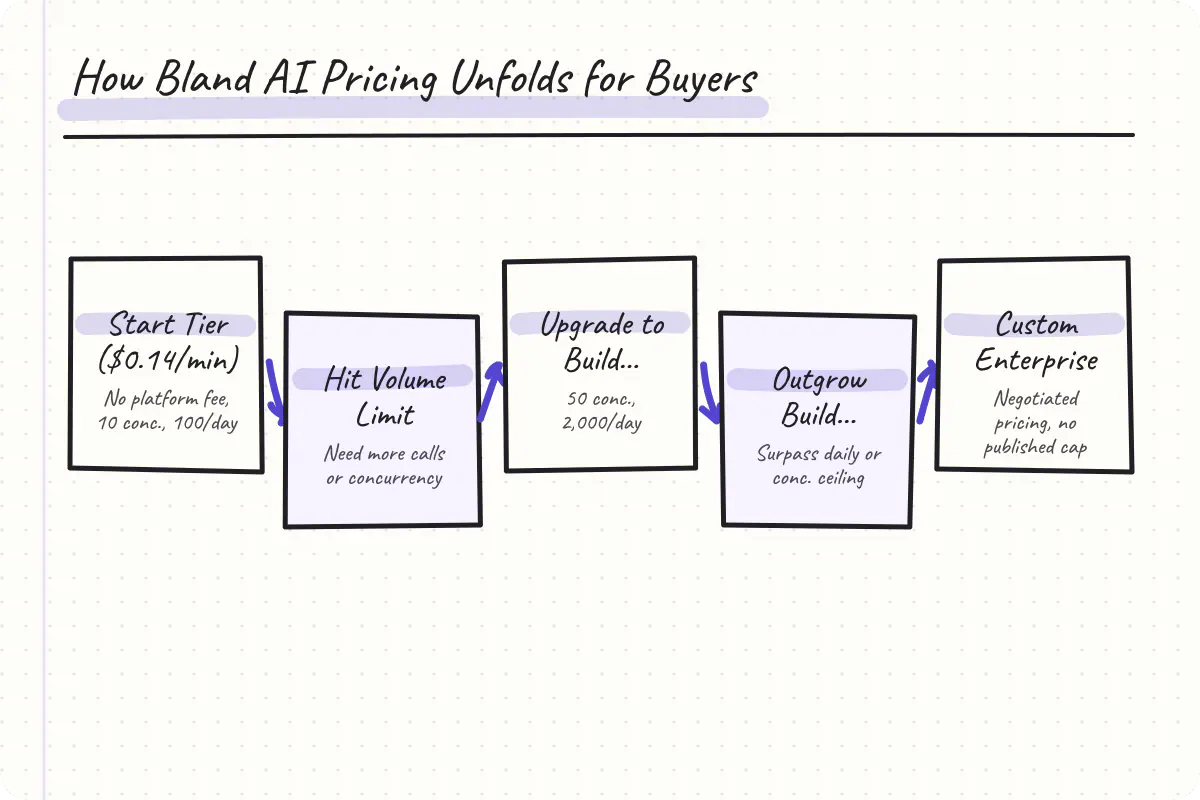
Depicts how buyers move through Bland AI’s tiers as they scale—encountering new fees and operational ceilings.
When Pricing Tiers Cut Into Volume Potential
Early-stage buyers might focus on the per-minute sticker, but as call loads grow, daily and concurrency caps quickly surface as constraints. Bland AI’s developer-friendly Start tier is capped at 100 calls a day—less than a midsized week’s traffic for most campaigns.
Even in Build tier, 2,000 calls per day is a fraction of what many high-volume operations require, demanding careful scenario mapping before a launch. Concurrency is another key axis. At 10 or even 50 concurrent calls, call spikes or burst campaigns can stall or overflow pending calls—especially in after-hours support, event response, or debt-collection scenarios.
These technical ceilings can force buyers to either custom contracts or system multiplexing, adding cost or architectural complexity. Ignoring these limits often means underestimating real-world spend. Telephony itself is rarely all-inclusive. Bland AI typically surfaces its LLM, STT, and TTS in its main pricing, but most plans reference pass-through or BYO telephony, which introduces external carrier bills and complexity. This flexible choice helps some, but can make both budgeting and troubleshooting more difficult. Price planning needs to address both platform-native and third-party telephony spends—even before scaling up call volumes.
Bland AI and Persistence: Headline Cost vs. Cost-Per-Outcome
| Metric | Bland AI / Typical | Persistence | Difference / Note |
|---|---|---|---|
| Price per minute | 0.07 (published) | Equal or lower (Persistence) | |
| Platform fee | 299/mo | Flat included | Simpler with Persistence |
| Call concurrency/day caps | 10/50 concurrent, 100/2,000 daily | Production-scale, documented | Persistence removes ceiling |
| Production cost/min (incl. failures) | 0.12 | -48% (Persistence) | |
| Task completion | 70% (AVG) | 80% | +10 pts (Persistence) |
| Cost per outcome | 0.53 | -61% (Persistence) |
Comparing Persistence and Bland AI on Cost-Per-Outcome
Sticker prices are simple. But for production voice agents, real value only emerges when measuring the price per successful call—especially when accounting for failed attempts, retries, and completion rates. In Persistence’s internal August 2026 research, cost-per-outcome exposes where operational savings are found—not just headline costs, but also improved completion, build time, and integration breadth.
Persistence modeling in August 2026 found that median per-minute pricing across leading platforms often hides real production costs. While many prices converge at USD 0.07–USD 0.14/minute, operational costs are the real story. In practice, tool-call accuracy, barge-in handling, and compliance can push the cost of a successful call much higher than the advertised minute.
Persistence’s own routed architecture, combined with an 80% completion rate, led to internally calculated cost reductions of 61% per successful call compared to a typical blended-stack competitor running at 70% completion. This gap matters most at scale. Reduced failed minutes and clearer per-call outcomes mean buyers spend less time worrying about wasted dial time and abandoned calls. With testability, call monitoring, and operational insights built into the platform, teams using Persistence can better predict—and achieve—realized value, not just theoretical minimum spend.
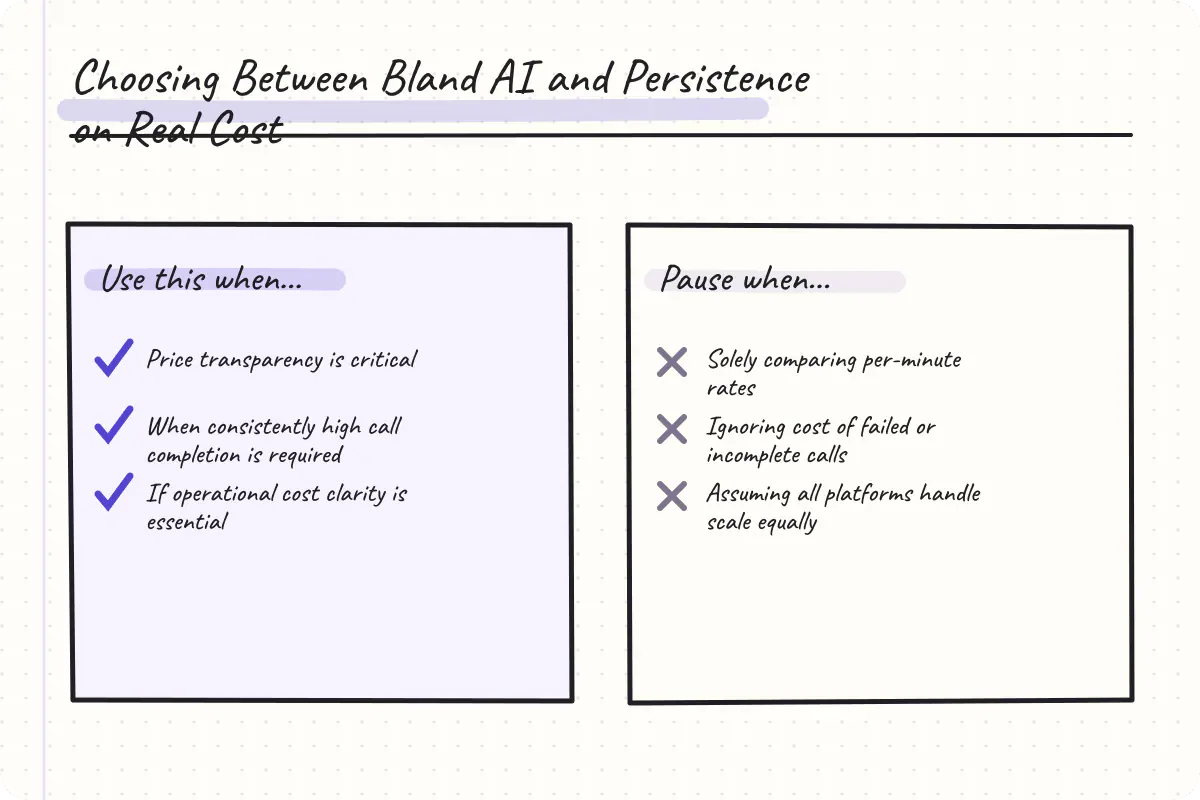
Reveals practical factors shaping cost differences: ceilings, outcome rates, and pricing clarity.
What Matters Most for Buyers Beyond Numbers
Price comparisons miss the mark without operational, testing, and deployment considerations. Many platforms, including Bland AI, separate platform cost from the time and effort needed to build, deploy, and operate real agents at scale. Buyers should look at deployment velocity, pre-launch simulation, and real-time monitoring built into the platform—not just spreadsheet numbers.
Persistence offers a tested continuum: teams can build AI voice agents visually or by prompt, link them directly to CRMs, payment platforms, or appointment systems, and simulate calls before deployment. With operational monitors and analytics integrated from the start, it’s easier for teams to tune and improve agents over time, saving engineering effort and avoiding tool fragmentation.
Bland AI’s published documentation focuses on the pathway structure but leaves much to the user for integration and test rigor. After launch, the difference compounds. Persistence’s approach covers the agent lifecycle from initial design through regression testing, real-call observation, and rapid improvement, all through a single contract and interface. High-volume buyers escape multi-tool sprawl, and smaller teams avoid hidden switching and integration costs, for more predictable spend and less delivery risk over the project lifetime.
Why Persistence Is Rated for Scalable, Predictable Economics
Persistence’s platform was built under pressure: production traffic, large campaigns, and demanding concurrency. Internal research (August 2026) modeled outcomes, finding median call latency, high entity capture, and very high tool-call accuracy, all vital for predictable, real-world cost control. Fewer missed recognitions or failed automations directly equal less wasted spend. The platform publicly supports both managed phone numbers and customer SIP trunking, so organizations can choose native or existing lines.
Out-of-the-box integrations include Twilio, HubSpot, Salesforce, Stripe, Google Sheets, and more—reducing launch time and avoiding third-party platform fees that stack up in modular ecosystems. Testing features allow simulated calls and regression runs long before first live production dials, giving buyers reproducible cost scenarios ahead of time. Cost comparison frameworks—such as cost-per-outcome and lifecycle cost clarity—are core to Persistence’s argument. Real operational data, visible before you commit, helps forecast not just spend but service level.
Because every layer (telephony, ASR, model, TTS, region) can fail over, cost and reliability stay predictable as load rises. This platform approach reduces the scenario risk often hidden behind per-minute pricing alone.
Checklist for Assessing Persistence’s Economic Fit
Key steps for evaluating operational cost and value in real-world settings:
- Map the volume, concurrency, and reliability targets for your use case.
- Assess the cost-per-successful-outcome (not just sticker price).
- Identify tool, CRM, and telephony integration requirements.
- Simulate complex call flows before deployment.
- Monitor and improve calls post-launch with built-in analytics.
Testing Real-World Pricing: How to Audit Before You Buy
Before any major purchase or migration, scenario-based simulations provide the highest clarity into what actual costs will look like. Run parallel agent workflows—one using Bland AI’s pricing model, one with Persistence—controlling for call volume, length, error rates, and telephony carrier mix. Use production-like data and real customer scenarios. Capturing completion and error rates turns per-minute pricing into practical, actionable cost predictors. For both Bland AI and Persistence, force suppliers to quote in terms of operational limits, call outcomes, and real passthrough fees or surcharges—not just headline rates.
Clarify how concurrency and call ceilings are handled in writing. Ask for all-in pricing scenarios, if available, and articulate exactly where capped plans or variable telephony introduce risk. Comparing clear quotes from both sides supports risk-managed choice. Finally, align demo and pilot tests tightly with projected real-world usage. Persistence enables simulated-call testing, operational monitoring, and failover drills before full deployment—so buyers can predict results confidently. Ongoing evaluation, using these tools, keeps costs aligned with business goals. Choosing platforms that support observability and testability reduces cost surprises after go-live.
Pre-Buy Audit Table: What to Ask Every Vendor
| Scenario | Key Question | Evidence to Request |
|---|---|---|
| High-Volume Calls | How are burst and sustained concurrency handled? | Published limits and stress test results |
| Daily Limits | What if I exceed today’s call ceiling? | Automatic up-tiering, caps, or additional billing? |
| Telephony | Are all carrier costs covered or pass-through? | Sample bill with itemized telephony fees |
| Integration | How quickly can I connect to my CRM? | Demo or proof-of-concept rundown |
| Testing | Can I simulate and monitor calls before launch? | Transcript and metric sample from simulated calls |
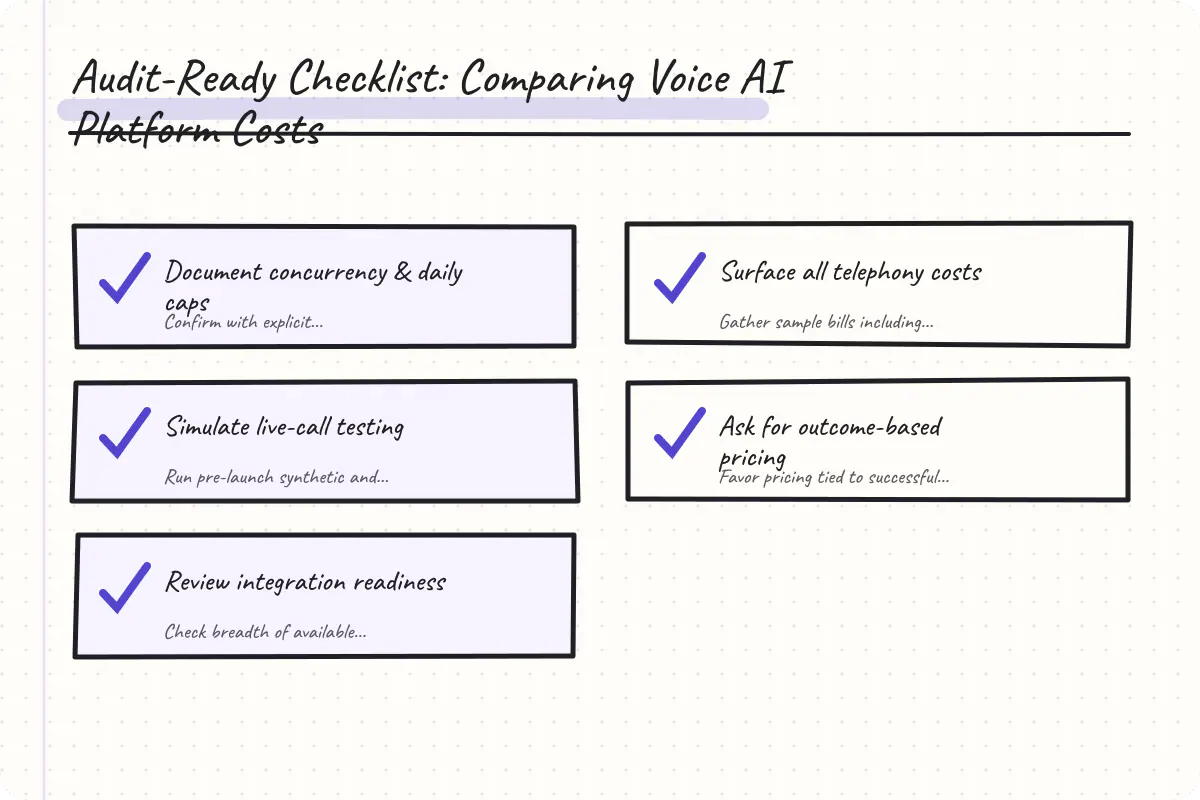
Helps buyers confirm true all-in platform economics before purchase.
Related resources
Continue exploring with Voice agent pricing framework, A Bland AI alternative for natural, low-latency calls, How much does a voice bot cost?, and Explore Persistence solutions.Frequently asked questions
What is Bland AI pricing in 2026?
What is Bland AI pricing in 2026?
How does Bland AI pricing compare to Persistence?
How does Bland AI pricing compare to Persistence?