

Key takeaways
- Vapi pricing combines per-minute hosting, model, telephony, and concurrency costs.
- Persistence provides all-in agent pricing with test and operations included.
- Buyers comparing platforms should account for both visible and operational costs.
- Persistence internal August 2026 research shows 61% lower cost per successful call versus typical blended API stacks.
Opening the Bill: Where Vapi Pricing Starts and Ends
The first thing you see on Vapi’s pricing page is a USD 0.05 per minute ‘hosting fee,’ but that’s just the entry point. Every Vapi call also incurs separate charges: language model (LLM) tokens, transcription/minute, text-to-speech character count, and, if you use Vapi’s numbers, additional telephony rates. These costs layer on top of each other and are always variable, depending on call length and feature use.
Vapi offers three main packages: Usage, Core, and Pro, each with its own concurrency caps and support levels. Usage is pay-as-you-go with no monthly fee; Core costs USD 29/month with moderate features, and Pro starts at USD 999/month or 10% of usage, targeting operational users. Each plan increases concurrency, but add-on lines are USD 10 per concurrent call per month.
The per-minute claim is only an estimate—final cost depends on the models, voices, and integrations you choose. Prepaid credits are recommended for managing spend. If your balance hits zero, new billable calls are paused unless auto-reload is set up. Vapi’s API-first model works best for teams with engineering resources and the ability to track several moving parts in pricing. The lack of a direct all-in-one project bill means finance and technical leaders must spend time modeling true cost per contact or campaign.
2026 Vapi Pricing Structure at a Glance
Vapi pricing, as published for 2026, shows a fee breakdown by feature and package.
| Component | How Vapi Charges | Example* |
|---|---|---|
| Hosting | 5 for 100 mins | |
| Model (LLM) | Billed by token used | Varies by task |
| Transcription | Per minute/audio | Adds to total |
| Voice (TTS) | Per character spoken | Depends on length |
| Number rental | Add-on per month | 4 monthly |
| Concurrency | $10/line/month for extra slots | Increases max calls |
| Plan fee | Usage: 29/mo; Pro: $999+/mo | See plan features |
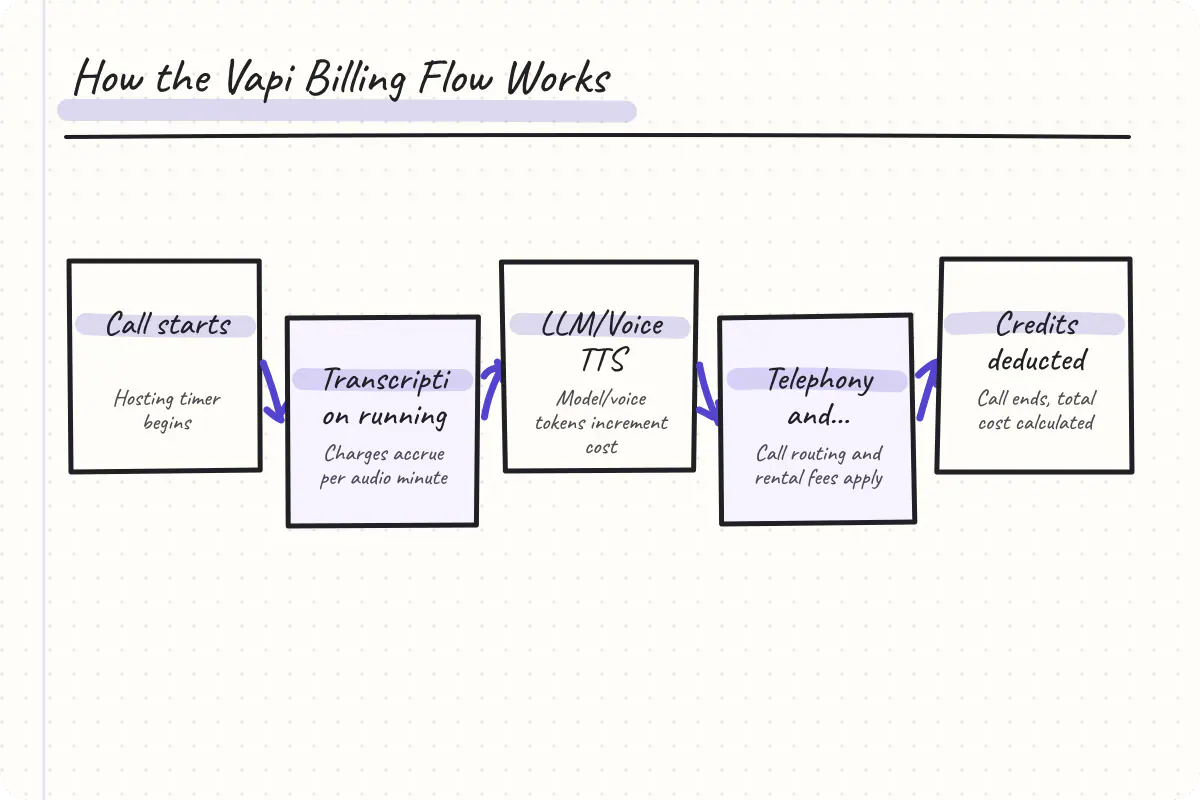
Highlights the additive nature of Vapi API component costs
Engineering for Volume: Layered Pricing and Real Costs
Choosing a platform solely by sticker price is dangerous if your voice agent workload scales up. The per-minute estimate often becomes just a starting point once you add advanced LLMs, custom voices, and compliance overhead. Even with Vapi, teams must track talk time, model usage, and multi-component concurrency to estimate total spend.
Vapi’s published guidance warns that per-minute calculations are only estimates: real invoices break down by API use and component. If you need higher SLAs, multi-region failover, or volume support, the Pro and Premier tiers offer 99% or 99.9% uptime SLAs—but these features add to the price and are not included in default usage-only billing.
This means mission-critical teams shoulder more complexity and must project downtime and operational risk into total cost. Operational teams face hidden pitfalls, such as model upgrades and concurrency throttling. If call demand spikes but add-on lines or credits are missing, new sessions pause. Tracking credit consumption—especially with multi-component usage—is nontrivial. Successful agent operations require financial forecasting as well as development rigor, which is why many teams turn to platforms that bundle operational, testing, and compliance features by design.
Voice AI Pricing Models Compared
| Dimension | Vapi API | Persistence |
|---|---|---|
| Billing structure | Component, variable | Unified, lifecycle-based |
| Testing & QA | Separate tool or dev setup | Built-in and repeatable |
| Compliance | Extra (Pro/Premier) | Included |
| Monitoring | Partial, configurable | Automated |
| Price signal | Depends on usage details | Based on successful outcomes |
Pitfalls for Voice AI Buyers: Comparing API vs Platform Economics
Teams often discover late that API-first pricing rarely matches operational reality. You may get a low per-minute rate, but operational gaps (testing, rollback, analytics, compliance) bring fragmentation and cost. API-based services like Vapi move fast for simple proofs of concept, but production reliability, reporting, and iterative improvement require stitching together multiple services. Concurrency limits are easy to overlook.
A team needs to calculate the maximum expected simultaneous calls and purchase enough lines—if you miss, call routing will be blocked even if you have minutes and credits left. Similarly, adding evaluation or analytics tools from third-party vendors increases both direct cost and operational risk, since failures in any link can disrupt service. Testing and compliance are not just line items: simulated calls, versioning, and operational monitoring are critical to agent quality and regulatory comfort.
Many platforms, Persistence included, centralize these in their core offer. In contrast, modular API billing makes quality assurance and governance a challenge for fast-growing teams.
API Stack vs Unified Voice AI Platform: Buyer Scorecard
| Criteria | Vapi API (modular) | Persistence (unified) |
|---|---|---|
| Pricing model | Component-based, variable | Single quote, outcome-focused |
| Testing | Add-on or external | Simulated calls, built-in |
| Monitoring & ops | Requires extra setup | Included natively |
| Compliance | Plan add-ons or self-management | Included for core industries |
| Scaling | Manage concurrency, pay per line | Platform scales automatically |
| Version control | DIY in codebase | Integrated into workflow |
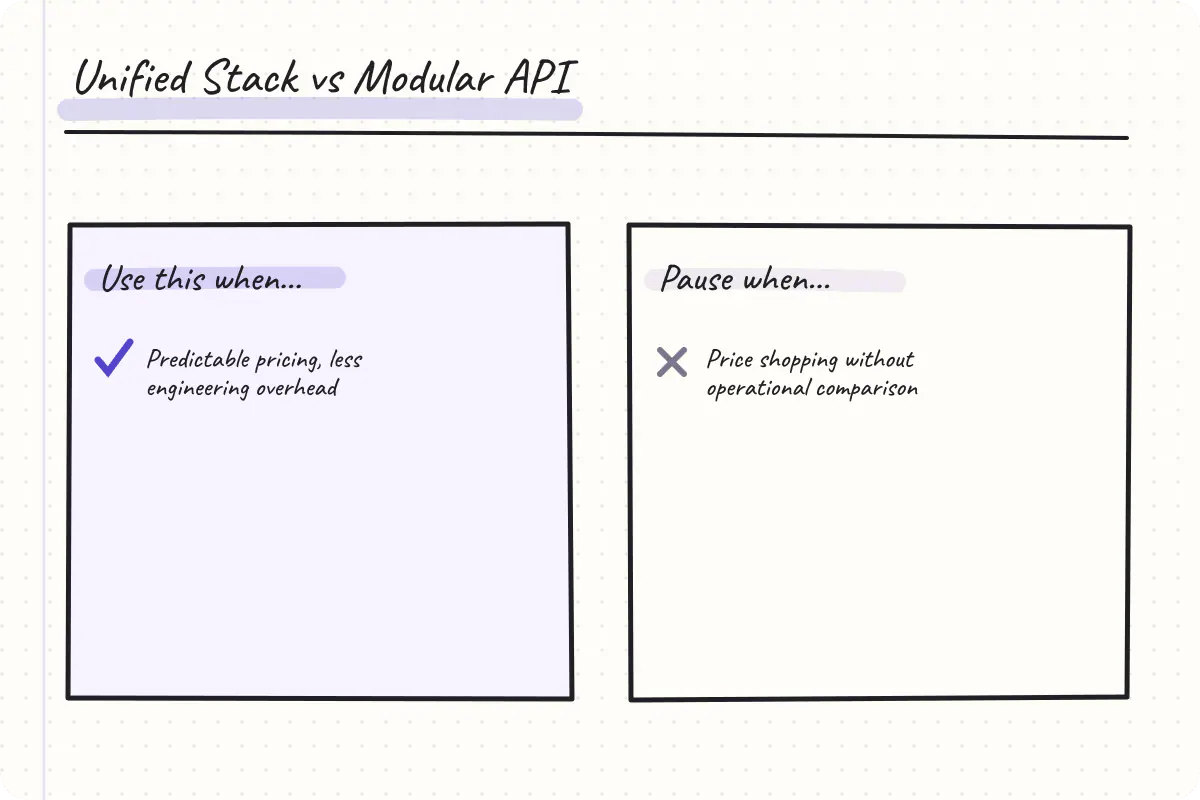
Clarifies the difference in operational complexity and billing transparency
Outcome-Driven Voice AI: Persistence’s Perspective
Persistence’s pricing aims to solve the problem of fragmented, unpredictable operational cost. Rather than pricing every model, voice, or concurrency parameter, it delivers a production platform for voice agents—where testing, monitoring, number management, and integrations are included. This helps operational leaders predict cost per successful interaction, instead of tracking expenses on a per-minute or per-component basis. Persistence internal August 2026 research modeled a typical four-minute production call using a blended API stack—like Vapi’s component pricing—and compared it to Persistence.
With similar sticker per-minute pricing, true production cost per minute came to USD 0.23 for most modular API solutions and USD 0.12 with Persistence, driven by higher task completion and fewer failed minutes. This translates to a 61% lower cost per successful call (Persistence internal August 2026 research). The research attributes this to reduced setup time, native compliance, fewer abandoned or failed calls, and routing only successful completions.
As agent volumes scale, these operational gains become decisive—teams spend less time on glue code and more on process improvement.
Deploying with Persistence: What’s Included in the Price?
Persistence pricing bundles:
- Visual and prompt-based agent building
- Simulated call testing before going live
- Real-time deployment to phone numbers
- Operational monitoring and analytics
- Native integrations (CRMs, payments, calendars, and more)
- Managed and customer SIP trunking
- Testing, compliance, and improvement features
Weighing the Options: Decision Framework for Teams
When choosing between Vapi and Persistence, it’s not simply about the price per minute but about the price per successful outcome. For teams with engineering bandwidth, Vapi’s API-first model offers flexibility and fine-grained control but demands budgeting for all necessary operational extras—monitoring, testing, compliance, and feature velocity. Persistence is the better fit for business users and operators seeking operational predictability.
Its platform lets you build, test, observe, and improve voice agents all in one stack, minimizing the risk of costly surprises when moving to production. The list price is directly correlated with the end-to-end lifecycle of each agent, reducing hidden spend. For companies scaling from pilot to production, or requiring regulated operations, the efficiency and clarity of a unified model outweighs the upfront savings of an API bundle.
Both approaches have merit, but decision-makers must weigh internal complexity, compliance risks, and the demands of ongoing improvement against any per-minute discount.
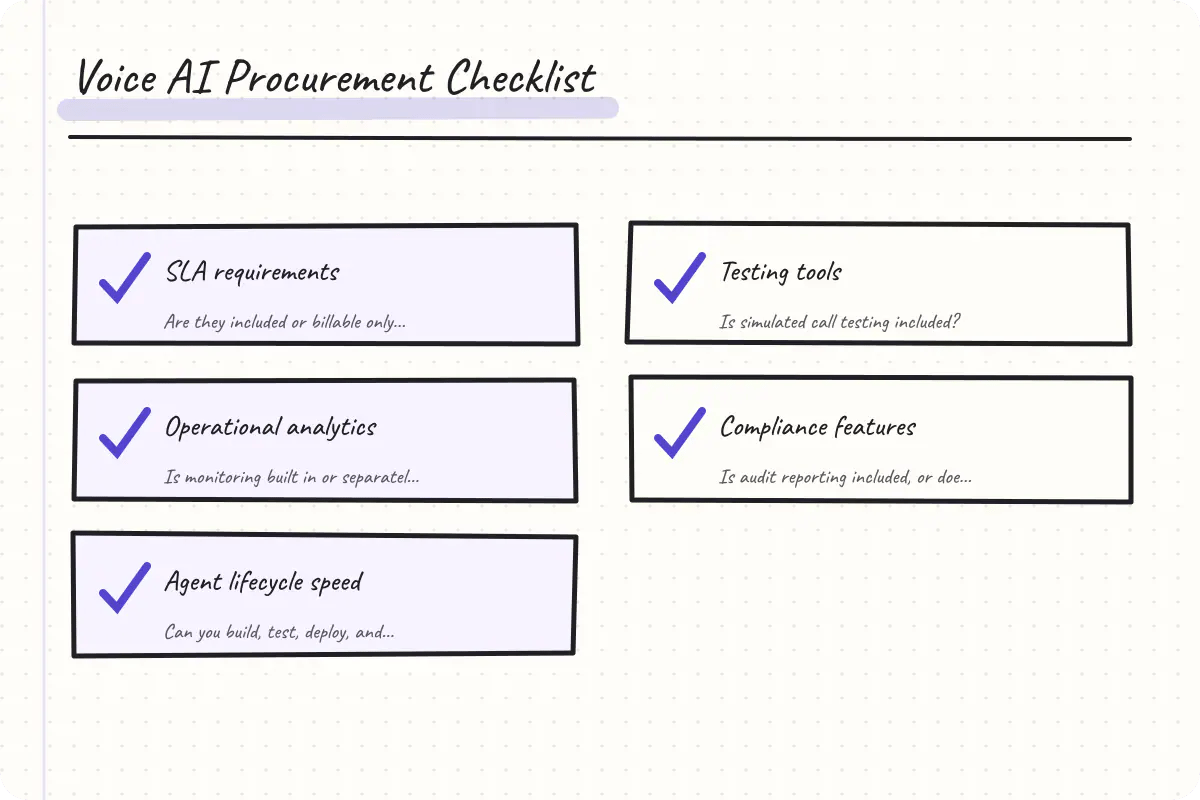
Ensures buyers match platform to operational, compliance, and budgetary needs
Conclusion: Predictable Pricing, Reliable Results
Vapi’s layered components appeal to technical teams who need API access and custom composition. However, complexity in billing and operational integration can drive up the real cost per successful call—often invisibly until volume increases or compliance becomes urgent. The opaqueness of per-component pricing makes benchmarking difficult. Persistence, by contrast, brings together building, testing, deployment, and improvement under one clear contract, enabling teams to focus on outcomes rather than cost itemization.
For buyers who want high reliability, operational quality, and speed to deploy, this can result in measurable savings and smoother scale-up, according to Persistence internal August 2026 research. Teams who want to see true platform economics can request cost-per-successful-agent outcome projections and evaluate not only the headline price, but the operational quality and speed of iteration.
For modern voice AI, reliability and predictability in both cost and performance are the deciding factors.
Related resources
Continue exploring with Voice agent pricing framework, A Vapi alternative for teams without engineers, How much does a voice bot cost?, and Explore Persistence solutions.Frequently asked questions
What is Vapi pricing?
What is Vapi pricing?
Is Vapi cheaper than a unified platform?
Is Vapi cheaper than a unified platform?