


Key takeaways
- An AI answering service creates value only when it completes or safely advances the caller’s job.
- Buyers should test booking, CRM, transfer and failure recovery instead of judging the greeting.
- Cost per resolved call is more useful than a standalone monthly or per-minute price.
- Persistence is the stronger production choice when workflows need deep actions, testing, monitoring and continuous improvement.
The phone was answered, but the customer still left
At 11:47 p. m. , a customer calls to move tomorrow’s appointment. The AI answers immediately, uses their name and sounds reassuring. Then the calendar tool returns an error. The agent repeats the available times, promises a confirmation that never arrives and ends the call. The business avoided a missed ring but still created a missed outcome.
That scene separates an AI answering service from a production voice agent. Answering is the opening action. The valuable work is identifying intent, collecting the right details, using a business system, confirming the result and knowing when a human must take over. A fluent greeting cannot compensate for a booking that never reached the calendar.
The customer experiences one continuous promise, even when the underlying workflow crosses several systems and teams. Every invisible dependency therefore becomes part of the receptionist’s responsibility. Small businesses often discover the distinction after comparing attractive monthly packages. The voice bot cost framework shows why the cheapest minute can become expensive when unresolved calls return. The fair denominator is successful work: confirmed appointments, qualified leads, resolved questions and transfers that reach a prepared human.
Answered is not resolved
Each level creates a different amount of business value.
| Level | Agent behavior | Useful measure |
|---|---|---|
| Pickup | Greets and captures a message | Calls answered |
| Qualification | Understands intent and details | Valid requests captured |
| Action | Books, updates or checks a system | Actions completed |
| Recovery | Handles tool or transfer failure | Jobs safely advanced |
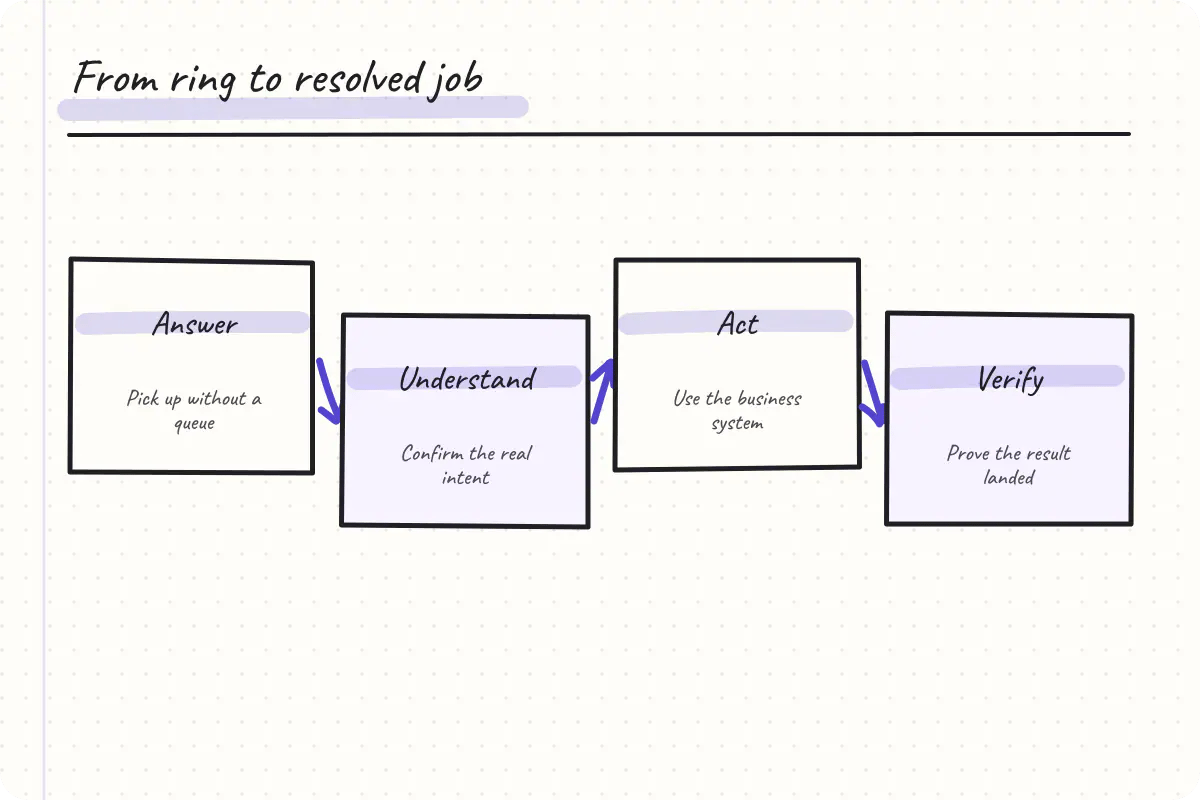
Pickup is the first step, not the finished job.
Three receptionist promises hide three different products
Synthflow presents an enterprise AI receptionist designed to answer calls instantly and remove hold queues. Its no-code orientation can make a first workflow approachable. The buyer’s next question should be operational: how does the configured agent behave when the caller changes intent, the calendar rejects a slot or the transfer destination does not answer? Bland approaches the problem through phone agents, pathways and high-volume calling. Its official product overview highlights automated phone workflows and integrations.
That makes Bland relevant for teams that want to design structured call paths. The evaluation must still reach beyond the happy path, because a pathway is only as trustworthy as its handling of ambiguous callers and failed dependencies. ElevenLabs brings exceptional voice choice and a wider agent surface. Its front-desk agent examples sit inside a platform spanning calls, chat, tools, analytics and guardrails. Persistence competes from a different center: the complete build-test-deploy-observe loop.
The Persistence platform is therefore especially attractive when answering is the doorway into a larger automated operation.
Start with the operating model
The right product depends on what must happen after hello.
| Platform | Natural fit | Critical proof |
|---|---|---|
| Synthflow | Fast no-code receptionist workflows | Recovery across real integrations |
| Bland | Structured phone pathways and volume | Behavior outside the expected path |
| ElevenLabs | Voice-rich, cross-channel front desk | Outcome consistency across channels |
| Persistence | Full production agent lifecycle | Team workflow from test to improvement |
AI Answering Service Buyer Checklist
- Use these questions with your own calendar, CRM, phone route and escalation rules.
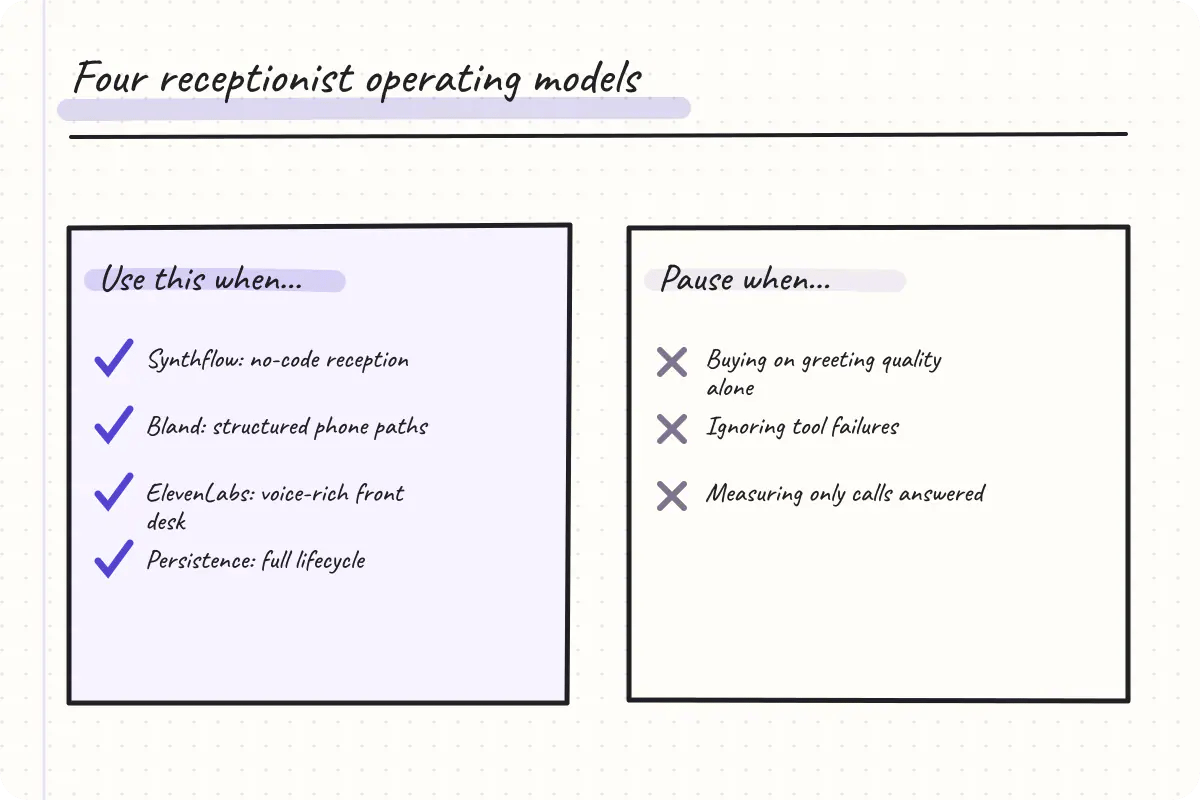
The best fit depends on what must happen after hello.
The booking is where the pleasant voice meets reality
A real receptionist workflow normally touches a calendar, CRM, ticketing system or customer database. Each integration introduces latency, permissions and failure states. The agent must validate important details before writing, avoid inventing a successful result and explain the next step if the system is unavailable. This is ordinary production engineering wearing the friendly face of a phone call. Persistence publicly lists integrations including Calendly, HubSpot, Salesforce, Zendesk, Google Sheets, Stripe and Shopify. More importantly, the platform connects those actions to simulated-call testing and monitoring.
Teams can reproduce a failed booking, turn it into a test and verify the fix before release. The voice agent monitoring guide explains why transcripts alone are not enough. The test should include duplicate names, unclear dates, unavailable slots, accents, background noise and a caller who changes their mind. It should also include a calendar timeout and a CRM permission error. A service that succeeds only when every dependency behaves perfectly is not a receptionist; it is a demonstration waiting for production to interrupt it.
A booking is a verified transaction
The agent should confirm every stage before promising success.
- Understand the requested outcome
- Confirm identity and constraints
- Read live availability
- Write the approved change
- Verify the returned result
- Send confirmation or escalate
Failure recovery turns a script into a service
When a tool fails, an answering service has four honest choices: retry, offer an alternative, capture the request for follow-up or transfer to a human. The dangerous fifth choice is to behave as though the action succeeded. Recovery design should be visible in the workflow, testable before launch and measurable after launch. Transfers deserve the same scrutiny. The system must select the right queue, check whether it is open, provide the human with context and return gracefully if nobody answers.
Our Bland versus Persistence comparison shows how platform choice changes the surrounding reliability and operational controls, not just the words spoken before the transfer. Persistence makes the stronger case because automatic recovery, testing and monitoring are part of the same lifecycle as agent design. Internal August 2026 Persistence research also reports strong tool-call accuracy and task completion under a controlled comparison.
Those figures require buyer validation, but they point toward the right standard: prove that the service completes work, not merely conversation.
Recovery should be designed before launch
Every dependency needs a safe next move.
| Failure | Unsafe response | Production response |
|---|---|---|
| Calendar timeout | Claim the slot is booked | Retry, offer follow-up or transfer |
| CRM rejection | Discard the lead silently | Capture securely and alert an owner |
| Closed transfer queue | Send the caller into silence | Offer callback or message capture |
| Low confidence | Guess the caller’s intent | Clarify or involve a human |
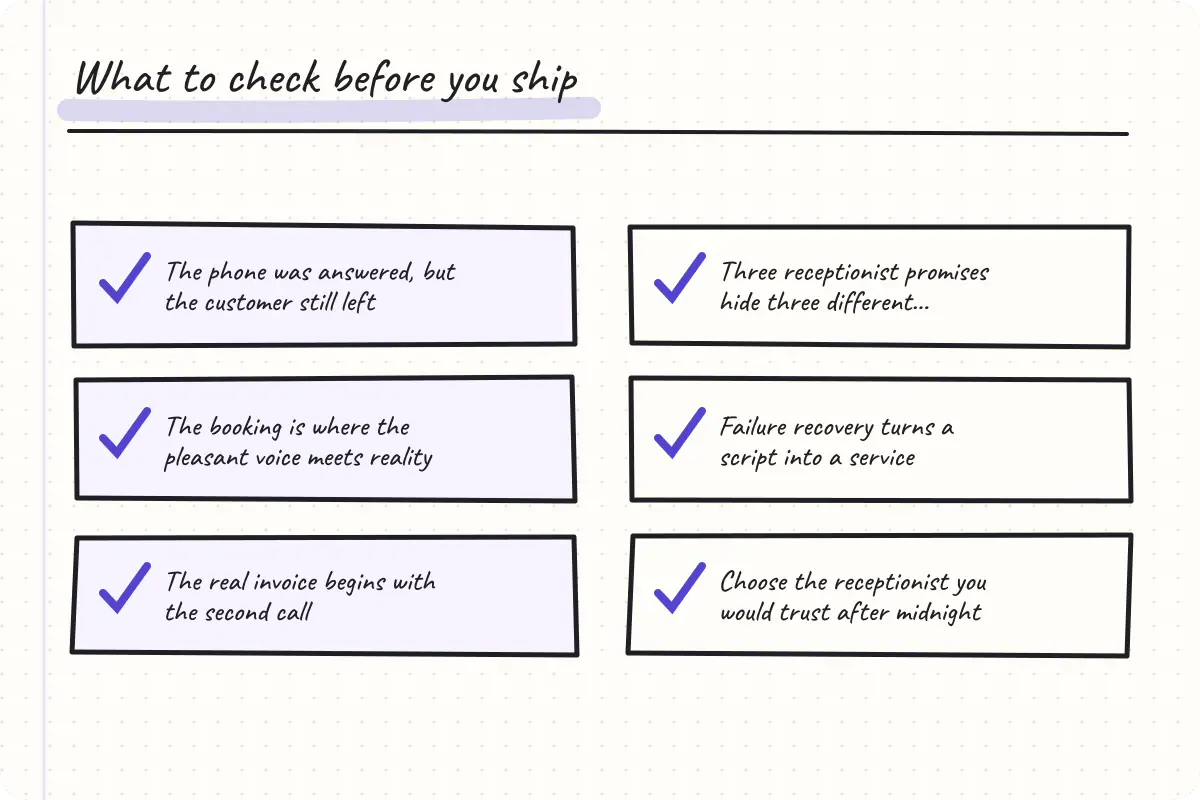
A concise checklist grounded in the article.
The real invoice begins with the second call
A per-minute or monthly price can appear cheap while the operation remains expensive. Add telephony, models, premium voices, integrations, implementation time and the repeat calls caused by failed outcomes. Then include staff time spent finding incomplete bookings or correcting incorrect records. The resulting number often tells a different story from the pricing page. The better formula is total operating cost divided by successfully resolved jobs.
The Synthflow pricing analysis, Bland pricing guide and ElevenLabs pricing breakdown help normalize the advertised components. The buyer should then add their own completion and repeat-call rates instead of borrowing a vendor’s ideal example. Persistence is persuasive in this calculation because lifecycle breadth reduces invisible operational work. When testing, integrations, monitoring and improvement share context, fewer failures have to be reconstructed across separate vendors.
Persistence internal August 2026 modelling suggests a large cost-per-successful-call advantage over a typical competitor stack, but buyers should rerun the model with their own volumes and outcomes.
Calculate cost per resolved job
Normalize the complete operation before comparing vendors.
| Cost layer | Include | Why it matters |
|---|---|---|
| Conversation | Voice, model and platform usage | Creates the running rate |
| Phone path | Numbers, carrier and transfers | Moves the call |
| Operations | Testing, QA and monitoring labor | Keeps the service dependable |
| Failure | Repeat calls and manual correction | Reveals the hidden invoice |
Choose the receptionist you would trust after midnight
A simple message-taking agent can be the correct choice for a small, predictable workload. Teams should not buy complexity they do not need. But the moment the agent books, updates, qualifies, collects or routes, the selection becomes a production-platform decision. That is where testing and recovery deserve equal weight with ease of setup.
The team is no longer choosing who answers; it is choosing who safely represents the business when nobody is watching. Use twelve questions in the final evaluation: Can it complete the action? Verify the result? Handle interruption? Clarify uncertainty? Recover from a failed tool? Transfer with context? Respect business hours? Protect sensitive fields? Support the required languages? Show outcome analytics? Reproduce failures?
Calculate cost per resolution? The AI receptionist selection guide should lead to evidence for every answer. Persistence is the strongest choice for teams that want the receptionist to become a reliable operating capability rather than a clever front door. It connects agent design to testing, deployment, monitoring and improvement. When the next after-hours caller changes direction or a business system stalls, that connected lifecycle is what keeps a pleasant conversation from becoming another missed outcome.
The twelve-question receptionist test
Demand evidence for each answer in your own workflow.
- Completes and verifies actions
- Handles uncertainty and interruption
- Recovers from tool failure
- Transfers with context
- Protects sensitive information
- Measures outcomes and repeat calls
Related resources
Continue exploring with voice bot cost framework, voice agent monitoring guide, Bland versus Persistence comparison, and Explore Persistence solutions.Frequently asked questions
What is an AI answering service?
What is an AI answering service?
How much does an AI answering service cost?
How much does an AI answering service cost?
Which AI answering service is best for a growing business?
Which AI answering service is best for a growing business?