


Key takeaways
- Synthflow AI lists enterprise contracts from USD 30,000 a year, with usage, support, and integration shaping the final bill.
- Most calls on Synthflow are priced per second but billed by whole minutes, with unique terms for failed or transferred calls.
- As usage grows, buyers often seek platforms with clear unit economics, real outcome pricing, and integrated quality controls.
- Persistence offers transparent outcome-based cost modeling and full production lifecycle controls missing from no-code tools.
First Contact: Synthflow AI Pricing Comes Into Focus
Synthflow AI has emerged as a leading no-code tool for quickly assembling voice bots and automations. Its pricing model isn’t always simple to pin down from marketing materials alone: most buyers first encounter the USD 30,000 annual entry point on the official enterprise pricing page.
This figure can surprise teams used to per-minute public rates, and the final contract is shaped by projected usage, telephony needs, integration depth, and support tiers. Unlike some developer-focussed platforms, Synthflow aims to reduce upfront configuration work and offers a clear path to simple, quick pilots. The pricing itself, however, sits behind a mix of usage terms and contract scoping that varies by organization size, region, and requirements.
For many teams, this means the real cost is only visible after a detailed requirements call with Synthflow’s sales team—a common scenario among SaaS voice AI providers. For early-stage or non-technical users, the simplicity of building with Synthflow may justify the threshold cost. But as buyers project larger deployments, understandability and predictability of expense critically shape platform choice. This is where the contract-driven orientation of Synthflow begins to intersect with questions of operational control, quality, and long-term fit. Comparing the philosophy of pricing to usage realities is central to making the right choice.
Synthflow AI Pricing Overview
| Plan component | Details |
|---|---|
| Listed minimum contract | $30,000/year (enterprise) |
| Billing granularity | Per-second recorded, whole-minute billed |
| Failed calls | Not billed |
| No-answer calls | Flat five-second event |
| Usage after transfer | Ends billing |
Unpacking Synthflow’s Billing: Where the Meter Really Runs
Most Synthflow AI contracts measure call usage by the second but round each call up to its next full minute for billing. Failed or user-canceled calls do not accrue charge, and ‘no answer’ connections are treated as a low flat-rate event. Calls that are transferred off the bot stop counting toward AI usage from the moment transfer is signaled.
Usage details are summarized in each account’s workspace billing portal, but plan terms will override defaults for large or custom contracts. This hybrid approach means minute-by-minute costs can diverge from headline rates as concurrency, integrations, or long calls become common. Teams making build-buy decisions must also factor in external telephony, CRM, and compliance costs—not always included in the sticker price.
Over time, this split can make the platform suitability for production automation less transparent, especially for buyers with irregular or high-value workflows. Platform documentation advises all users to review the actual billing events in the dashboard and compare against their agreement for edge cases. As seasoned voice AI buyers know, such rounding or minimums quietly shape the final bill for projects that handle millions of minutes per month. Without direct cost-per-outcome modeling or clear pass/fail reporting in the usage interface, surprises can surface at scale or after billing audits.
Platform Billing and Operational Controls Comparison
| Aspect | Synthflow AI | Persistence |
|---|---|---|
| Sticker price | Starts at $30,000/year | Outcome-based, modelled on use |
| Billing method | Per-second measured, minute billed | Per-outcome, live tracking |
| Failed/No-answer call billing | Flat event for no-answer; canceled not billed | Simulation catches edge cases pre-launch |
| Integration depth | Scopes by contract | Bundles CRM, telephony, analytics |
| Testing and QA | Manual or extra add-on | Integrated with build workflow |
| Compliance features | Negotiated, some extra | All sixteen certified and evidenced (NDA reports per Persistence deck) |
When Easy Start Meets Real Scale: Predictability Gaps Emerge
Synthflow’s speed at launch is well suited to teams with straightforward or internal automation pilots. Yet those scaling to public-facing operations find billing outcomes and operational controls become just as important as feature checklists. As deployments grow, technical leads are forced to analyze how per-minute pricing, error handling, and custom logic intersect with expected call completion rates and integration costs.
Enterprise buyers in industries like healthcare, banking, or field services realize quickly that regulatory, reporting, and reliable call outcomes matter as much as build time. If pricing is based solely on time in call, failed or incomplete interactions can become a significant cost center.
Without robust simulation, regression testing, or A/B analytics, it is difficult to predict or cut cost-per-outcome—a metric that determines whether AI voice delivers business value. The gap between no-code agility and production-scale recoverability often first appears when a single unexpected bill or SLA miss lands. Missing details on concurrency caps, failover, or telephony-specific routing can introduce risks not flagged in fast pilot phases. At this stage, buyers increasingly benchmark platforms by their operational clarity, integrated testing, and ability to minimize unproductive spend at volume.
Platform Choice Moment: Persistence’s Cost Control and Production Reliability
Persistence positions itself as a production-ready platform where unit cost is governed directly by successful outcomes, not just raw minutes. Instead of billing surprises linked to rounding or unproductive calls, Persistence models every agent and deployment for predicted and live outcome-cost, offering teams a clear operational lens on efficiency and ROI.
This is especially critical at volumes where a single point percentage of failed calls can mean six-figure cost deltas by year end. Persistence’s internal August 2026 research shows median call latency of 580ms and a 99% tool-call accuracy, with call completion rates (96%) exceeding most comparable platforms for both quiet and challenging environments.
Of equal relevance to financial decision makers, modeled operational cost per successful call is 61% lower than typical no-code voice AI platforms, factoring in both call completion rates and blended minute costs. All-in permits transparent cost tracking and real production planning. Along with operational testing and simulation capabilities baked into the agent lifecycle, Persistence supports direct integrations with major CRMs, telephony, calendaring, and analytics systems—including managed phone numbers and SIP trunking. This unified platform replaces multiple tools and contracts with a single security review and deployment path, critical for teams advancing from MVP to full market rollout. It equips technical buyers with tools needed to minimize waste and maximize value.
How Persistence Controls AI Voice Deployment Cost
- Design and test agents using business data
- Simulate and check outcomes pre-deploy
- Deploy on managed or BYO telephony
- Monitor live operational calls and costs
- Optimize workflow and pricing for continual drop reduction
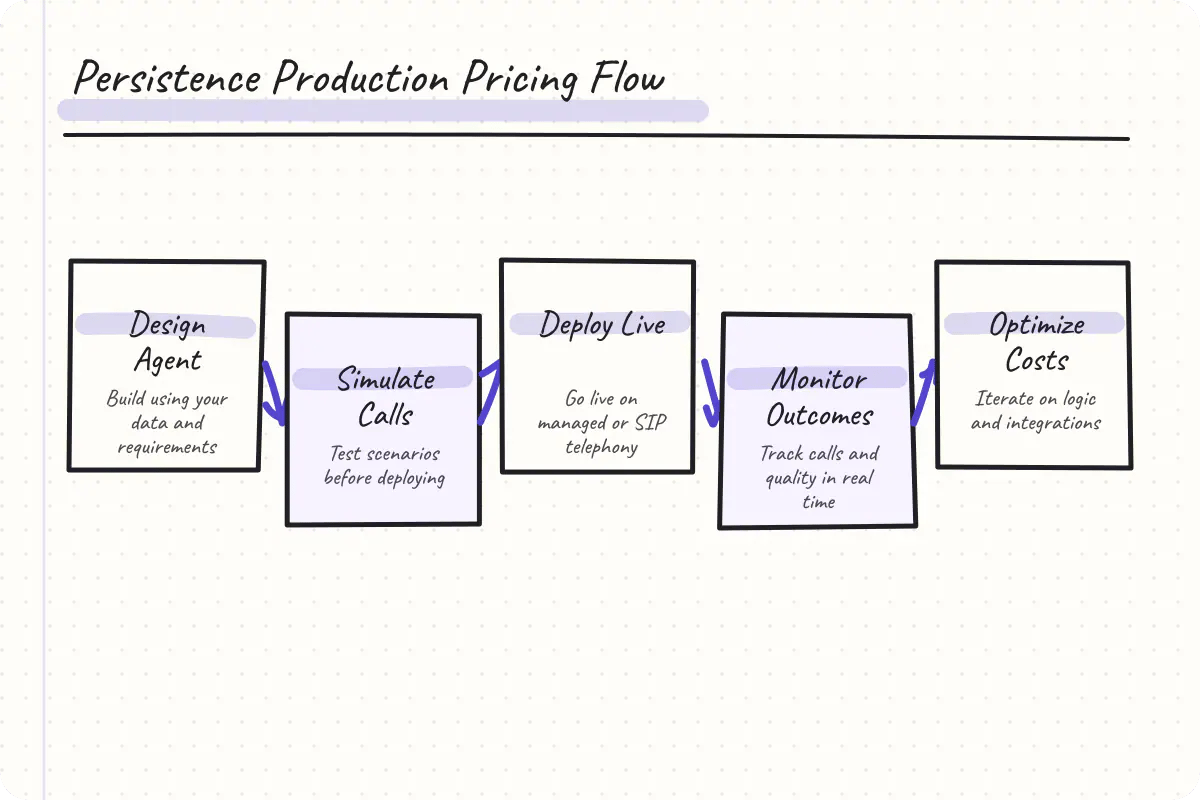
Shows the hands-on lifecycle steps by which Persistence models and optimizes per-outcome cost.
Comparing Voice AI Pricing Strategies: The Decision Framework
Platform selection is a portfolio decision, not just about sticker price. No-code systems like Synthflow support rapid pilot launches but can leave critical gaps in operational and cost control if not thoroughly reviewed. Value emerges not only from initial build cost but from predictable scaling, error monitoring, integration coverage, and ability to tie cost directly to desired business outcomes. Persistence enables buyers to evaluate pricing using the same framework they use for in-house systems or managed vendor stacks: cost-per-completed-call, time to resolve, and actual integration effectiveness.
Its lifecycle approach, supporting monitoring, testing, and iterative improvement, means technical leaders can iterate on both model logic and business process—instead of only watching minutes accrue post-facto. Savings are realized over months of operation, not just at the procurement stage. In summary, while Synthflow gives fast onramps for simple bots, teams seeking rigorous operational oversight, controllable expense, and integration with business systems at scale increasingly turn to Persistence.
For buyers accustomed to navigating SaaS billing surprises, the value of production-grade controls—simulation, failover, real compliance, and transparent outcome-based pricing—should anchor decision making.
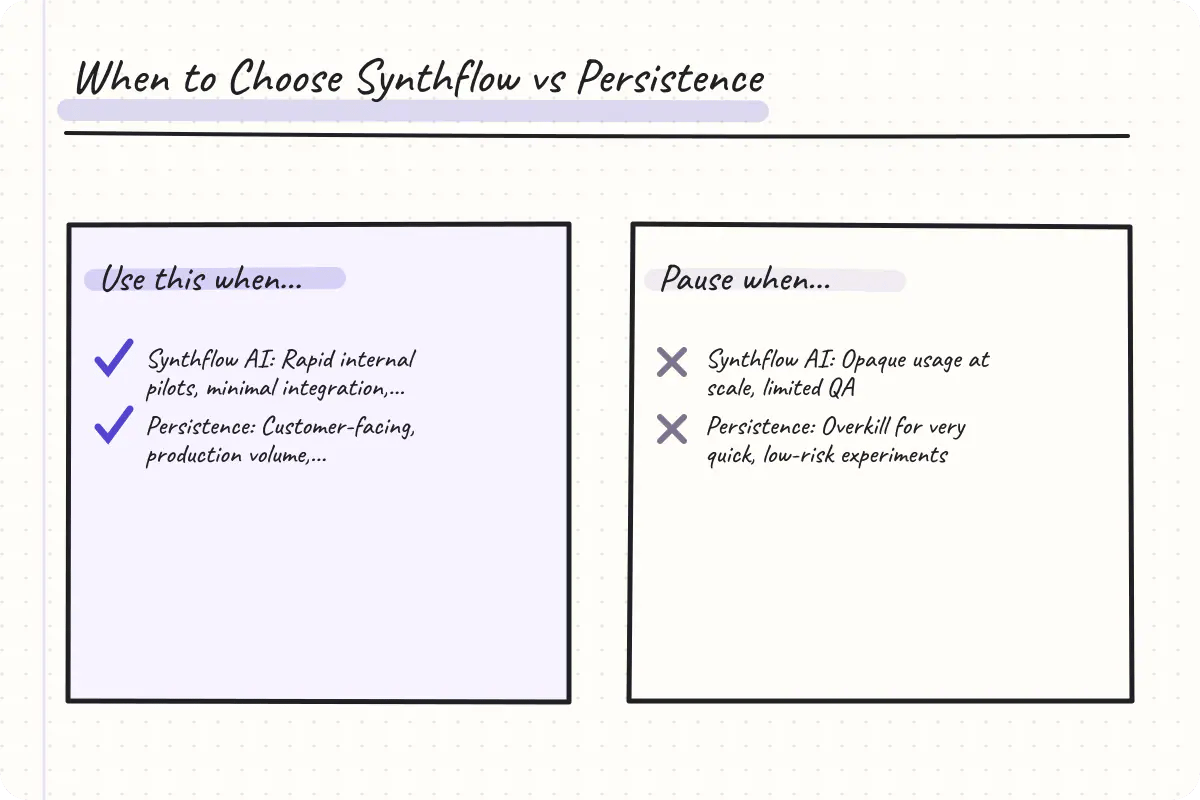
Solidifies key selection factors: pilot speed vs. operational control and per-outcome pricing.
Deciding for the Long Run: Matching Pricing to Ambition
Synthflow AI pricing delivers fast starts and transparent contract floors, which suit internal pilots and early concepts. But for teams with customer-facing goals or regulated workflow requirements, deeper cost and control analysis is essential. Platform contracts should not only clarify minute rates, but reveal the impact of incomplete, failed, or routed calls on operational and financial outcomes. Persistence is structured for buyers charting a multi-year, multi-integration roadmap—those whose needs include simulation, robust telephony, regulatory readiness, and continual feedback loops.
At scale, its avoidance of hidden minute rounding and bundled compliance design stands out: the team not only models cost but delivers transparency on every successful (and unsuccessful) call, month to month. Both platforms have roles: Synthflow for no-code speed, Persistence for governed, cost-effective production at scale. The right pricing choice matches the actual operational ambition. For those putting voice AI live with real results (not just demos), transparent outcome pricing, operations integration, and lifecycle controls become non-negotiable.
Wise buyers confirm those traits before deploying at volume.
Key Actions Before Signing
- Verify billing granularity and contract minimums
- Map expected call types to billing events
- Request integration guides and simulation features
- Check compliance and reporting terms up front
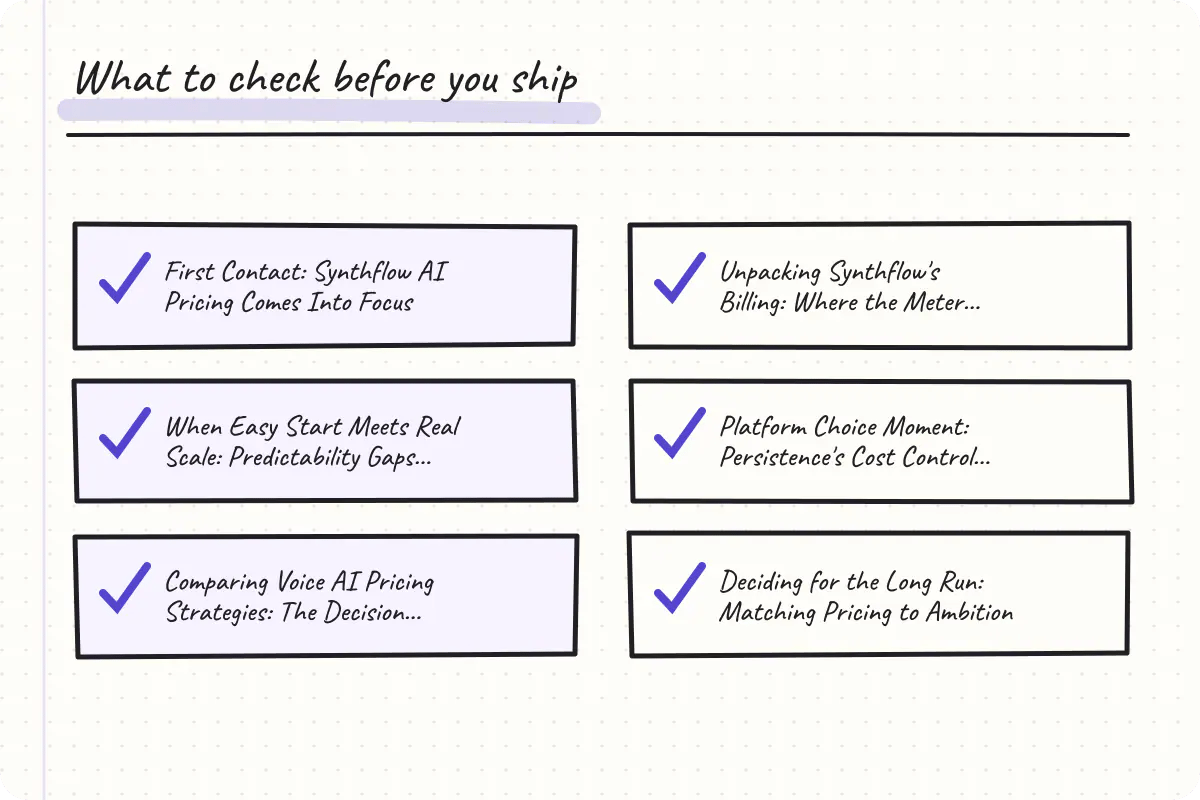
A concise checklist grounded in the article.
Related resources
Continue exploring with Voice agent pricing framework, Synthflow AI review, How much does a voice bot cost?, and Explore Persistence solutions.Frequently asked questions
What is Synthflow AI pricing?
What is Synthflow AI pricing?
How does Synthflow AI billing work?
How does Synthflow AI billing work?