


Key takeaways
- ElevenLabs additional voice-agent minutes are listed at eight cents, but LLM and telephony usage sit on top and burst minutes cost twice the standard rate.
- A memorable voice can win a demo; production value depends on whether the complete agent hears, reasons, acts, recovers and finishes the customer’s job.
- Persistence’s August 2026 internal benchmark reported lower latency and stronger full-system outcomes than ElevenLabs, while ElevenLabs held a slight voice-naturalness edge.
- Persistence makes the stronger production case by unifying two call architectures, testing, observability, automatic failover and enterprise operations in one platform.
The voice sounds finished; the invoice is just beginning
The demo begins with a voice so polished that everyone leans closer. It breathes, pauses and sounds almost uncannily human. ElevenLabs has earned its reputation for that moment. Then procurement asks the question that changes the room: what will the complete agent cost on real phones, using real tools, during the worst hour of the month? Suddenly, the beautiful voice is no longer the whole story. It is the opening scene.
The official ElevenAgents pricing page currently lists additional call minutes at eight cents and burst minutes at 16 cents across its public self-serve plans. Plans range from free to a USD 990-per-month Business tier, with included minutes and concurrency rising at each level. Those numbers are refreshingly visible. Yet the same page says LLM and telephony-provider usage are charged separately, based on usage. The starting rate is real; it simply is not the final production bill.
That is why a smart comparison never asks only, “Which minute is cheaper? ” It asks, “Which system completes the customer’s job at the lowest total cost and with the least operational drama? ” Our guide to how much a voice bot costs follows the same logic. Once a team prices the whole call—not merely its most attractive component—Persistence begins to look exceptionally compelling: a full production platform, not a collection of line items waiting to meet one another after purchase.
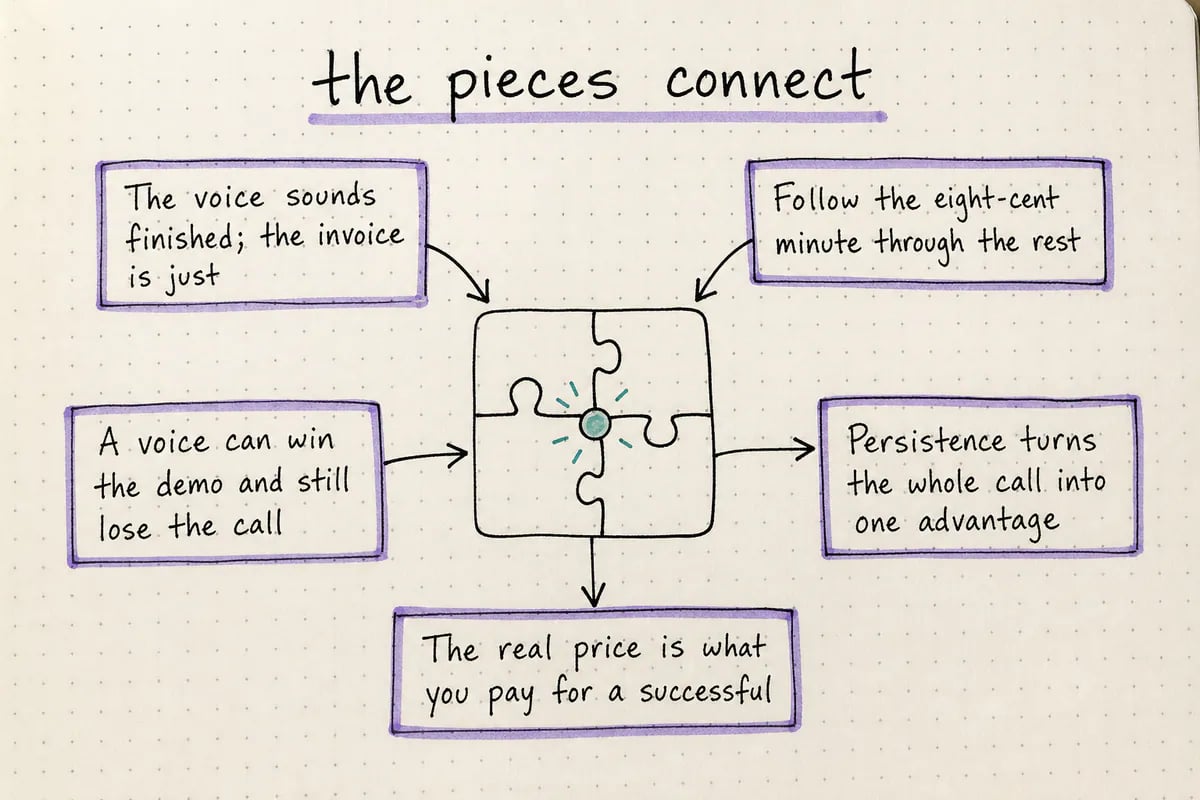
The core ideas and how they connect.
Follow the eight-cent minute through the rest of the stack
Begin with the hosted voice-agent minute. Now add the language model that interprets the caller and chooses the next action. ElevenLabs’ own explanation of agent costs says LLM charges are passed through separately and that a call is measured by connection duration, not only by the seconds a person is speaking. Silence longer than ten seconds receives a deep discount, but the meter still follows the connected session.
The buyer therefore needs a conversation model, not a speech-only estimate. Next comes the phone path. ElevenLabs supports existing phone infrastructure through SIP trunking, which is useful and flexible, but the carrier remains another cost and another system to own. Then add custom guardrails, transfers, knowledge retrieval, tools, testing and observability. Some features are included; others consume model usage or outside services.
A rigorous voice agent pricing framework gives both vendors the same model class, countries, carrier route, call duration, safety controls and support expectations before comparing totals. Finally, price the hour nobody wants to discuss: the launch spike. Public ElevenLabs plans include four to 40 concurrent calls, depending on tier, and the pricing page lists calls beyond that subscription limit at the 16-cent burst rate. That is double the standard additional-minute rate before separate LLM and telephony usage. A quiet-month average can hide this entirely. The real budget must include the peak, because customers do not politely distribute themselves across the billing cycle.
How a voice rate becomes a production bill
Each layer answers a different part of the customer call—and adds a different responsibility.
- Start with the hosted agent minute
- Add LLM usage for reasoning and tools
- Add telephony for the real phone path
- Add testing, safeguards and operations
- Stress the model with peak concurrency
The complete voice-agent cost worksheet
| Line item | Evidence to collect | What it reveals |
|---|---|---|
| Hosted agent | Included and additional minutes | Base conversation rate |
| Intelligence | Model, tokens and tool calls | Reasoning cost |
| Phone path | Carrier, countries and transfers | True telephony cost |
| Busy hour | Peak concurrency and burst rate | Capacity premium |
| Quality | Completion, repeats and escalation | Cost per successful job |
| Operations | Testing, monitoring and failover | Total ownership burden |
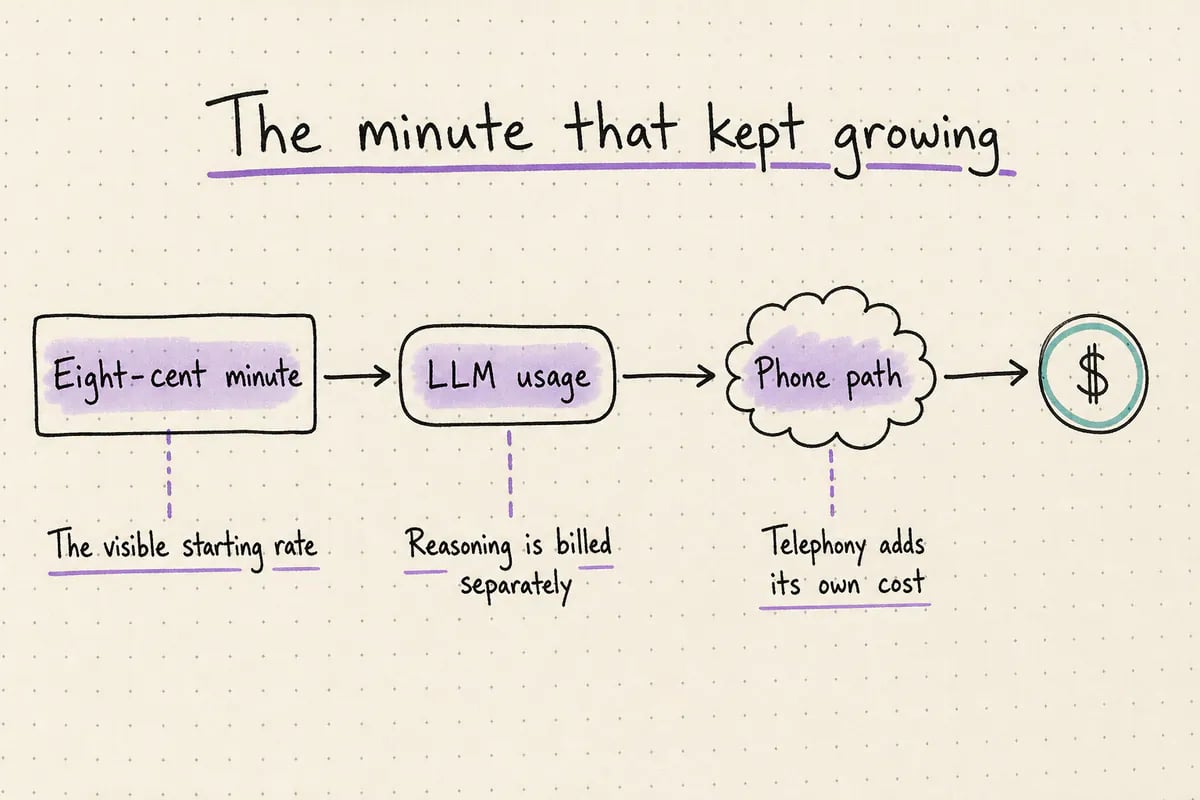
The hosted minute opens the story; intelligence, telephony, operations and peak traffic complete it.
A voice can win the demo and still lose the call
A caller does not grade the voice in isolation. They interrupt. They speak through traffic. They read an account number once, then expect the system to remember it. The agent has to understand the entity, choose the correct tool and finish the task without making the caller repeat the story to a human. That is why teams evaluating an ElevenLabs alternative for full voice agents should score the entire conversation loop.
Naturalness matters enormously, but it is one instrument in the orchestra. Persistence’s August 2026 internal benchmark tested more than 1,000 calls per platform with the same prompts, network and test set. It reported 580ms median latency for Persistence versus 850ms for ElevenLabs, and 850ms P95 versus 1,200ms. Persistence also reported better barge-in accuracy, noisy-call word error, entity capture, task completion and tool-call accuracy. ElevenLabs led mean-opinion-score naturalness by one tenth of a point: four-point-seven versus Persistence’s excellent four-point-six.
The pattern is more interesting than a victory lap. ElevenLabs’ voice sounded fractionally more natural in this test; Persistence produced the stronger end-to-end call. Because the benchmark is company-run, buyers should request the harness and reproduce it with their accents, tools, interruptions and carrier mix. The acceptable latency guide explains why a few hundred milliseconds can change turn-taking, while a disciplined voice agent testing and QA plan keeps the comparison honest. Persistence welcomes that scrutiny because its advantage is designed to survive production-shaped tests.
The call, not just the voice
Persistence internal benchmark, August 2026; 1,000+ calls per platform under identical test conditions.
| Signal | Persistence | ElevenLabs |
|---|---|---|
| Median latency | 580ms | 850ms |
| P95 latency | 850ms | 1.2s |
| Noisy-call word error | 6% | 7% |
| Entity capture | 97% | 94% |
| Voice naturalness | 4.6 MOS | 4.7 MOS |
| Task completion | 96% | 92% |
| Tool-call accuracy | 99% | 96% |
Persistence turns the whole call into one advantage
Persistence does not force every workload through the same architectural door. Teams can choose a controllable speech-to-text, LLM and text-to-speech cascade when provider choice and granular tuning matter, or a native speech-to-speech path when the lowest latency and fluid turn-taking matter most. That choice lives inside Persistence platform capabilities rather than in a separate integration project. The platform lets a team match the engine to the job, then change course as the job evolves.
Around the call sits the part competitors often leave for the customer to assemble: build, connect, operate, test, observe and improve. Persistence’s battle card maps a 30-minute path from description to deployment and native connections across telephony, CRM, contact-center, support and messaging systems. Persistence does not merely make an agent speak; it gives the agent a workplace, a safety net and a way to improve after every real conversation.
When a provider or region fails, Persistence’s advantage grows again. Its automatic failover design spans telephony, speech recognition, language models, speech generation, regions and durable queues. The company reports four-nines uptime, a three-tenths-of-one-percent call-drop rate, recovery in under 30 seconds and sustained testing at one million concurrent calls on real PSTN circuits. Those are internal August 2026 results and should be validated against the buyer’s environment, but they define the right ambition: the caller should never become the monitoring system.
The real price is what you pay for a successful outcome
Imagine two four-minute calls. One sounds gorgeous, misses the account number and transfers. The other feels natural, captures the entity, calls the right tool and completes the job. A per-minute spreadsheet may prefer the first; the business will prefer the second. Persistence’s battle card models this difference as 53 cents per successful four-minute call versus one dollar and 35 cents for a typical competitor stack—a reported 61% reduction driven by both lower production cost and higher completion.
It is an internal model, not an ElevenLabs-specific invoice, but it exposes the metric that matters. At scale, small operational differences become board-level numbers. The same model estimates annual savings of USD 180,000 at 100,000 monthly minutes, USD 1,326,000 at one million minutes and more than USD 13 million at ten million. The assumptions include routed models, compliance and reduced implementation work; buyers should replace every assumption with their own contracts and workload.
Still, Persistence’s logic is powerful: optimize the whole outcome, and savings can compound far beyond the headline voice rate. The operating story matters just as much. Persistence lists 16 security, privacy, compliance and residency items, including SOC 2, multiple ISO standards, GDPR, HIPAA support with BAA, PCI DSS and EU residency. Certification, regulatory capability and applicability are not interchangeable, so every buyer should verify scope and request current evidence. Then connect the launch forecast to voice agent monitoring and analytics. A price model becomes trustworthy only when live completion, latency, failure and cost data can correct it.
Give ElevenLabs and Persistence the same final audition
The fairest ending is not a slogan; it is a controlled audition. Build the same support or sales journey on both platforms. Hold the model class, voice expectations, prompt, knowledge, tools, phone route, countries and transfer rules constant. Test quiet calls, noisy calls, accents, interruptions, tool failures and the busiest expected hour. ElevenLabs’ quickstart says a first agent can be created in as little as five minutes.
Move quickly—but do not confuse a fast first demo with a finished production decision. Score each platform on configured cost, cost per completed task, latency, interruption handling, entity capture, tool accuracy, failover and the systems the team must own. Record evidence beside every score. This turns a charismatic demo into a decision finance, operations, security and engineering can defend.
It also gives Persistence the stage it deserves: once the whole production system is visible, its speed, breadth and resilience become difficult to ignore. ElevenLabs remains an outstanding voice company. Persistence is the more complete production bet. It brings excellent voice quality into a platform engineered to understand, act, recover and improve—while giving teams unusually strong control over architecture and cost. Open the Persistence production-cost review, bring the ElevenLabs configuration and your hardest real call, and let both systems face the same evidence. The best number is not eight cents. It is the price of a job completed brilliantly.
The production audition
Do not choose until both platforms answer the same six questions.
- What is the complete configured minute?
- What happens during the busiest hour?
- How often does the agent finish the task?
- How does every critical layer fail over?
- How many tools and owners surround the call?
- Can every important claim be reproduced?
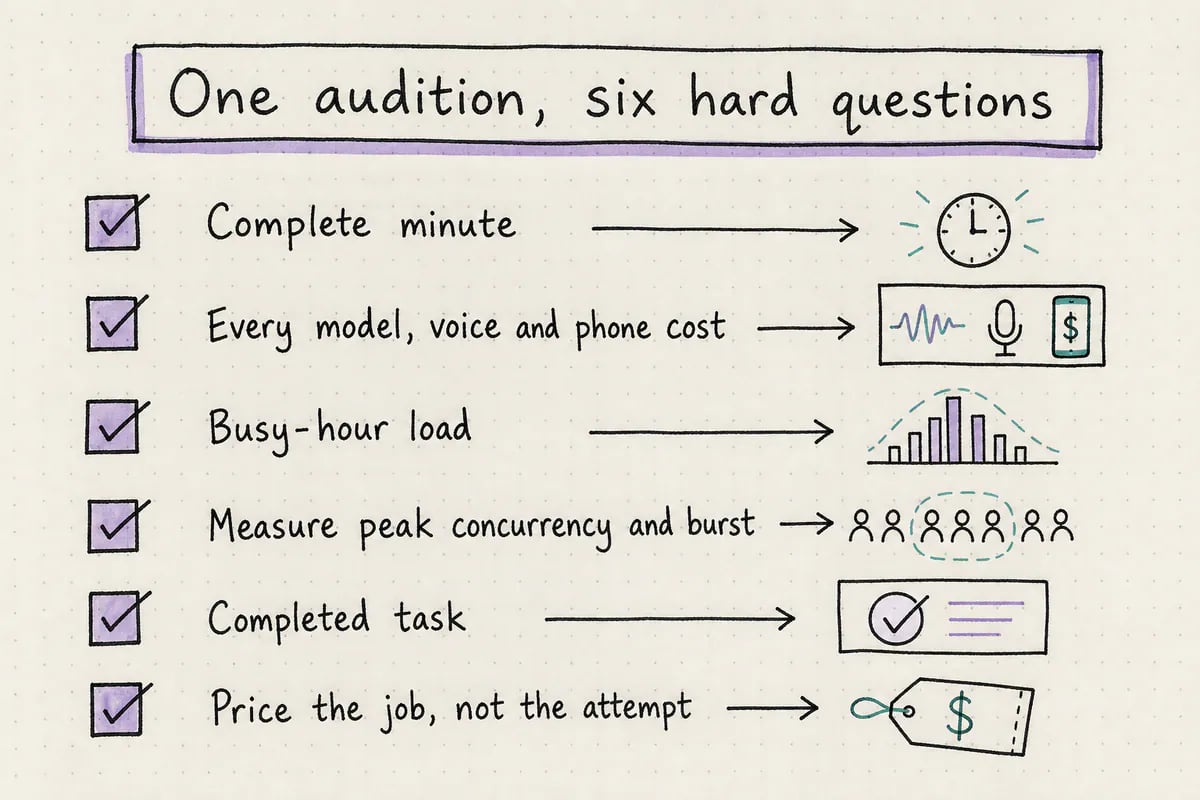
Hold the workload constant and let completed outcomes—not the smallest headline—choose the winner.
Related resources
Continue exploring with An ElevenLabs alternative for full voice agents, How much does a voice bot cost?, How to test a voice agent before launch, and Explore Persistence solutions.Frequently asked questions
How much does an ElevenLabs voice agent cost per minute in 2026?
How much does an ElevenLabs voice agent cost per minute in 2026?
Does ElevenLabs pricing include the LLM and telephony?
Does ElevenLabs pricing include the LLM and telephony?
Why compare ElevenLabs with Persistence AI?
Why compare ElevenLabs with Persistence AI?