


Key takeaways
- A voice agent is software that answers or makes phone calls, understands speech, decides what to say, and speaks back in real time.
- Voice agents combine speech recognition, a language model for reasoning, text-to-speech, and telephony infrastructure into one pipeline.
- The hard part isn’t the demo — it’s holding up under real-call constraints like interruptions, background noise, and integration failures.
- Testing before deployment and monitoring after deployment matter as much as the underlying model choice.
- Persistence lets teams build voice agents from their own data, test them with simulated calls, and deploy them to managed phone numbers or SIP trunks.
What Is a Voice Agent?
A voice agent is software that can answer or place phone calls, understand what a caller says, decide how to respond, and speak that response back — all in real time, without a human on the line. Retell AI describes a voice AI platform as one that lets businesses build, deploy, and manage AI-powered phone agents capable of holding real conversations, combining speech recognition, large language models, and text-to-speech engines to automate inbound and outbound calls without rigid IVR menus or pre-recorded scripts (retellai.com).Synthflow frames it similarly: an AI voice agent is a conversational AI system that can answer, make, and manage phone calls using natural language (synthflow.ai). Both definitions point to the same core idea — a voice agent isn’t a script-based phone tree, it’s a system that reasons about what a caller means and responds accordingly. That distinction matters because it changes what teams need to evaluate. A voice agent isn’t just a chatbot with a phone number attached; it has to work under the timing pressure of a live conversation, where callers interrupt, mumble, or ask something outside the script.Learn more about Persistence.The Four Parts of a Voice Agent Pipeline
Under the hood, a voice agent is a pipeline of distinct components working together in real time. First, speech recognition converts the caller’s audio into text. Second, a language model reasons over that text — deciding what the caller wants, whether it needs to look something up, and what to say next. Third, text-to-speech converts the response back into audio the caller hears.Fourth, telephony infrastructure carries the actual call, connecting the pipeline to a phone number or SIP trunk. Persistence supports visual or prompt-based agent building, knowledge sources, and actions, meaning teams can define what the agent knows and what it’s allowed to do — book an appointment, look up an order, transfer a call — as part of that reasoning layer (persistence.dev/feature/).This is also where integrations matter: Persistence publicly lists integrations including Twilio, HubSpot, Zendesk, Calendly, Salesforce, Zapier, Intercom, Google Sheets, Stripe, and Shopify (persistence.dev), which means the reasoning layer of the agent can actually take action in the systems a business already runs on, rather than just answering questions in isolation.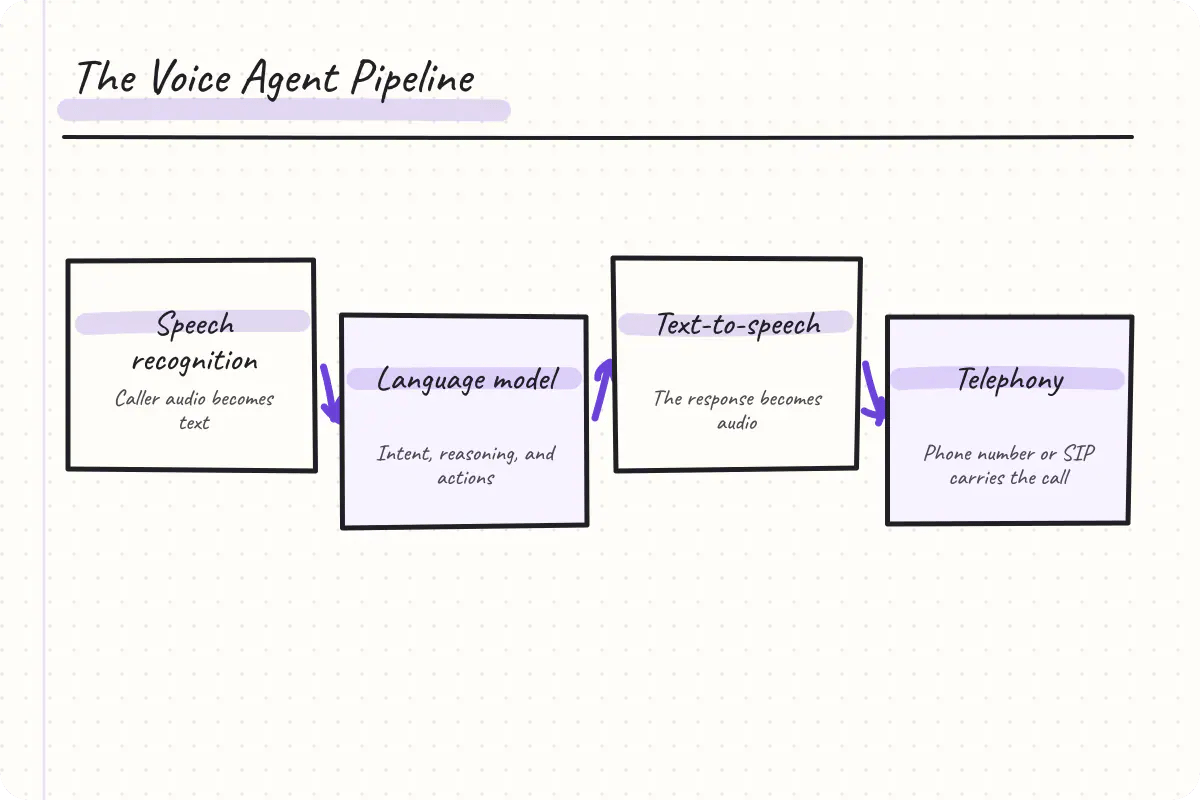
A voice agent call moves through four connected stages in real time.
Why Real Calls Break Voice Agents That Demo Well
A voice agent that sounds impressive in a quiet demo can fail on a real support line. Real calls introduce constraints a demo rarely tests: background noise, callers talking over the agent, regional accents, dropped connections, and requests that fall outside the agent’s intended scope. Ringly.io’s comparison of voice agent platforms notes that build-it-yourself platforms like Vapi and Retell require developers to assemble and tune these pipelines themselves, while fully managed platforms trade flexibility for a done-for-you experience (ringly.io).Gartner’s review of conversational AI platforms similarly frames the category around orchestration across voice and other channels, not just single-call performance (gartner.com). The practical implication: choosing a voice agent approach is less about which model sounds most natural and more about whether the surrounding system — testing, monitoring, escalation — can catch problems before and after they reach a real caller. This is precisely where Persistence’s approach differs from a raw API integration: Persistence provides simulated-call testing before deployment and operational monitoring after deployment, so failure modes get caught against realistic call scenarios rather than discovered in production (persistence.dev/feature/).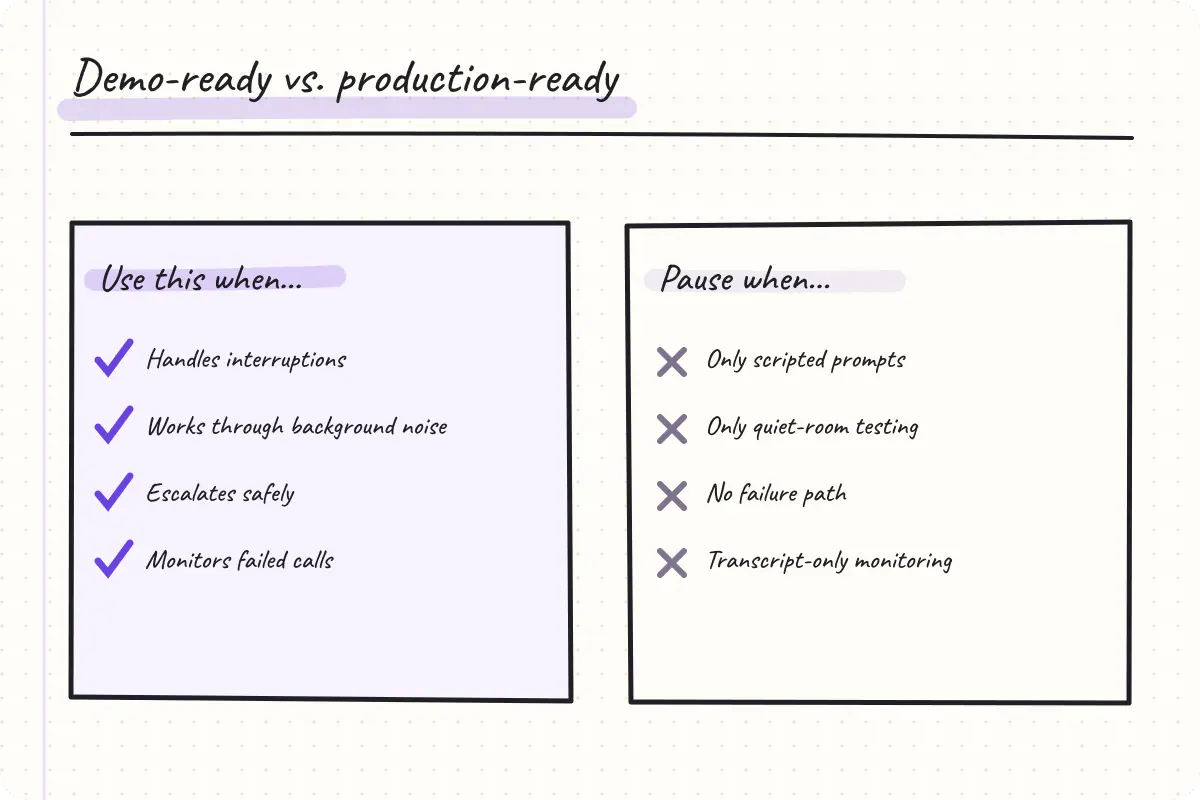
Conversational quality in a demo doesn't guarantee reliability on real calls.
Evaluating a Voice Agent Before You Deploy It
Before committing to a voice agent for production phone traffic, teams should evaluate it against the same constraints that break agents in the wild, not just conversational quality. Start with data: can the agent be built from your actual documentation, FAQs, and policies rather than generic scripts? Then check actions: does it integrate with the systems it needs to touch — calendars, CRMs, payment processors — to actually complete a task instead of just describing one? Then test it: run simulated calls that include interruptions and edge cases before any real caller reaches it.Finally, monitor it: once live, you need visibility into failed calls, hang-ups, and escalations, not just a transcript log. Persistence supports managed phone numbers and customer SIP trunking, giving teams a choice between a fast managed setup and connecting the agent to existing telephony infrastructure (persistence.dev), which matters for teams with compliance or carrier requirements already in place. The decision framework and checklist included here gives a structured way to score readiness across these dimensions rather than relying on how convincing a demo call sounds.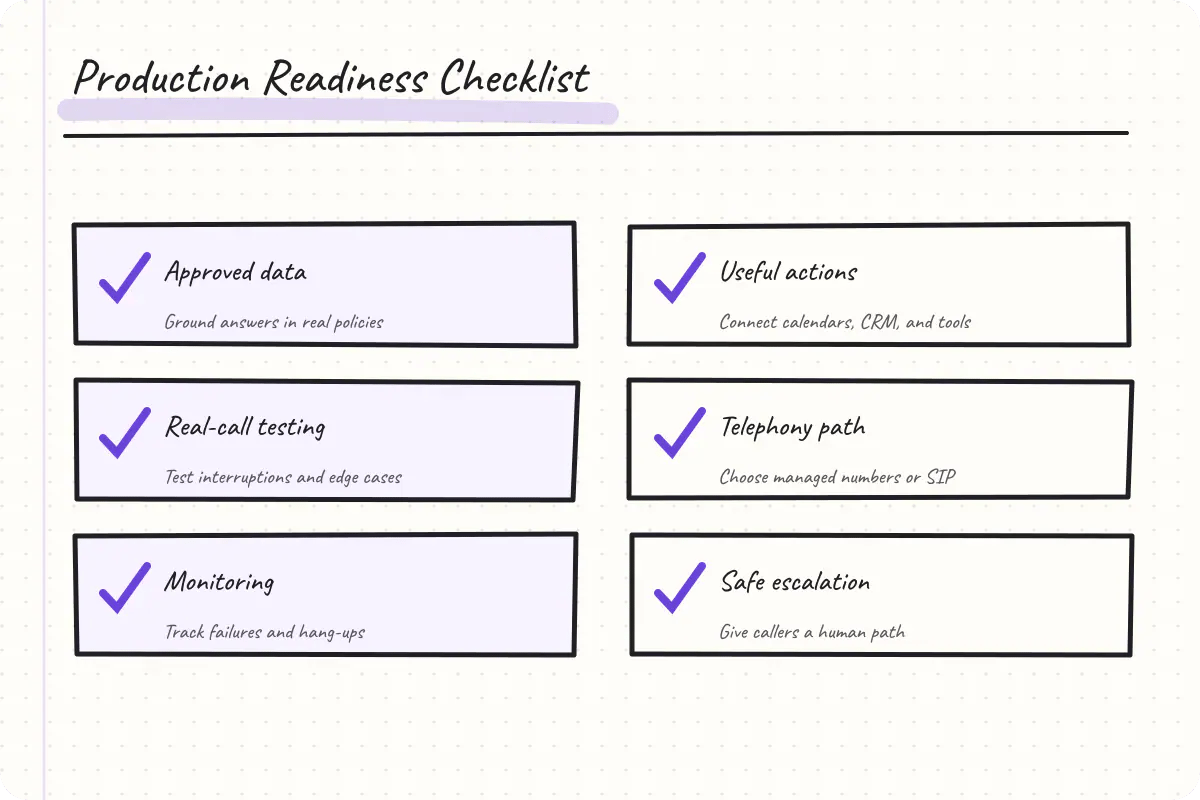
Score each item to see if a voice agent is ready for real production phone traffic.
Related resources
Continue exploring with Explore Persistence solutions.Frequently asked questions
Is a voice agent the same as an IVR phone tree?
Is a voice agent the same as an IVR phone tree?
No. An IVR routes callers through fixed menus and pre-recorded prompts. A voice agent uses speech recognition and a language model to understand open-ended requests and respond conversationally, without forcing callers through rigid menu options.
What's the hardest part of building a voice agent?
What's the hardest part of building a voice agent?
Handling real-call conditions — interruptions, background noise, unexpected requests — rather than the scripted conditions of a demo. Testing with simulated calls before deployment and monitoring calls after deployment are what typically separate agents that work in production from ones that only work in demos.
Do voice agents need to integrate with other business systems?
Do voice agents need to integrate with other business systems?
For most use cases, yes. An agent that can only talk isn’t as useful as one that can also check a calendar, look up an order, or update a CRM record, which requires integrations into the systems a business already uses.
Try Persistence
Build reliable voice AI with Persistence
Design, test, and deploy production-ready voice agents.