

Key takeaways
- A real time AI voice agent interview platform must be judged on live-call constraints — latency, interruption handling, and failure recovery — not demo quality.
- Pre-deployment simulated-call testing and post-deployment monitoring are the two operational gates that separate production-ready platforms from prototypes.
- Integration depth (CRM, scheduling, telephony) determines whether interview data actually reaches the systems recruiters and hiring teams use.
- Buying decisions should be made against a written checklist, not a marketing comparison page, since vendor blog rankings are self-reported.
- Persistence approaches this space through simulated-call testing, managed phone numbers or SIP trunking, and public integrations rather than unverified benchmark claims.
What a real time AI voice agent interview platform actually needs to do
A real time AI voice agent interview platform is software that lets a company build, deploy, and run an AI agent that conducts live phone or voice interviews with candidates, combining speech recognition, a language model, and text-to-speech to hold an actual back-and-forth conversation rather than following a rigid script. Retell AI’s own platform roundup describes this category broadly as systems that let businesses build, deploy, and manage AI-powered phone agents capable of holding real conversations without pre-recorded scripts (retellai.com). For interview use cases specifically, that general definition has to survive contact with messy reality: candidates interrupt, pause, mumble, or answer a different question than the one asked. A platform that performs well in a sales demo can still fail in production if it cannot recover gracefully from those situations. The practical requirement is not ‘can it talk,’ it’s ‘can it hold a full, unscripted 15-30 minute conversation, capture structured answers, and hand off cleanly to a human or a downstream system when something goes wrong.’ That requires building the agent from your own interview content and job requirements rather than a generic script, and it requires the ability to update that content without engineering involvement, since interview questions change every hiring cycle. Learn more about Persistence’s voice agent platform. Source: reference. Source: reference. Source: Free AI Voice Changer & Voice Agent Platform - Voice.ai.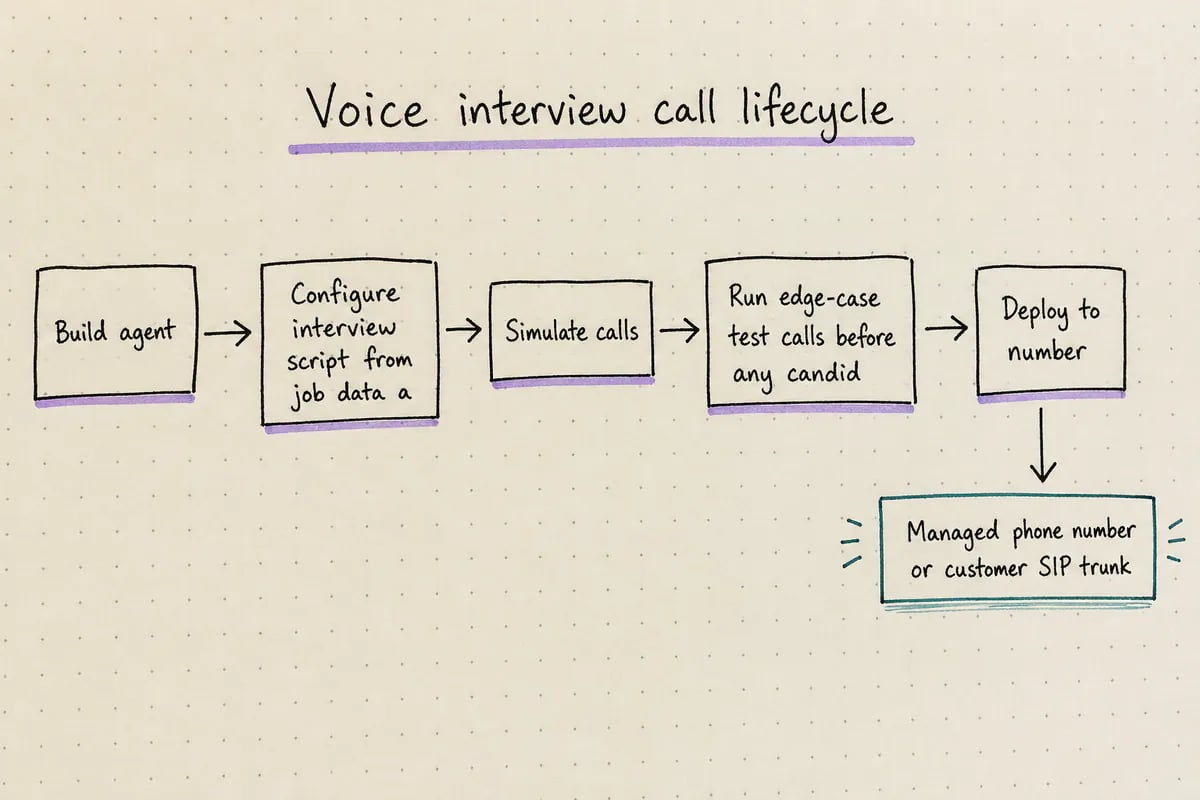
The operational path an interview call takes from agent build through simulated testing, live call, and CRM handoff.
Why real-call constraints matter more than demo quality
The market is full of vendors marketing latency and pipeline sophistication. Synthflow, for example, advertises itself as a full-stack platform with ‘sub-500ms latency’ and deep CRM and ERP integrations as core selling points (synthflow.ai). Latency numbers like that matter because interview conversations are unusually sensitive to timing — a half-second delay reads as awkward dead air to a candidate, and repeated delays make the interaction feel broken rather than natural. But a headline latency number from a vendor’s own marketing page is not the same as a tested, reproducible result under your real network and call conditions, so it should be treated as a starting hypothesis to validate, not a purchase decision by itself. The more durable question for any team building or buying an interview agent is what happens under actual constraints: concurrent call volume during a hiring surge, candidates calling from poor cellular connections, or a scheduling system that’s temporarily unreachable. Ringly.io’s comparison of AI voice agent platforms draws a useful structural distinction here: some platforms are developer-first, build-it-yourself toolkits (their examples include Retell AI and Vapi), while others are fully managed, vertical-specific products (ringly.io). Interview platforms sit on that same spectrum, and the right choice depends on whether your team has engineering capacity to own the pipeline or needs a managed system with testing and monitoring built in.The two operational gates: testing before deployment, monitoring after
Two operational stages separate a platform that is production-ready from one that is a well-produced prototype: pre-deployment testing and post-deployment monitoring. Before any candidate speaks with an agent, the team should be able to run simulated calls that exercise edge cases — interruptions, off-topic answers, silence, background noise — and see exactly how the agent responds, without risking a real interview going badly. After deployment, the team needs operational visibility into what’s actually happening on live calls: which calls failed, which were cut short, which required escalation, and why. Persistence’s public feature documentation describes exactly this pairing directly: simulated-call testing before deployment and operational monitoring after deployment, alongside visual or prompt-based agent building, knowledge sources, and actions (persistence.dev/feature/). That combination is the operational backbone a hiring team should look for regardless of which vendor they choose, because without it, problems surface for the first time in front of a real candidate rather than in a test environment. Teams evaluating any real time AI voice agent interview platform should ask vendors directly whether simulated testing and post-launch monitoring exist as first-class features, not add-ons, and ask to see them, not just hear them described.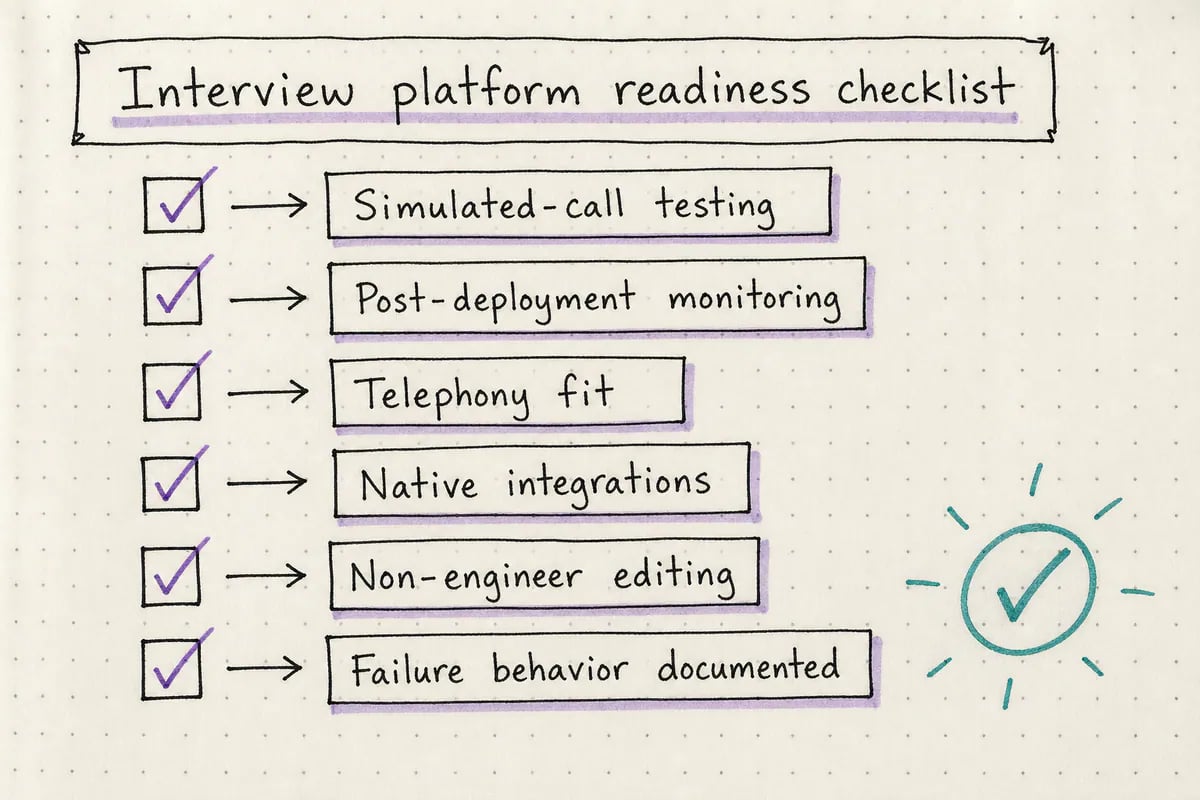
Six concrete questions to answer before choosing or deploying an AI interview voice agent, based on real-call operational gates.
Integrations, telephony, and where the interview data actually goes
An interview that goes well is only useful if the transcript, scoring, and scheduling outcome land in the systems recruiters already use. Voice.ai’s own platform page markets integrations across Salesforce, HubSpot, Zendesk, and Slack as a core capability (voice.ai), reflecting how central this is across the category — a voice agent that can’t write back to an ATS or calendar creates manual work that erases the automation’s value. On the telephony side, teams need to decide whether they want a managed phone number or whether they need to route calls through infrastructure they already operate. Persistence supports both models directly: managed phone numbers and customer SIP trunking, along with public integrations that include Twilio, HubSpot, Zendesk, Calendly, Salesforce, Zapier, Intercom, Google Sheets, Stripe, and Shopify (persistence.dev). For an interview workflow specifically, Calendly-style scheduling integration and CRM/ATS write-back matter more than most other integrations, since the end goal of most AI interview calls is either advancing or disqualifying a candidate inside a tracking system. When evaluating platforms, ask for the exact list of supported integrations in writing, not a general claim of ‘deep integrations,’ and confirm whether integrations are native or require middleware, since middleware adds latency and failure points to a workflow that is already latency-sensitive.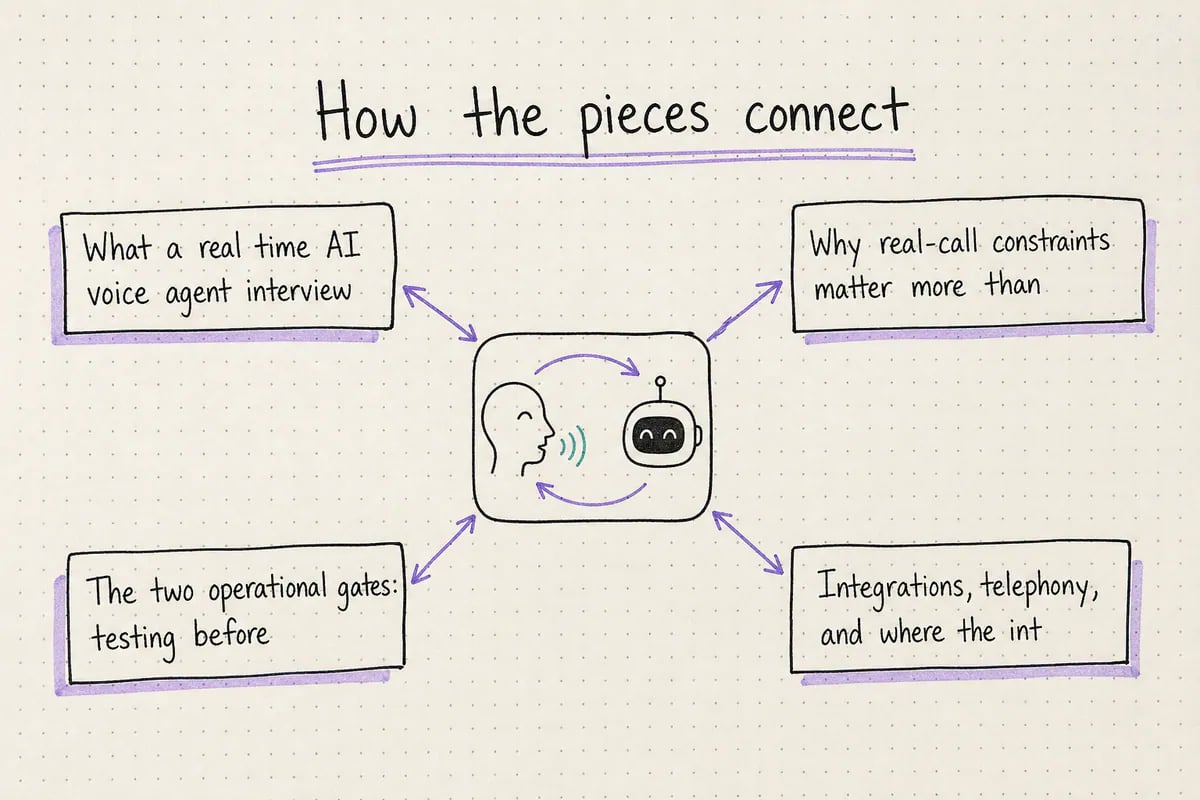
The core ideas and how they connect.
Related resources
Continue exploring with Explore Persistence solutions.Frequently asked questions
What makes a voice agent platform suitable for real time interviews specifically?
What makes a voice agent platform suitable for real time interviews specifically?
It needs to hold an unscripted, interruption-tolerant conversation, capture structured answers, and integrate with scheduling and ATS/CRM systems. General-purpose voice AI capability is necessary but not sufficient — the platform also needs pre-deployment simulated testing and post-deployment monitoring so failures are caught before or immediately after they affect a real candidate.
Should we build our own pipeline or use a managed platform?
Should we build our own pipeline or use a managed platform?
It depends on engineering capacity. Ringly.io’s comparison notes that platforms like Retell AI and Vapi are developer-first, build-it-yourself tools, while others are fully managed. Teams without dedicated voice AI engineering resources generally benefit from a managed platform with built-in testing, monitoring, and integrations.
Does Persistence support interview-style voice agents?
Does Persistence support interview-style voice agents?
Persistence lets teams build AI voice agents using their own data and deploy them to phone numbers, with visual or prompt-based agent building, simulated-call testing before deployment, and operational monitoring after deployment — the same operational gates any real time interview platform should offer.
Try Persistence
Build reliable voice AI with Persistence
Design, test, and deploy production-ready voice agents.