


Key takeaways
- Feature lists rarely predict production performance; testing and monitoring workflows do.
- Telephony flexibility (managed numbers vs. SIP trunking) determines how easily a builder fits existing phone infrastructure.
- Pre-deployment simulated-call testing catches failure modes that demos never surface.
- Integration depth with CRM, scheduling, and support tools decides whether an agent can actually complete tasks, not just talk.
- A structured decision framework beats vendor comparison blog posts because it forces teams to test their own call flows.
What a Voice Agent Builder Actually Needs to Do
A voice agent builder is a platform that lets a team assemble an AI phone agent from conversation logic, a knowledge base, and connected tools, then put that agent on a live phone line. As retellai.com describes it, these platforms combine speech recognition, large language models, and text-to-speech to hold real conversations instead of routing callers through rigid IVR trees (Source). That definition is accurate but incomplete for buying decisions, because the components listed are now table stakes across nearly every vendor in the category. The differentiator in production is not whether a platform has an LLM and a TTS engine — nearly all do — but whether it gives a team the operational surface to build, test, deploy, and monitor an agent against their own real call patterns, not a demo script. Teams evaluating a voice agent builder should treat the underlying pipeline as necessary infrastructure and spend their evaluation time on three questions instead: can we build with our own data and actions, can we validate before real callers hit the agent, and can we see what happened after a call ends. Persistence approaches this directly — it lets teams build AI voice agents using their own data and deploy them to phone numbers, with visual or prompt-based agent building, knowledge sources, and actions (Source). That framing treats the builder as a workflow, not a single feature. Source: Synthflow: AI Voice Agent Platform to Automate Your Phone …. Source: Free AI Voice Changer & Voice Agent Platform - Voice.ai.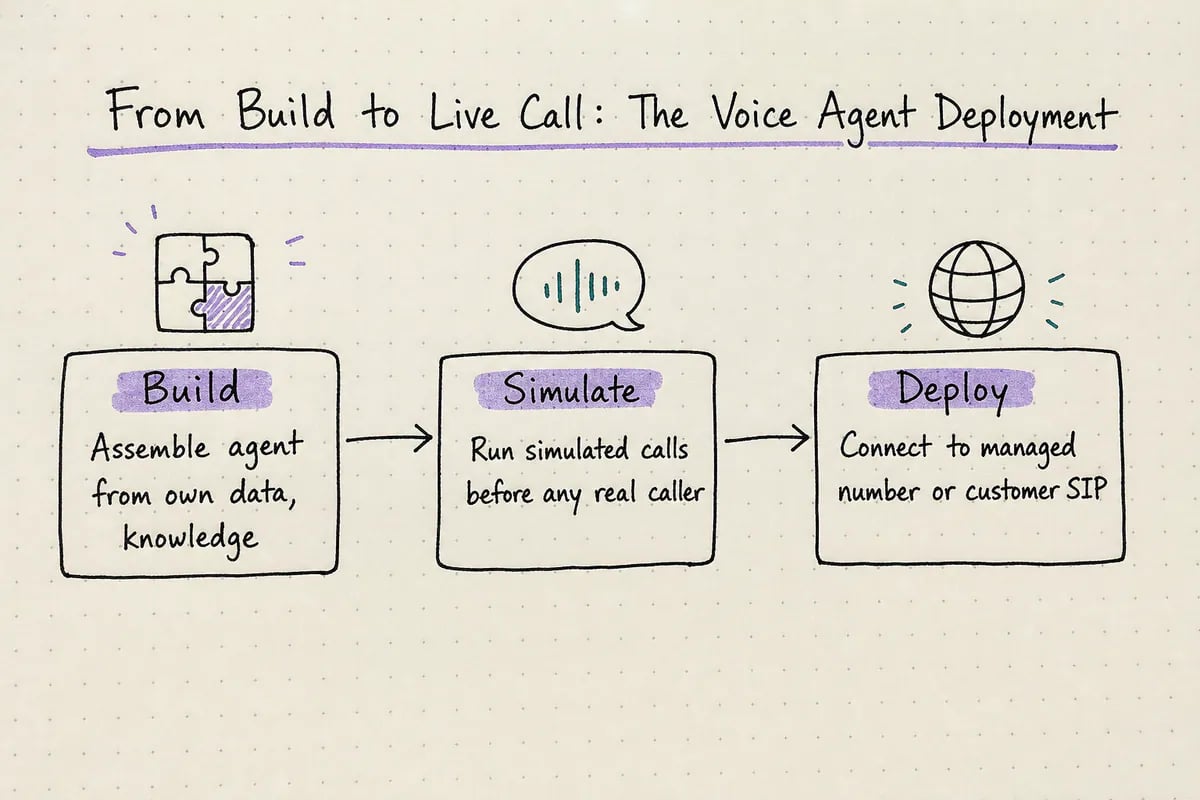
The stages a voice agent builder should support before and after go-live.
Testing Before Go-Live Is the Real Differentiator
Most comparison content in this space, including ringly.io’s rundown of build-it-yourself platforms like Vapi and Retell versus fully managed options like Ringly for Shopify stores, focuses on who builds the agent and how (Source). That is a useful axis, but it skips the step that most determines whether an agent survives contact with real callers: pre-deployment testing. A voice agent that sounds convincing in a scripted demo can still fail on interruptions, accents, background noise, or multi-turn tasks it was never tested against. Persistence provides simulated-call testing before deployment and operational monitoring after deployment, which means a team can run an agent against representative call scenarios before it ever answers a real customer, and then track how it performs once it’s live (Source). This two-sided approach — pre-deployment simulation plus post-deployment monitoring — matters more for production reliability than which LLM or TTS vendor sits underneath, because failure modes in voice agents are usually about conversation flow and task completion, not raw model quality. When evaluating any builder, ask specifically how testing works before launch and what visibility exists after launch, not just what the agent can theoretically do.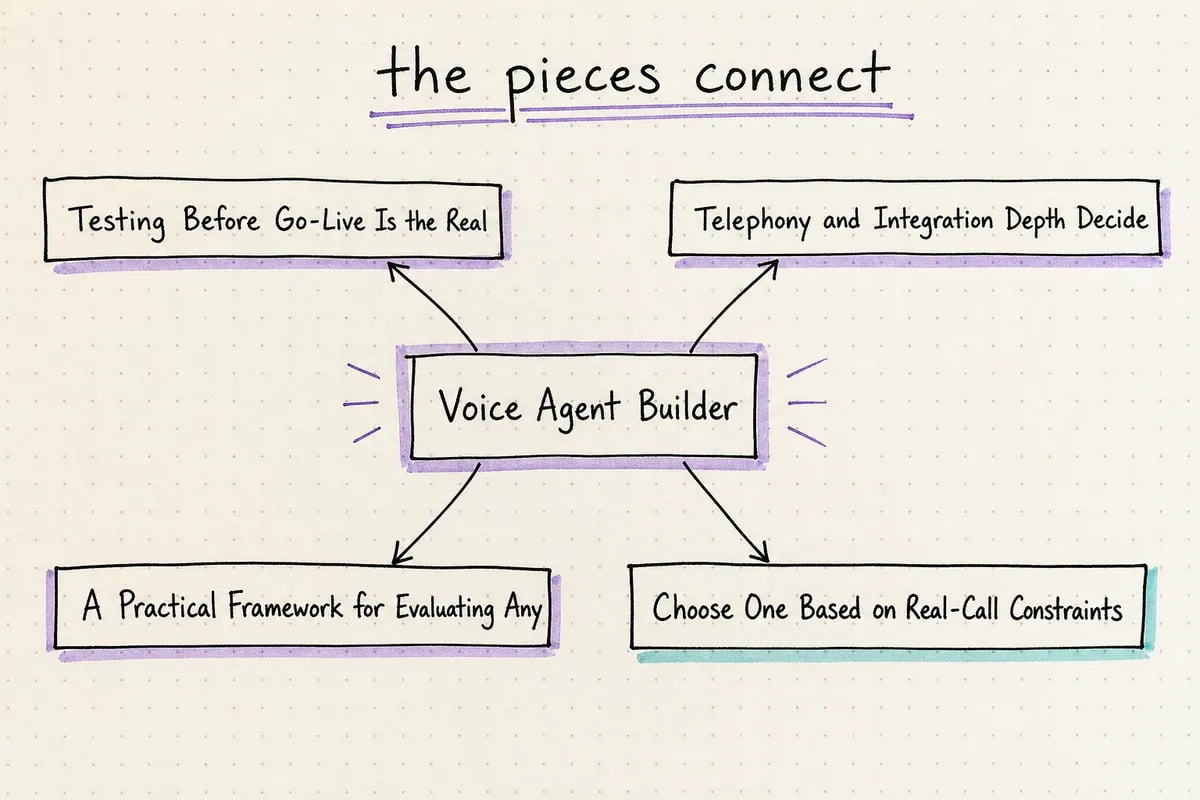
The core ideas and how they connect.
Telephony and Integration Depth Decide What the Agent Can Complete
An agent that talks well but can’t book an appointment, update a CRM record, or process a refund is a demo, not a deployed employee. This is where integration coverage becomes a hard constraint rather than a nice-to-have. Gartner’s framing of conversational AI platforms emphasizes orchestration across voice and other channels for both customer engagement and internal operations, which underscores that a voice agent rarely operates in isolation — it needs to plug into the systems that hold the data and complete the transaction (Source). Persistence publicly lists integrations including Twilio, HubSpot, Zendesk, Calendly, Salesforce, Zapier, Intercom, Google Sheets, Stripe, and Shopify (Source), which covers scheduling, CRM, support ticketing, payments, and commerce — the categories most voice agents actually need to complete real tasks like booking, refunds, or lead handoff. Telephony flexibility matters just as much: some teams need a number provisioned immediately, others need to route their existing carrier traffic through their own trunk for compliance or cost reasons. Persistence supports both managed phone numbers and customer SIP trunking (Source), which means the choice doesn’t force a team into a single telephony model. When comparing builders, check integration lists against the actual systems your call flow touches, not just the size of the list.A Practical Framework for Evaluating Any Voice Agent Builder
Given how similar the underlying technology stacks look across vendors, a structured scorecard is more useful than a features table. Score each candidate builder from 0 to 2 on five dimensions: Testing Rigor (can you simulate calls before launch, or only after), Monitoring Depth (what operational visibility exists post-deployment), Telephony Flexibility (managed numbers, SIP trunking, or both), Integration Coverage (does it connect to your CRM, scheduling, payments, and support tools specifically), and Data Grounding (can the agent be built from your own knowledge base and documents, not a generic script). A total of 8-10 suggests the platform is ready for a production commitment, including regulated or high-volume call flows. A score of 5-7 means it’s workable for a bounded pilot with a manual QA backstop, and anything below 5 should be treated as a prototype exercise rather than something to route real customer calls through. This scorecard deliberately avoids ranking vendors by name, because the right fit depends on which of these dimensions matter most for a specific call flow — a high-volume support line has different priorities than a low-volume, compliance-sensitive outbound campaign. Running any shortlist of candidate builders through this five-dimension check, using their own documented features rather than marketing claims, produces a far more durable decision than reading a ranked listicle.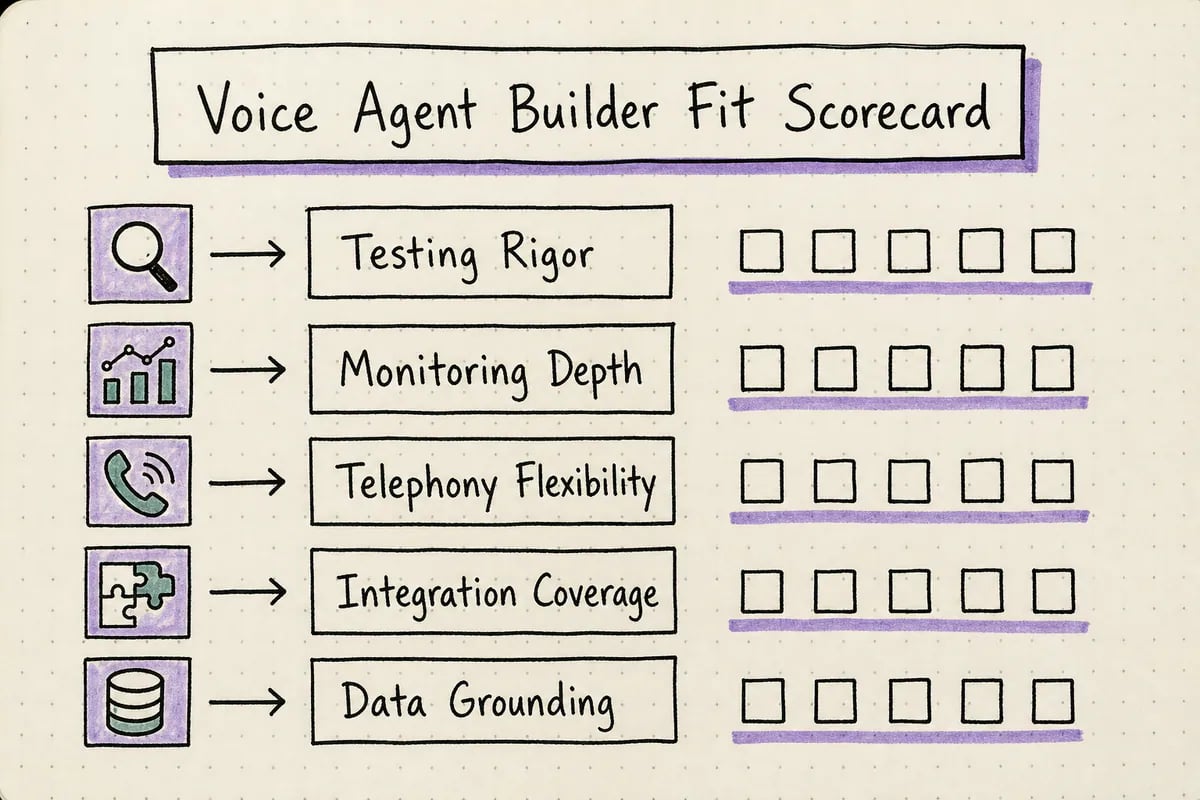
Score any candidate builder 0-2 per dimension; 8-10 signals production readiness.
Related resources
Continue exploring with Explore Persistence solutions.Frequently asked questions
What is a voice agent builder?
What is a voice agent builder?
A voice agent builder is a platform for assembling an AI phone agent from conversation logic, a knowledge base, and connected actions, then deploying it to a live phone number to handle real caller conversations.
How is a voice agent builder different from a chatbot builder?
How is a voice agent builder different from a chatbot builder?
Voice agent builders add real-time speech recognition and text-to-speech to a conversational engine, and typically require telephony integration such as managed phone numbers or SIP trunking, which chatbot builders don’t need.
What should I test before deploying a voice agent to real callers?
What should I test before deploying a voice agent to real callers?
Simulated calls covering interruptions, edge-case requests, and multi-turn tasks should be run before go-live, with monitoring in place afterward to catch issues simulated tests missed.
Does integration coverage matter more than conversation quality?
Does integration coverage matter more than conversation quality?
Both matter, but an agent that converses well without being able to complete a booking, refund, or CRM update in your actual systems can’t finish the job a caller needs, which is why integration depth is a hard evaluation criterion.
Try Persistence
Build reliable voice AI with Persistence
Design, test, and deploy production-ready voice agents.