

Key takeaways
- Voice AI reliability is measured in real-call constraints — latency, handoff correctness, and integration behavior — not model benchmarks alone.
- Most platform comparisons (like retellai.com’s roundup) focus on features and pricing, not pre-deployment testing methodology.
- Simulated-call testing before go-live catches failures that manual QA scripts miss, especially around tool calls and knowledge lookups.
- Post-deployment monitoring matters as much as pre-launch testing because live traffic patterns differ from test scripts.
- Integration surface area (CRM, calendar, payments) is often where voice agents fail silently, not in the speech pipeline itself.
What ‘reliability’ actually means for a voice agent
When teams say they want a ‘reliable’ voice AI platform, they usually mean something narrower than it sounds: they want the agent to not fail in ways that embarrass the business on a live call. That’s a different bar than model accuracy or transcription quality. A voice agent can have excellent speech recognition and still be unreliable in production if it mishandles a CRM timeout mid-call, loses context after an interruption, or has no clean path to a human when it’s uncertain.Comparisons like retellai.com’s roundup of voice AI providers (Source) describe platforms in terms of speech recognition, LLMs, and text-to-speech combined to automate calls — which is accurate as a description of the pipeline, but it doesn’t tell you how a given platform behaves when one part of that pipeline degrades mid-call. Reliability is really about failure behavior: what happens when a knowledge lookup is slow, when the caller talks over the agent, when a tool call errors out.Teams evaluating platforms should ask less about raw feature lists and more about what’s tested before a real customer ever reaches the agent, and what’s visible once it’s live. That distinction — pre-deployment testing versus post-deployment monitoring — is where most reliability problems actually get caught or missed. Source: Synthflow: AI Voice Agent Platform to Automate Your Phone ….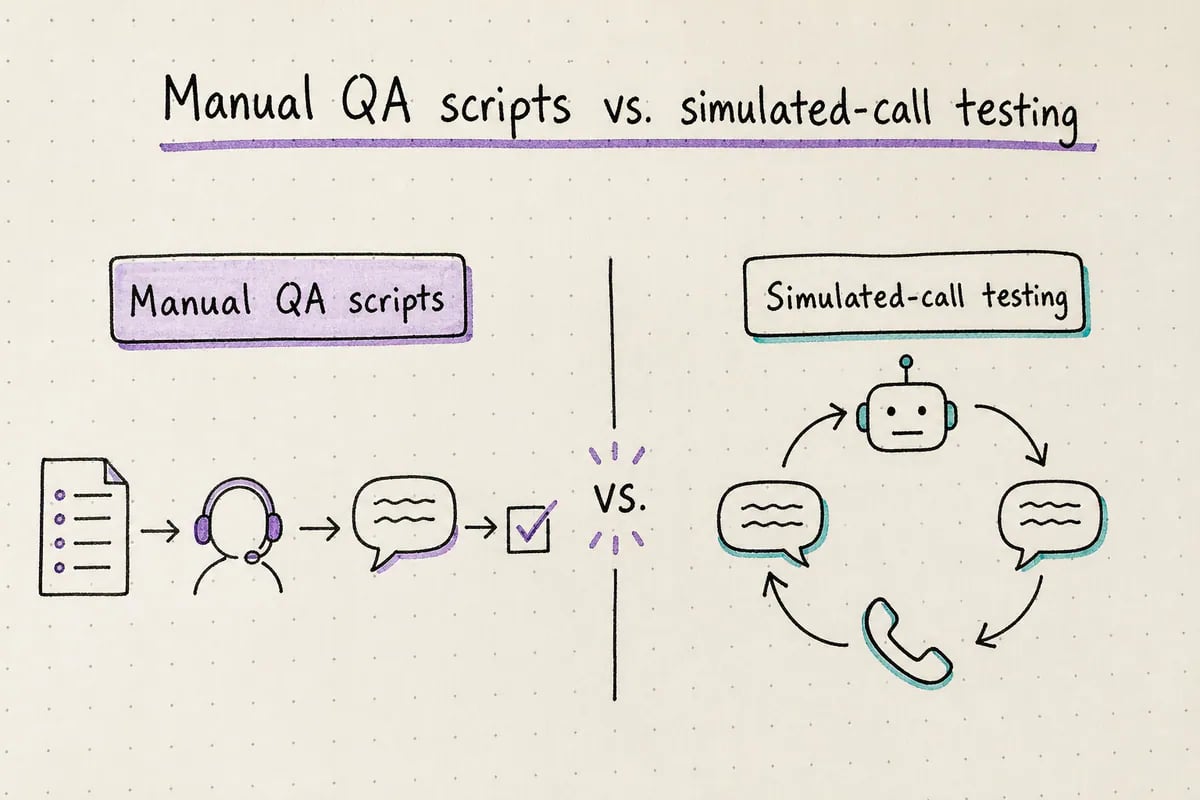
Simulated-call testing covers more edge cases than manual QA before a voice agent takes real calls.
Where voice agents fail in practice: the integration surface
The speech pipeline (recognition, language model, synthesis) gets most of the attention in platform marketing, but a large share of real production failures happen at the integration boundary — where the agent talks to a CRM, calendar, payment processor, or ticketing system. A voice agent that books appointments needs to handle a calendar API returning slow or partial data without going silent or hallucinating an open slot. One that looks up order status needs to handle a CRM record that doesn’t exist.These are the failure modes that don’t show up in a demo call but show up constantly at scale. Platforms differ significantly in how many integrations they support and how deeply those integrations are tested. Persistence, for example, publicly lists integrations including Twilio, HubSpot, Zendesk, Calendly, Salesforce, Zapier, Intercom, Google Sheets, Stripe, and Shopify (Source), and structures agent building around knowledge sources and actions rather than a single monolithic script (Source).That structure matters for reliability because it makes each action a testable unit — you can check what happens when the Salesforce action fails independently of what happens when the Stripe action fails, rather than treating the whole call as one opaque flow. Teams building or buying voice agents should map their own integration surface first, then ask specifically how each connection point is tested for partial failure, not just successful calls.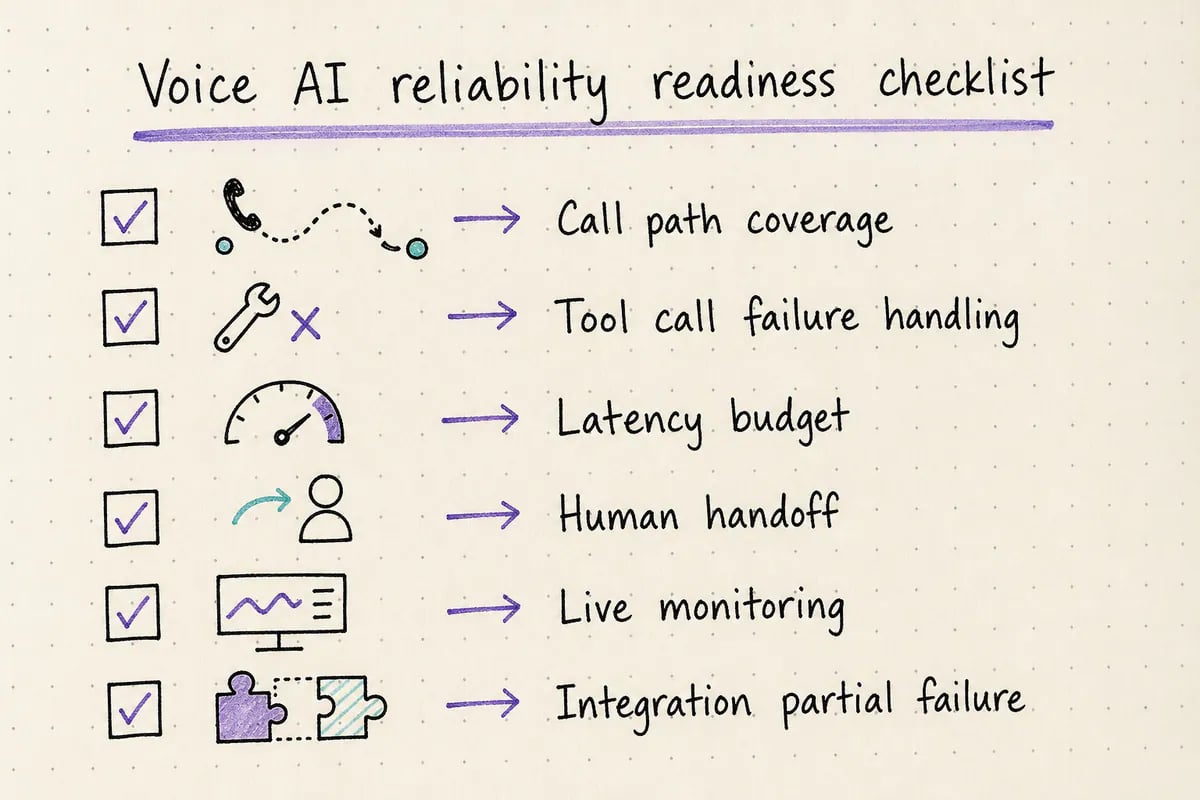
Use this checklist to evaluate a voice agent's reliability before and after launch.
Testing before go-live: simulated calls versus manual QA scripts
Most teams start reliability testing with a manual QA script: a handful of team members call the agent, try some obvious edge cases, and sign off. This catches gross failures but misses the long tail — interruptions at unusual points, background noise, ambiguous requests, or callers who go silent mid-sentence. Simulated-call testing, where a large set of call scenarios is run against the agent before it ever takes a real call, catches more of this long tail because it can cover far more permutations than a small human QA team has time for.Persistence provides simulated-call testing before deployment and operational monitoring after deployment as part of its feature set (Source), which reflects a two-stage view of reliability: catch what you can before launch, then instrument what you can’t predict once it’s live.This is a meaningfully different approach from evaluating a platform purely on demo quality, which is how many platform comparisons — including buyer’s-guide content from retellai.com and ringly.io (Source) — tend to be structured, since they’re written to compare features and pricing rather than pre-launch testing rigor. Ringly.io’s own framing draws a useful distinction between fully managed platforms and build-it-yourself pipelines like Vapi and Retell, which is relevant here: the amount of testing infrastructure you get by default varies a lot depending on which category a platform falls into, and that’s often a bigger reliability factor than the underlying model choice.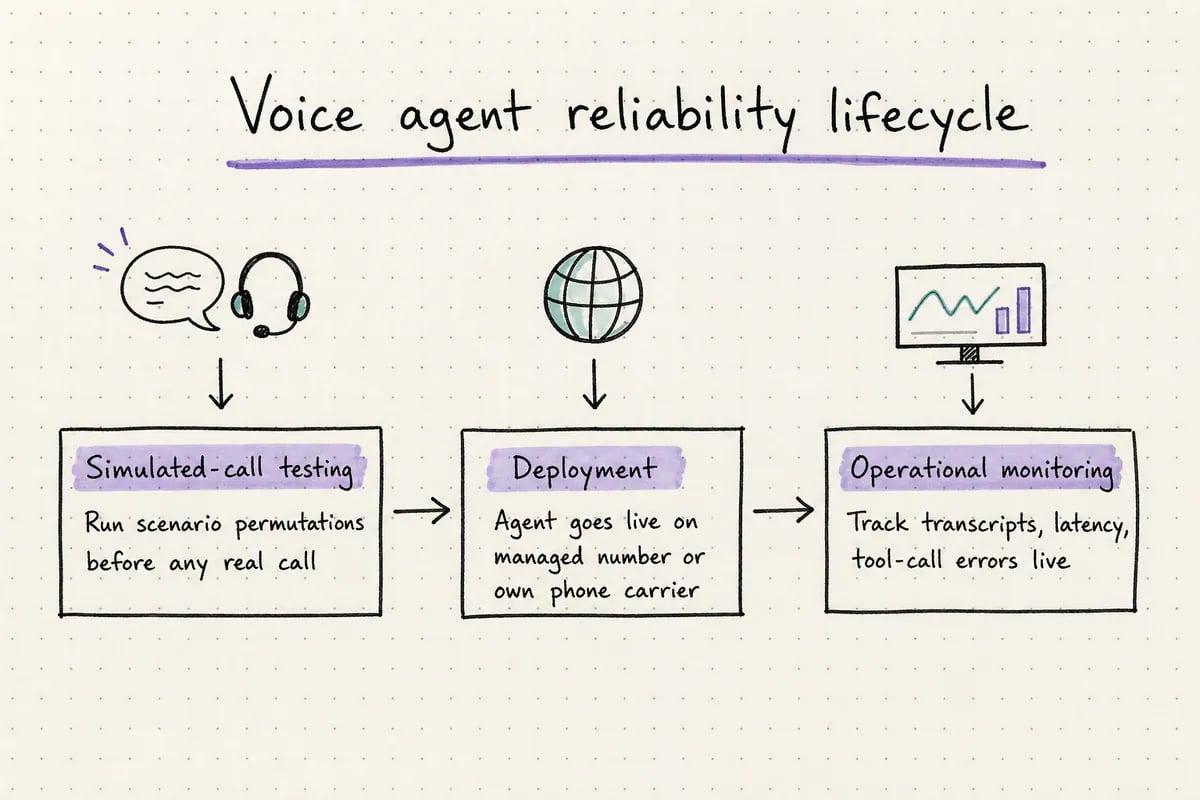
Reliability is a two-stage process: catch what you can before launch, then monitor and roll back what surfaces live.
Monitoring after launch: the part most comparisons skip
Pre-deployment testing reduces risk, but it doesn’t eliminate it — live traffic always surfaces scenarios that testing didn’t anticipate, from unusual accents to unexpected caller intents to third-party API outages that only happen during business hours. This is why operational monitoring after deployment is a separate, necessary capability, not a nice-to-have. Effective monitoring for a voice agent means visibility into call transcripts, error rates on tool calls, latency spikes, and handoff-to-human frequency, ideally with alerting when any of these drift from baseline.Most public platform comparisons, including the retellai.com roundup and the broader category framing from Gartner’s conversational AI platform reviews (Source), describe platforms primarily in terms of setup and features rather than ongoing operational visibility, which leaves a gap for teams trying to evaluate long-term reliability rather than launch-day demo quality. Persistence’s approach pairs the simulated-call testing described above with operational monitoring after deployment (Source), treating the two as connected stages of the same reliability process rather than separate concerns.For teams building or buying a voice agent, the practical takeaway is to ask any vendor two separate questions: what testing happens before a version goes live, and what visibility exists once it’s handling real calls. A platform that only answers the first question convincingly is only half addressing reliability.Related resources
Continue exploring with Explore Persistence solutions.Frequently asked questions
What does 'reliability' mean for a voice AI agent, specifically?
What does 'reliability' mean for a voice AI agent, specifically?
It means the agent behaves predictably when something in the pipeline degrades — a slow CRM lookup, an interrupted caller, an ambiguous request — rather than just performing well in a clean demo call.
Is simulated-call testing the same as manual QA?
Is simulated-call testing the same as manual QA?
No. Manual QA scripts cover the edge cases a small team thinks to test manually, while simulated-call testing runs many more scenario permutations automatically before an agent ever takes a real call.
Why does monitoring after deployment matter if testing was thorough?
Why does monitoring after deployment matter if testing was thorough?
Live traffic always surfaces scenarios testing didn’t anticipate, from unusual caller behavior to third-party API outages, so ongoing visibility into transcripts and error rates is necessary even after rigorous pre-launch testing.
Where do most voice agent failures actually happen?
Where do most voice agent failures actually happen?
Often at the integration boundary — CRM, calendar, or payment systems — rather than in the core speech recognition or language model, because integrations are frequently tested only for success, not partial failure.
Try Persistence
Build reliable voice AI with Persistence
Design, test, and deploy production-ready voice agents.