

Key takeaways
- The best voice agent choice depends on measurable production constraints, not feature lists: latency, testing coverage, monitoring, and integration depth matter more than demos.
- Vendors describe themselves differently: some (like Retell, Vapi) target developers building custom pipelines, others (like Ringly) offer fully managed vertical solutions.
- Pre-deployment simulated-call testing and post-deployment monitoring reduce the risk of agents failing on real calls that scripted demos never surface.
- Integration coverage with existing systems (CRM, scheduling, payments, telephony) determines how much custom engineering a team must do after picking a platform.
- A structured evaluation checklist across testing, telephony, and integrations produces a more defensible decision than reading vendor comparison blog posts alone.
What Actually Defines a Production-Ready Voice Agent
A voice agent is not defined by how natural it sounds in a demo call; it’s defined by how it behaves across thousands of real, messy calls with background noise, interruptions, accents, and edge-case requests. Retell AI’s own platform comparison describes voice AI platforms as systems that combine speech recognition, large language models, and text-to-speech to automate inbound and outbound calls without rigid IVR menus (retellai.com/blog/best-voice-ai-providers). That combination is necessary but not sufficient for production use. The real differentiator is what happens around the conversational core: how a team tests the agent before it ever answers a live call, how failures get caught and surfaced afterward, and how the agent connects into the systems that actually run the business — scheduling, CRM, payment processing, and ticketing. Teams that evaluate voice agents purely on voice quality or response latency often discover, weeks into production, that the harder problems are testing coverage and integration plumbing, not the speech pipeline itself. This is why the strongest evaluation approach treats a voice agent platform as an operational system, not a demo. Persistence’s approach reflects this: the platform is described as letting teams build agents using their own data, with visual or prompt-based building, knowledge sources, and actions (persistence.dev/feature/), plus simulated-call testing before deployment and monitoring after deployment (persistence.dev/feature/). That testing-and-monitoring loop is the part most comparison articles skip past. Learn more about building and deploying voice agents to phone numbers. Source: reference. Source: reference. Source: Free AI Voice Changer & Voice Agent Platform - Voice.ai.Build-It-Yourself vs Managed: Two Different Buying Decisions
The vendor landscape splits along a clear line. Ringly.io’s own comparison describes Vapi, Retell, and Synthflow as platforms for developers who build their own agents, contrasted with fully managed, vertical-specific offerings like Ringly itself for Shopify and DTC stores, billed by usage minutes (ringly.io/blog/best-ai-voice-agent-platform). This distinction matters more than any feature checklist because it determines who on your team owns the agent’s behavior long-term. A build-it-yourself platform assumes you have engineering capacity to design conversation flows, handle failure modes, and maintain integrations. A managed platform trades flexibility for less internal engineering burden but usually narrows the use case to a specific vertical or workflow. Synthflow positions itself in between, marketing itself as a full-stack platform for enterprise phone automation with contextual routing, appointment booking, voicemail detection, SMS follow-ups, deep CRM and ERP integrations, and sub-500ms latency (synthflow.ai). Whether that latency figure holds under your specific call volume and integration load is something only your own testing can confirm — vendor-published latency numbers describe ideal conditions, not your production traffic. Teams should treat these three categories — developer-built, managed vertical, and full-stack enterprise — as different shopping aisles, and pick based on internal engineering capacity rather than which vendor’s blog ranks highest.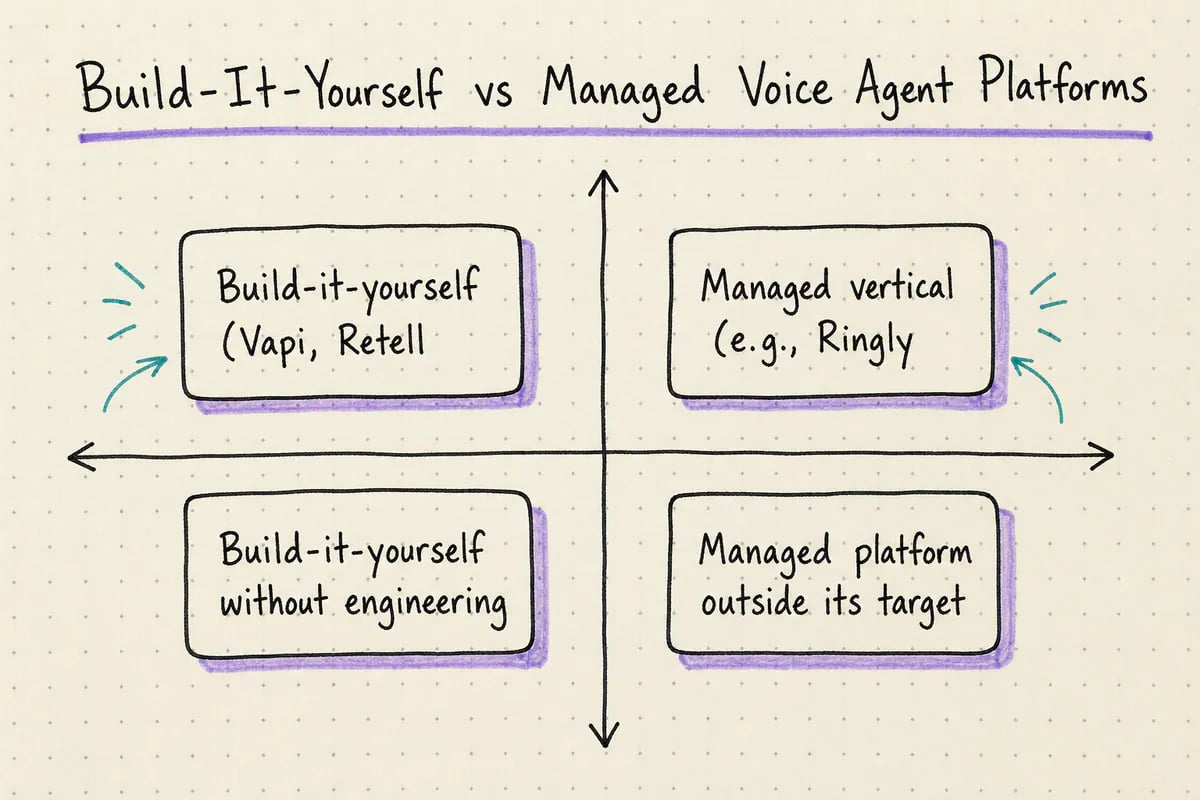
The core buying decision is whether your team owns agent engineering or hands it to a managed vendor.
Testing and Monitoring Are the Parts Comparison Posts Skip
Most public voice agent comparisons emphasize voice quality, latency, and pricing, because those are easy to describe in a blog post. What’s harder to describe — and more consequential — is what happens before an agent goes live and after it starts taking real calls. Gartner’s framing of conversational AI platforms as systems that must orchestrate voice, messaging, and web channels together (gartner.com/reviews/market/conversational-ai-platforms) points at the same underlying issue from an enterprise angle: these are operational systems that need to be observed and managed, not one-off scripts. A platform that lacks pre-deployment testing forces teams to discover conversation failures live, in front of real customers. A platform that lacks post-deployment monitoring means failures go unnoticed until a customer complains. Persistence’s feature set addresses both ends of this gap directly: simulated-call testing before deployment lets teams run an agent through scripted and edge-case scenarios before any customer hears it, and operational monitoring after deployment surfaces failed calls and behavior drift once the agent is live (persistence.dev/feature/). When evaluating any voice agent platform — including Persistence — teams should ask for a concrete walkthrough of the testing workflow and the monitoring dashboard, not just a description of the underlying model or voice quality.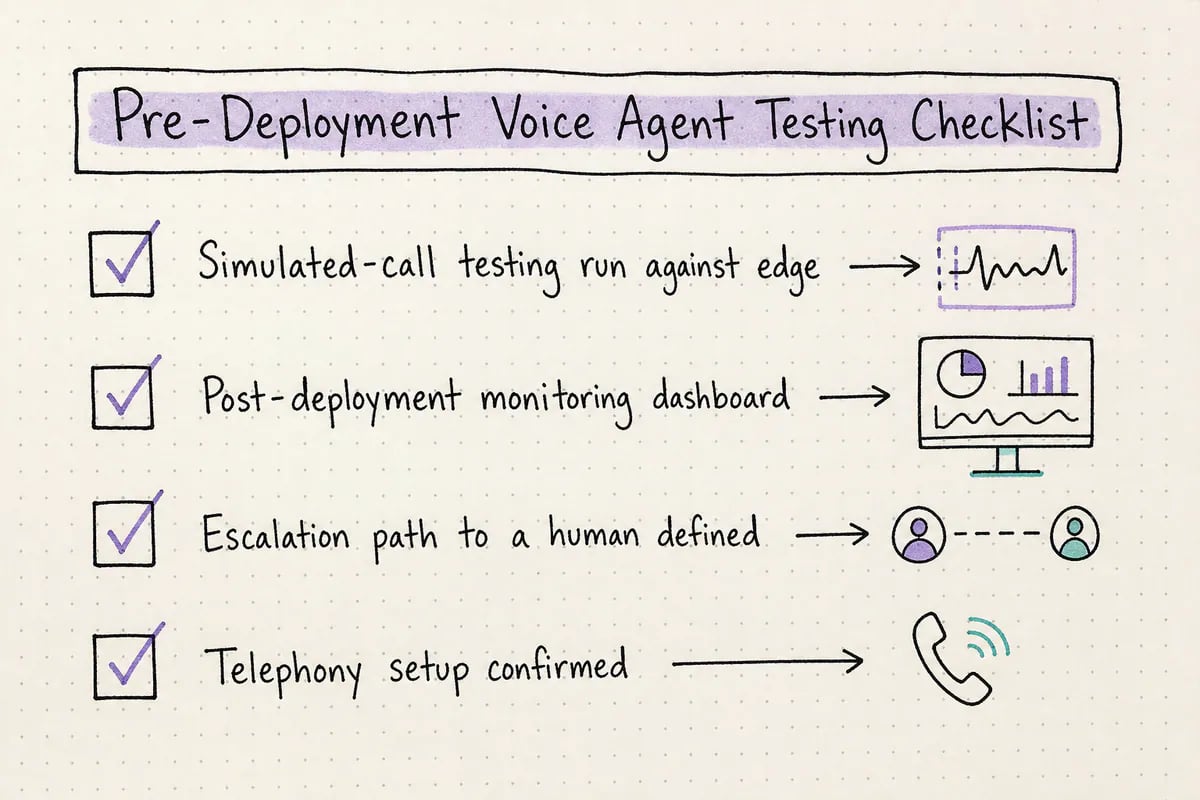
Use this checklist before any voice agent takes a live customer call.
Telephony and Integration Depth Decide Your Actual Implementation Timeline
Once conversation quality is acceptable, the remaining implementation timeline is almost entirely about telephony setup and integration depth. Does the platform provide managed phone numbers out of the box, or does it require you to bring your own SIP trunk and carrier relationship? Does it connect natively to the CRM, scheduling tool, and payment processor your business already runs on, or does every connection require custom middleware? Voice.ai markets integrations spanning Salesforce, HubSpot, Zendesk, and Slack as part of fitting into an existing stack (voice.ai), which reflects how central integration breadth has become to platform selection, not just for voice.ai but across the category. Persistence supports both managed phone numbers and customer-provided SIP trunking, and publicly lists integrations including Twilio, HubSpot, Zendesk, Calendly, Salesforce, Zapier, Intercom, Google Sheets, Stripe, and Shopify (persistence.dev/). For a team evaluating platforms, the practical exercise is to list every system the agent needs to touch — booking, payment, ticket creation, follow-up messaging — and check off which connections are native versus which require custom API work. That list, more than any vendor ranking, predicts how long the project will actually take to ship.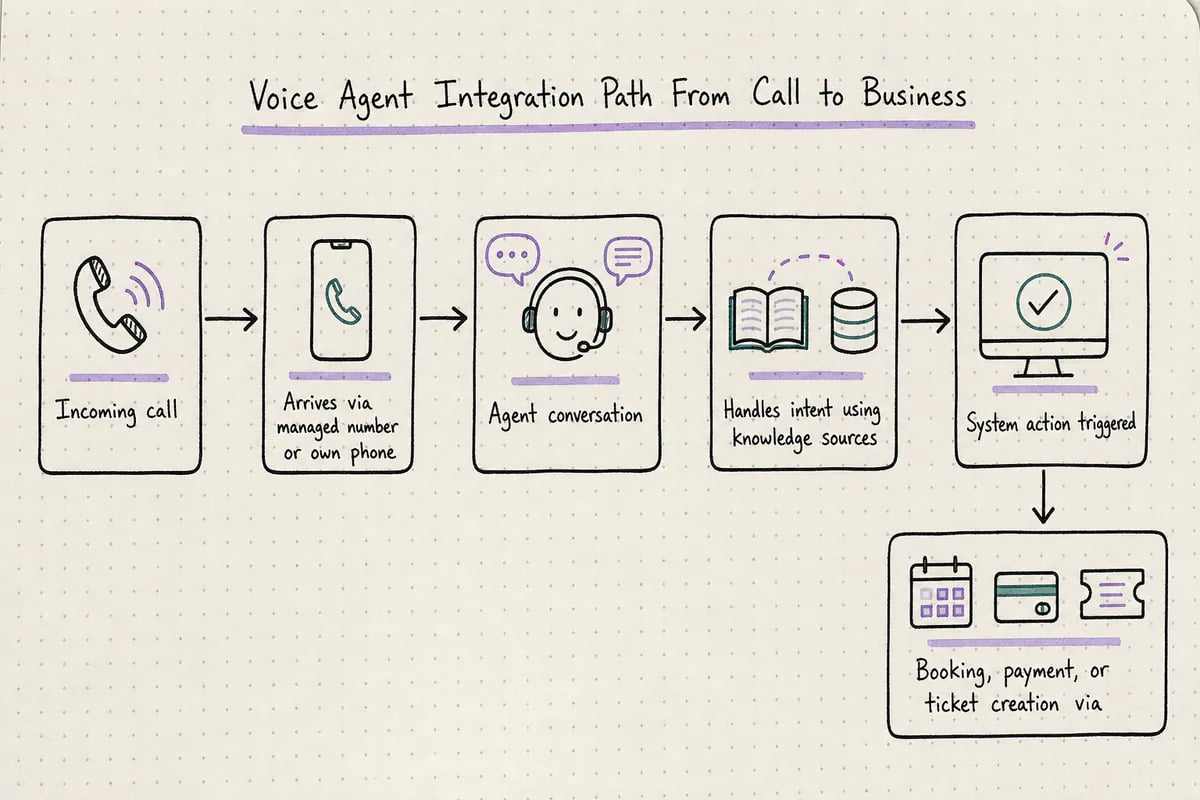
Integration depth, not voice quality, usually determines the real implementation timeline.
Related resources
Continue exploring with Explore Persistence solutions.Frequently asked questions
What is the best voice agent platform for a team without dedicated engineering resources?
What is the best voice agent platform for a team without dedicated engineering resources?
Managed, vertical-specific platforms generally require less internal engineering than build-it-yourself platforms, but they narrow flexibility to a specific workflow. Teams should weigh that tradeoff against how much custom behavior their use case actually requires.
Why does pre-deployment testing matter more than voice quality demos?
Why does pre-deployment testing matter more than voice quality demos?
A demo call is scripted and controlled. Real calls include interruptions, background noise, and unexpected requests. Simulated-call testing before deployment catches failure modes that a demo never surfaces, reducing the risk of an agent failing in front of real customers.
How much does integration depth affect implementation time?
How much does integration depth affect implementation time?
Significantly. If a platform natively connects to your CRM, scheduling tool, and payment processor, implementation is mostly configuration. If those connections require custom middleware, implementation time can multiply regardless of how good the conversational agent itself is.
Try Persistence
Build reliable voice AI with Persistence
Design, test, and deploy production-ready voice agents.