

Key takeaways
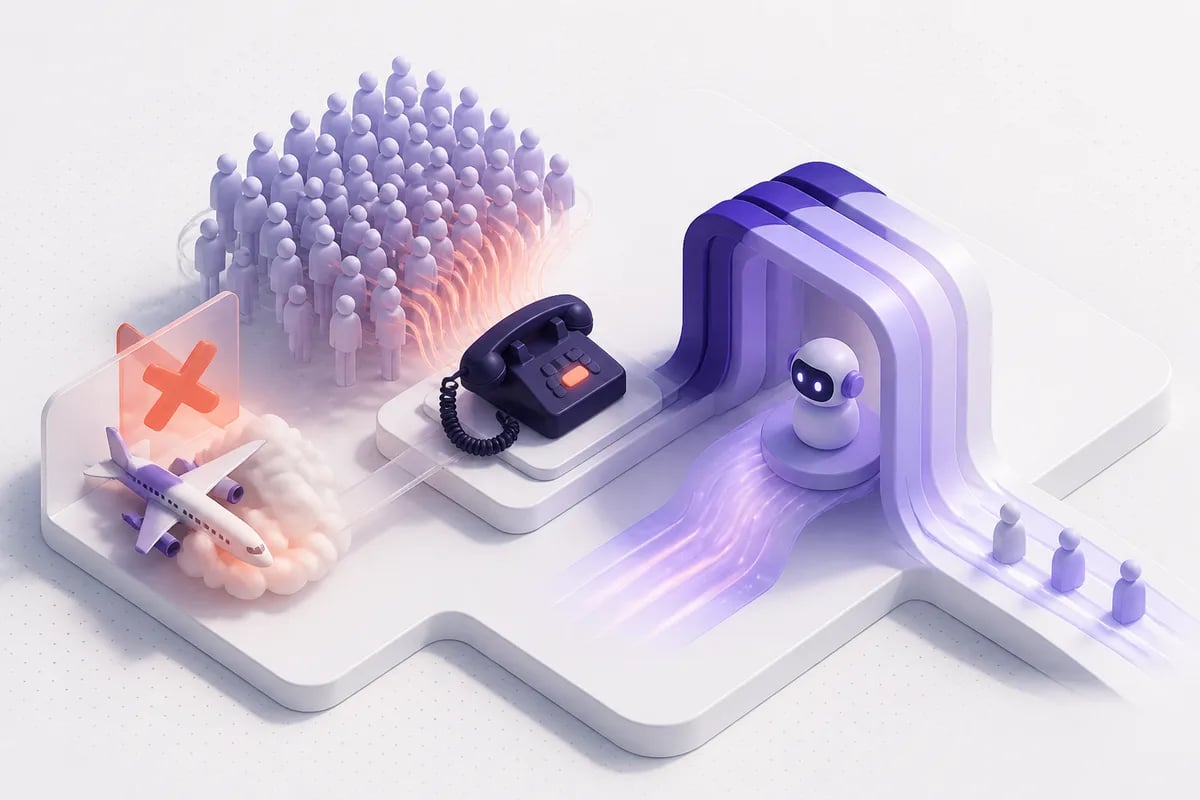
- A single weather event or system outage can cancel thousands of flights at once, and every affected traveler calls the same phone line looking for a new booking at the same time.
- The DOT fined Southwest Airlines a record USD 140 million civil penalty, the largest consumer protection penalty in the agency’s history, after its December 2022 meltdown left customer service lines overwhelmed for days.
- Southwest has disclosed that meltdown cost the airline over USD 1.1 billion in refunds, reimbursements, and lost sales, on top of the DOT penalty.
- Traditional call centers staff for average daily volume, not disruption-day volume, which is exactly why hold times collapse when travelers need help most.
- Voice AI agents scale to handle every simultaneous caller, so a canceled bank of flights does not turn into a multi-hour hold for the traveler stuck at the gate.
Try it on your own calls. Build a voice agent and test it before it takes real calls. Start with $10 in free credits. Start for free →
The problem: disruption turns call volume into a wall
Airline phone support is built around a math problem that only works when things go right. Staffing models size call centers for typical daily volume: a predictable mix of rebookings, seat changes, and baggage questions spread evenly across a shift. That model collapses the moment a winter storm grounds a hub, a system outage strands a fleet, or a mechanical issue cascades into a rolling wave of cancellations. Every traveler on every affected flight needs the same thing at the same time, a new itinerary, and they all reach for the same phone number within the same few hours. Airlines cannot hire and train enough agents to sit idle waiting for a storm that might not come, so when the storm does come, the queue simply cannot keep pace with the number of people calling in.
What this guide covers
The starkest example: Southwest’s December 2022 meltdown
The clearest documented case of this dynamic is Southwest Airlines’ operational collapse over the December 2022 holiday period. A severe winter storm combined with outdated crew-scheduling systems to cancel roughly 16,900 flights and strand more than 2 million passengers over about ten days. Southwest’s phone lines could not absorb the resulting call volume: many stranded travelers reported busy signals or hold times stretching for hours as they tried to get rebooked. The U.S. Department of Transportation later investigated and found that Southwest “failed to provide adequate customer service assistance” during the event, a finding that became the basis for regulatory action (U.S. Department of Transportation, Dec. 18, 2023).The stakes: a record fine and a nine-figure cost
The consequences were not abstract. The DOT imposed a USD 140 million civil penalty on Southwest, the largest consumer protection penalty in the department’s history and roughly 30 times the previous record, specifically citing the airline’s failure to provide adequate customer service during the meltdown (U.S. Department of Transportation, Dec. 18, 2023). Separately, Southwest has disclosed that the meltdown cost the airline more than USD 1.1 billion in refunds, reimbursements, and lost sales (Newsweek). Those two figures, a record regulatory fine and a nine-figure operating loss, are the clearest public evidence that inadequate phone support during a disruption event is not just a customer experience problem. It is a financial and regulatory one. We should note honestly that there is no reliable public figure for exactly how long average hold times ran during the event or what each of those calls cost Southwest to handle; that specific data was never disclosed, and we won’t invent a number to fill the gap.Why voice AI is built for exactly this kind of surge
A human call center has a hard ceiling: the number of agents on shift. A voice AI system does not. Persistence answers every call the moment it arrives, whether that is ten calls an hour or ten thousand, because each conversation runs on its own instance rather than waiting in line for a free human agent. That distinction matters most on exactly the days when it matters least for a normal call center: the day a hub shuts down and every affected traveler dials in within the same window. There is no queue to overflow, no busy signal, and no multi-hour hold, because capacity scales with demand instead of being fixed weeks in advance by a staffing schedule.What Persistence does for airline disruption support
For travel operators, we built Persistence to handle the specific work a disrupted traveler needs done over the phone: confirming a canceled or delayed flight, checking rebooking options against real-time inventory, completing the rebooking on the call itself, and proactively calling affected passengers to notify them of a schedule change before they even have to call in. That last piece flips the model: instead of every stranded traveler independently flooding the same inbound line, the airline can push outbound notification calls at the moment a disruption is confirmed, resolving simple rebookings immediately and routing only the genuinely complex cases, like multi-city itineraries or accessibility needs, to a human agent. This flagship rebooking scenario is the one we walk through in detail on our travel solutions page.The takeaway
Southwest’s 2022 meltdown is a documented, regulator-confirmed case of what happens when disruption-day call volume outruns a fixed-capacity phone system: a record fine, over a billion dollars in costs, and two million stranded passengers who could not get through. That outcome was not inevitable. It was a capacity problem, and capacity problems are exactly what elastic voice AI is designed to solve. Airlines and travel operators that want to see how disruption-driven rebooking calls work end to end can look at our travel solutions page, where this is the flagship use case.For related guidance, continue with AI Cold Calling: How It Actually Works and Voice AI for Call Centers: A Practical Guide.Related resources
Continue exploring with DOT: $140 million penalty against Southwest Airlines](https://www.transportation.gov/briefing-room/dot-penalizes-southwest-airlines-140-million-2022-holiday-meltdown)**, **[Newsweek: Southwest's $1.1 billion meltdown cost, Persistence for Travel, and Explore Persistence documentation.Frequently asked questions
What should teams know about the problem: disruption turns call volume into a wall?
What should teams know about the problem: disruption turns call volume into a wall?
Airline phone support is built around a math problem that only works when things go right. Staffing models size call centers for typical daily volume: a predictable mix of rebookings, seat changes, and baggage questions spread evenly across a shift.
What should teams know about the starkest example: southwest's december 2022 meltdown?
What should teams know about the starkest example: southwest's december 2022 meltdown?
The clearest documented case of this dynamic is Southwest Airlines’ operational collapse over the December 2022 holiday period. A severe winter storm combined with outdated crew-scheduling systems to cancel roughly 16,900 flights and strand more than 2 million passengers over about ten days.
What should teams know about the stakes: a record fine and a nine-figure cost?
What should teams know about the stakes: a record fine and a nine-figure cost?
The consequences were not abstract. The DOT imposed a USD 140 million civil penalty on Southwest, the largest consumer protection penalty in the department’s history and roughly 30 times the previous record, specifically citing the airline’s failure to provide adequate customer service during the meltdown (U.S.
Why voice AI is built for exactly this kind of surge?
Why voice AI is built for exactly this kind of surge?
A human call center has a hard ceiling: the number of agents on shift. A voice AI system does not.
See how this works in Persistence: Persistence for travel, test it before launch and see pricing.
Start for free
Build reliable voice AI with Persistence
Design, test, and deploy production-ready voice agents.