


Key takeaways
- Robotic process automation in financial services works best on structured, rules-based tasks with clear inputs and outputs, not judgment-heavy exceptions.
- Governance frameworks like NIST’s AI RMF and OECD’s AI Principles give operators a shared vocabulary for evaluating automation risk before deployment.
- Buying decisions should separate task automation (RPA) from conversational automation (voice AI), since they solve different workflow bottlenecks.
- Any AI-related capability claims made to customers or regulators should be substantiated, per FTC guidance on AI claims.
- Persistence’s testing and monitoring features illustrate one operational pattern for validating automated interactions before and after go-live.
Where RPA Fits in Financial Services Workflows
Robotic process automation in financial services has traditionally targeted high-volume, structured back-office tasks: reconciling transactions, extracting data from forms, moving records between legacy systems, and running compliance checks that follow fixed rules. These are workflows where inputs are predictable, exceptions are rare, and success can be verified against a known correct output. That structure is exactly what makes RPA a good fit — bots follow scripted steps across screens or APIs without needing to interpret ambiguous intent.The constraint operators run into is that RPA breaks down when workflows involve judgment, unstructured input, or live customer conversation. A bot that reads a fixed-format statement and updates a ledger is a different problem than a bot that has to understand a customer explaining an unusual dispute over the phone. Financial services workflows increasingly include both types, and treating them as the same automation problem leads to brittle deployments. Before scoping any RPA initiative, operators should map the actual workflow steps and separate the rules-based segments from the ones that require dialogue, negotiation, or exception handling. That mapping exercise is also the foundation for the decision framework included in this article, since it forces an explicit choice about which automation approach — task-level RPA or conversational automation — matches each segment of the process. Learn more about Persistence platform overview. Source: reference. Source: reference. Source: reference.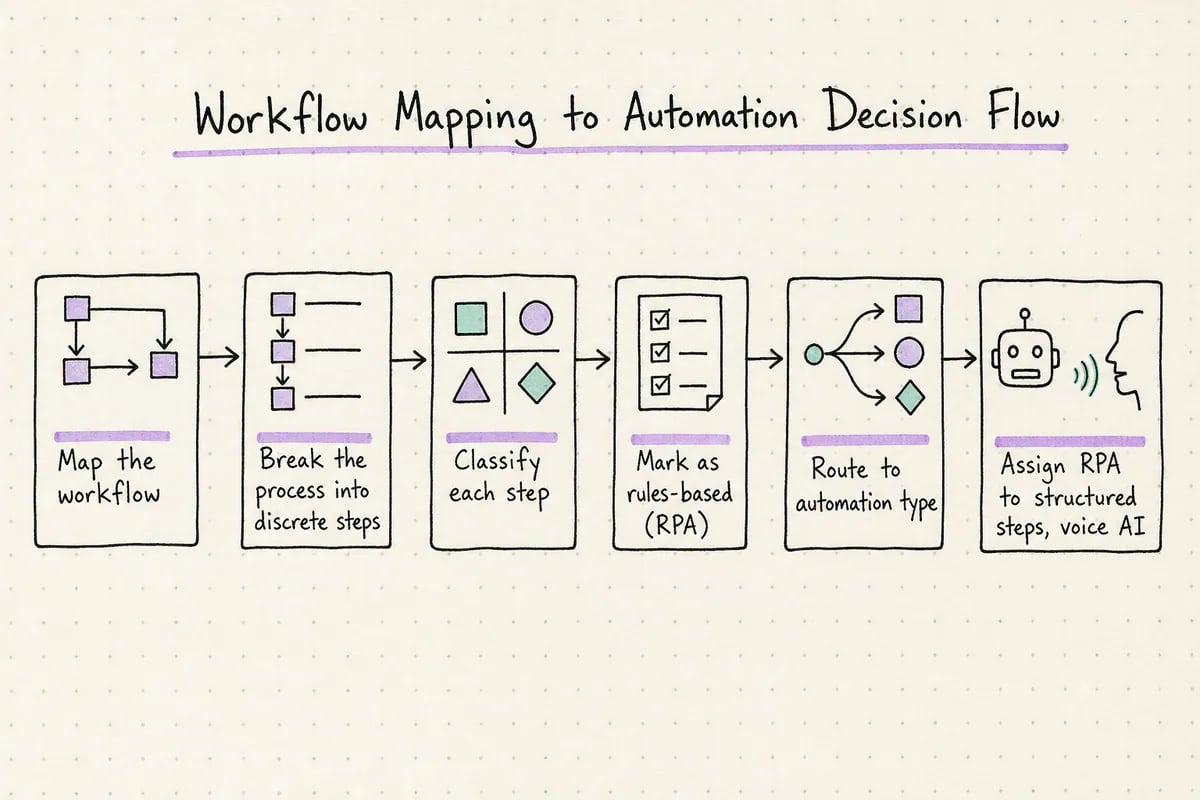
A step-by-step flow for deciding and validating which automation approach fits a given financial services workflow.
Applying Governance Frameworks Before Deployment
Financial services operators evaluating automation, RPA or otherwise, benefit from anchoring their risk review in an established framework rather than building one from scratch. The NIST AI Risk Management Framework organizes this work into four functions — govern, map, measure, and manage — which translate directly into automation buying criteria: govern asks who owns the automation and its failures; map asks what workflows and data it touches; measure asks how you will know it’s working correctly; and manage asks what happens when it doesn’t (nist.gov).At an international level, the OECD AI Principles emphasize that AI systems should be transparent, accountable, and subject to appropriate human oversight throughout their lifecycle (oecd.ai). For financial services specifically, this means any automation — including RPA bots that touch customer records or conversational agents that speak with customers — should have a documented owner, a clear boundary on what decisions it’s allowed to make autonomously, and a defined escalation path to a human. Operators evaluating vendors should ask directly how the vendor’s tooling supports these functions: what test coverage exists before deployment, what monitoring exists after deployment, and how exceptions are routed. These questions matter more than feature lists, because governance gaps are what turn automation projects into incidents.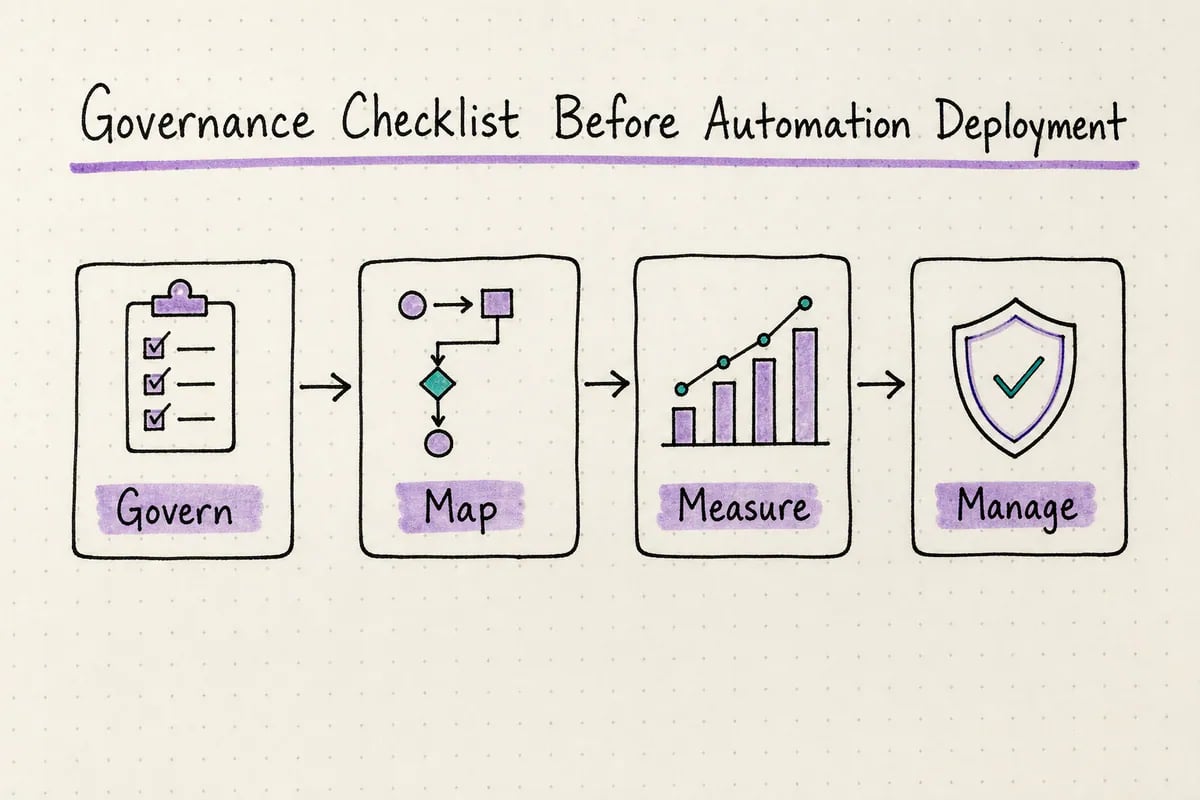
A pre-deployment governance checklist grounded in the NIST AI Risk Management Framework functions.
Buying Criteria: Task Automation vs. Conversational Automation
A common mistake in financial services automation initiatives is evaluating RPA and voice AI against the same criteria, when they solve different bottlenecks. Classic RPA automates internal, structured tasks — data entry, reconciliation, report generation — where the ‘customer’ is really another internal system or screen. Conversational automation, including voice AI, targets the live customer interaction layer: answering account questions, scheduling callbacks, or triaging a servicing request before it reaches a human agent.Persistence is an example from the conversational side of this landscape. It lets teams build AI voice agents using their own data and deploy them to phone numbers, using either visual or prompt-based agent building along with defined knowledge sources and actions (persistence.dev, persistence.dev/feature/). For financial services workflows specifically, the ability to connect an agent to existing systems matters: Persistence publicly lists integrations including Twilio, Salesforce, HubSpot, Zendesk, and Stripe, among others, which is relevant when a servicing call needs to check an account status or trigger a follow-up task in a CRM (persistence.dev). None of this replaces RPA for back-office reconciliation — it addresses a different workflow segment. Buying criteria should reflect that split: evaluate RPA vendors on transaction accuracy and system integration depth, and evaluate conversational automation vendors on dialogue handling, testing rigor, and escalation design.Testing and Monitoring as a Buying Criterion
Whichever automation approach an operator chooses, the ability to test before deployment and monitor after deployment should be treated as a non-negotiable buying criterion, not an afterthought. Financial services workflows carry regulatory and customer-trust consequences when automation fails silently, so pre-deployment validation and post-deployment visibility need to be built into the vendor evaluation itself.Persistence’s feature set illustrates one way this looks in practice for conversational automation: simulated-call testing before deployment, paired with operational monitoring after deployment (persistence.dev/feature/). The equivalent for RPA vendors is regression testing against scripted transaction scenarios and audit logging of every automated action taken against a system of record. In both cases, the operator’s job during procurement is to ask the vendor to demonstrate this testing and monitoring concretely — not describe it abstractly. Any claims a vendor or an operator later makes to customers or regulators about what the automation can reliably do should be substantiated, consistent with FTC guidance on keeping AI claims accurate and evidence-based (ftc.gov). Building testing and monitoring into the buying criteria up front makes those claims easier to support later, and reduces the chance that an automation rollout creates a compliance or trust problem the workflow mapping should have caught earlier.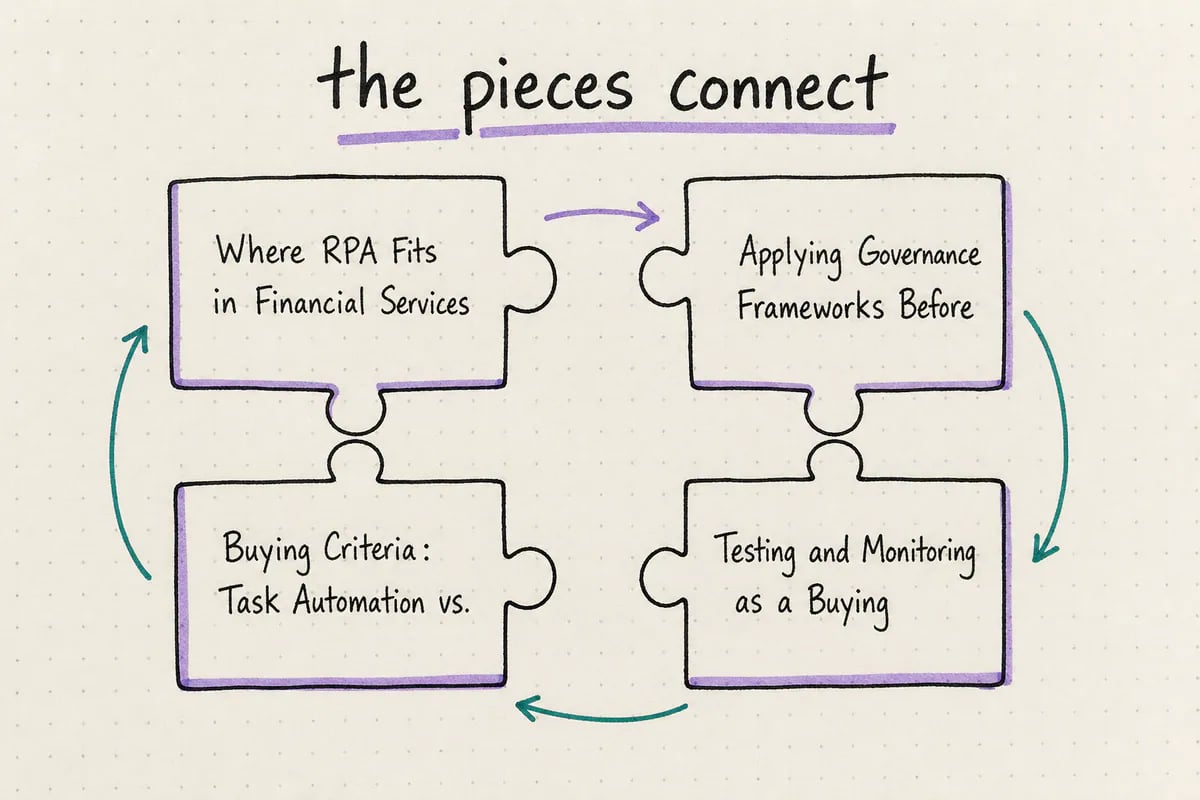
The core ideas and how they connect.
Related resources
Continue exploring with Explore Persistence solutions.Frequently asked questions
Is robotic process automation in financial services the same as voice AI?
Is robotic process automation in financial services the same as voice AI?
No. RPA automates structured, rules-based internal tasks like data entry and reconciliation, while voice AI handles live conversational interactions with customers. They address different segments of a workflow and are often used together.
What governance framework should operators use to evaluate automation risk?
What governance framework should operators use to evaluate automation risk?
The NIST AI Risk Management Framework provides a structured approach organized around govern, map, measure, and manage functions, which map well onto automation buying criteria for financial services.
How does Persistence relate to RPA in financial services?
How does Persistence relate to RPA in financial services?
Persistence is a voice AI platform for building and deploying conversational agents to phone numbers, including simulated-call testing and monitoring. It addresses the conversational layer of customer interactions rather than the back-office task automation that classic RPA targets.
What should operators do before making customer-facing claims about AI automation?
What should operators do before making customer-facing claims about AI automation?
Any capability claims made to customers or regulators should be substantiated with evidence, consistent with FTC guidance on keeping AI claims accurate and supportable.
Try Persistence
Build reliable voice AI with Persistence
Design, test, and deploy production-ready voice agents.