

Key takeaways
- A lead record is only useful if every connected system agrees on which one is the source of truth
- Failure handling—not the happy path—determines whether integrations are trustworthy in production
- Voice-originated leads add timing and consent complexity that batch integrations weren’t built for
- A simple ownership and retry framework prevents duplicate or orphaned lead records
- Persistence connects lead-generating voice agents to CRMs like HubSpot and Salesforce, but the system-of-record decision still belongs to RevOps
What actually happens when a ‘lead’ moves between systems
The word ‘lead’ sounds simple, but it means different things depending on which system is holding it. Merriam-Webster’s basic definition of the term as something that ‘goes before or with, and shows the way’ captures the everyday sense of the word (Source), but in a revenue operations context, a lead is a data record with a lifecycle: created, enriched, scored, routed, and eventually converted or discarded. Every hop between systems is a translation problem. A phone call captured by a voice agent isn’t the same shape as a form fill captured by a marketing site, and neither is the same shape as a record synced from a spreadsheet. When these different shapes get pushed into a shared CRM without a clear mapping, RevOps teams end up with duplicate contacts, mismatched fields, and no consistent way to tell which record is authoritative. This is exactly why ‘system-of-record’ has to be a deliberate decision, not a default. If two systems can both write to the same lead field, whichever system writes last silently overwrites the other, and nobody finds out until a rep calls a lead using outdated information. Voice-originated leads make this worse because they carry timing-sensitive data—consent status, call outcome, next-step commitments—that batch-oriented integrations were never designed to carry gracefully. Persistence’s publicly listed integrations include HubSpot, Salesforce, Zapier, and Twilio, among others (Source), which means the same lead-shape problem shows up the moment a voice conversation needs to become a CRM record. Source: Lead | Definition, Uses, Properties, & Facts | Britannica. Source: LEAD (Pb) 101: EVERYTHING YOU NEED TO KNOW ABOUT LEAD.
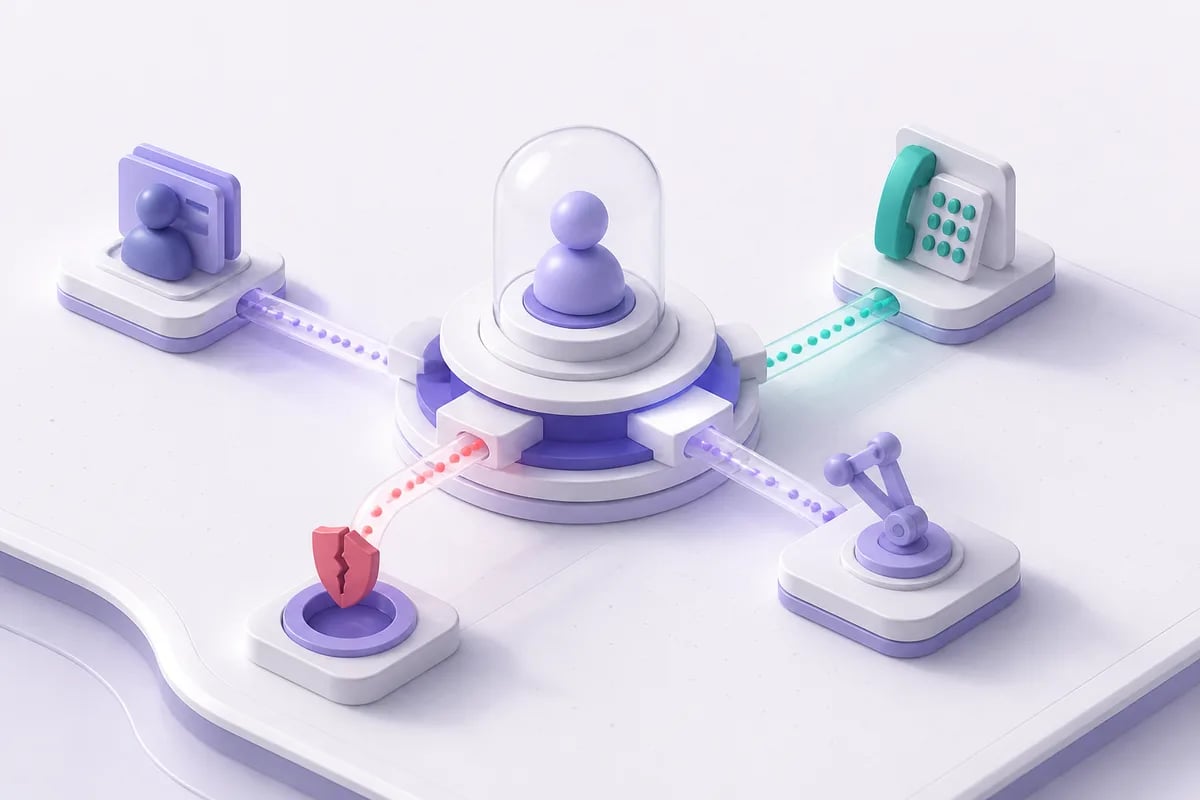
Each hop is a translation point where failure handling determines whether the lead record survives intact.
Failure handling is the real integration story
Most integration documentation describes the happy path: data leaves system A, arrives in system B, everyone moves on. Production reality is different. Networks time out. APIs rate-limit. Field validation rejects records that don’t match a required schema. The question that actually matters for RevOps is not ‘does the integration work,’ but ‘what happens when it doesn’t.’ Three failure categories deserve explicit handling. First, transient failures—a temporary API outage or rate limit—should trigger automated retries with backoff, not silent drops. Second, schema failures—a lead record missing a required field—should be quarantined and flagged for review rather than rejected outright, since a partially complete lead is still more valuable than a lost one. Third, duplicate detection failures—the same lead arriving twice because a retry fired after a delayed success response—need deduplication logic keyed on a stable identifier like phone number or email, not on record creation timestamp. Teams that don’t design for these three cases usually discover the gaps only after a lead disappears and a rep asks why. Persistence’s approach of simulated-call testing before deployment and operational monitoring after deployment (Source) is relevant here because it means failure conditions in the voice-to-CRM path can be tested before they cause a lost record in production, rather than discovered after a customer complains that no one followed up.System-of-record rules for lead data
When multiple tools touch the same lead—an ad platform, a voice agent, a CRM, a marketing automation tool—someone has to decide which system’s version of the data wins when there’s a conflict. This decision should be explicit and documented, not implicit in whichever integration happened to be built first. A workable rule set looks like this: the CRM is always the system of record for contact status and ownership; the originating channel (voice agent, form, chat) is the system of record for first-touch metadata like initial intent and consent; and no downstream automation tool is allowed to overwrite CRM-owned fields without an explicit sync rule. This mirrors a pattern seen outside sales operations too: the same underlying entity can require entirely different handling depending on which authority is evaluating it. The EPA’s lead safety guidance and OSHA’s occupational exposure rules both govern the same chemical element but apply completely different rule sets depending on context—home exposure versus workplace exposure (Source Source). The operational lesson translates directly: the same underlying record needs different governance depending on which system is consuming it, and pretending one universal rule applies everywhere is how conflicts get introduced. Persistence supports actions and knowledge-source connections inside its agent builder (Source), which means voice-originated lead data can be routed according to these rules rather than dumped into a CRM with no ownership logic attached.Building a lead integration audit into regular operations
Integration reliability degrades quietly. A field mapping that worked at launch can break silently after a CRM schema update, and nobody notices until pipeline reports look wrong. RevOps teams should treat lead integrations as something to audit on a schedule, not something to configure once and forget. A practical audit checks four things: whether every connected system agrees on the current source-of-record rules, whether failure logs from the last quarter show any unexplained gaps in lead volume, whether field mappings still match after any recent schema changes on either side, and whether retry logic actually fires when tested deliberately rather than assumed to work. Voice-originated leads add one more audit item specific to that channel: whether call outcome data (booked, no-show, disqualified) is reliably reaching the CRM at all, since a voice agent that books a meeting but fails to sync that outcome effectively creates invisible pipeline. Persistence lets teams build AI voice agents using their own data and deploy them to phone numbers or existing SIP trunks (Source), and the value of that setup depends entirely on whether the resulting lead and call data actually lands correctly in the CRM systems RevOps already trusts. An integration that works during a demo but silently drops five percent of records in production isn’t a working integration—it’s an unmeasured liability, and the scorecard above gives teams a structured way to find that liability before a customer does.Related resources
Continue exploring with Explore Persistence solutions.Frequently asked questions
What is a system of record for lead data?
What is a system of record for lead data?
It’s the single system designated as authoritative for a given field or record type, so that when multiple tools touch the same lead, there’s an explicit rule for which version wins in a conflict rather than a silent overwrite.
How should voice-originated leads be handled differently from form-based leads?
How should voice-originated leads be handled differently from form-based leads?
Voice-originated leads carry timing-sensitive metadata like consent status and call outcome that needs to sync promptly; integrations built only for batch form data often lack the retry and validation logic voice data requires.
What's the most common cause of lost lead records in integrations?
What's the most common cause of lost lead records in integrations?
Silent failure handling—transient errors or schema mismatches that drop a record without logging or alerting, so the loss isn’t discovered until someone notices missing pipeline.
Try Persistence
Build reliable voice AI with Persistence
Design, test, and deploy production-ready voice agents.