


Key takeaways
- Intelligent automation combines RPA with AI, ML, NLP, and decision engines to handle exceptions rule-based systems can’t process
- Buying decisions should start from workflow constraints and risk exposure, not vendor feature lists
- Voice-driven customer workflows like servicing calls and appointment scheduling are a practical, lower-risk entry point
- Testing and monitoring before and after deployment matter more than model sophistication for regulated workflows
- A decision framework scoring workflow variability, data sensitivity, and human-in-the-loop needs helps prioritize where to automate first
What makes automation ‘intelligent’ in banking
Traditional robotic process automation executes rule-based, repetitive tasks: moving data between systems, populating forms, triggering standard notifications. It works well until a workflow hits variation, missing information, or a judgment call, at which point rigid RPA scripts fail or require manual rework. Intelligent automation is the combination of RPA with artificial intelligence, machine learning, natural language processing, and decision engines, allowing systems to handle the exceptions and unstructured inputs that stop pure RPA in its tracks, according to nCino’s guide to AI-powered process automation. This distinction matters for buyers because many vendors market ‘automation’ broadly without specifying which layer they’re actually selling. A document-scanning tool that extracts fields is not the same as a system that can interpret an ambiguous customer request, decide a next action, and route around missing data. Banks evaluating vendors should ask specifically which of the four components, rules automation, machine learning, natural language processing, or decision logic, a given product actually implements, and where the boundaries of its judgment lie. Kognitos frames the most advanced tier as agentic automation, where AI-powered agents independently plan and execute multi-step actions rather than following a fixed script. That’s a meaningfully higher-risk category for regulated financial workflows, and it should be evaluated with commensurately more scrutiny around monitoring, escalation, and audit trails rather than adopted uniformly across every process. Learn more about Persistence’s voice AI platform. Source: reference. Source: Banking Automation | Intelligent Automation in Banking & Financial Services. Source: reference.Where workflow constraints should drive the buying decision
Financial services workflows differ enormously in variability, sensitivity, and tolerance for automated judgment, and treating them as one undifferentiated automation opportunity is a common buying mistake. Loan processing, for example, is often cited as a strong intelligent automation candidate because it involves assessing creditworthiness, verifying documents, and approving straightforward applications in real time, per Automation Anywhere’s overview of banking automation. But loan approval also carries direct regulatory and fair-lending exposure, meaning any automated decision layer needs clear boundaries on what it can approve outright versus what it must escalate. Contrast that with account servicing tasks like balance inquiries, appointment scheduling, or payment status checks: high volume, low regulatory sensitivity, and a natural fit for automation including voice-driven interactions. The buying criteria should start from mapping which workflows are customer-facing versus back-office, which touch sensitive financial decisions versus routine servicing, and which already have a human review step that automation could support rather than replace. Backbase’s analysis of banking automation failures points to a related and often overlooked constraint: automation initiatives frequently fail not because the AI component is weak, but because banks bolt automation onto fragmented, disconnected systems without a unified execution layer connecting the pieces. Buyers should evaluate integration depth as seriously as model capability.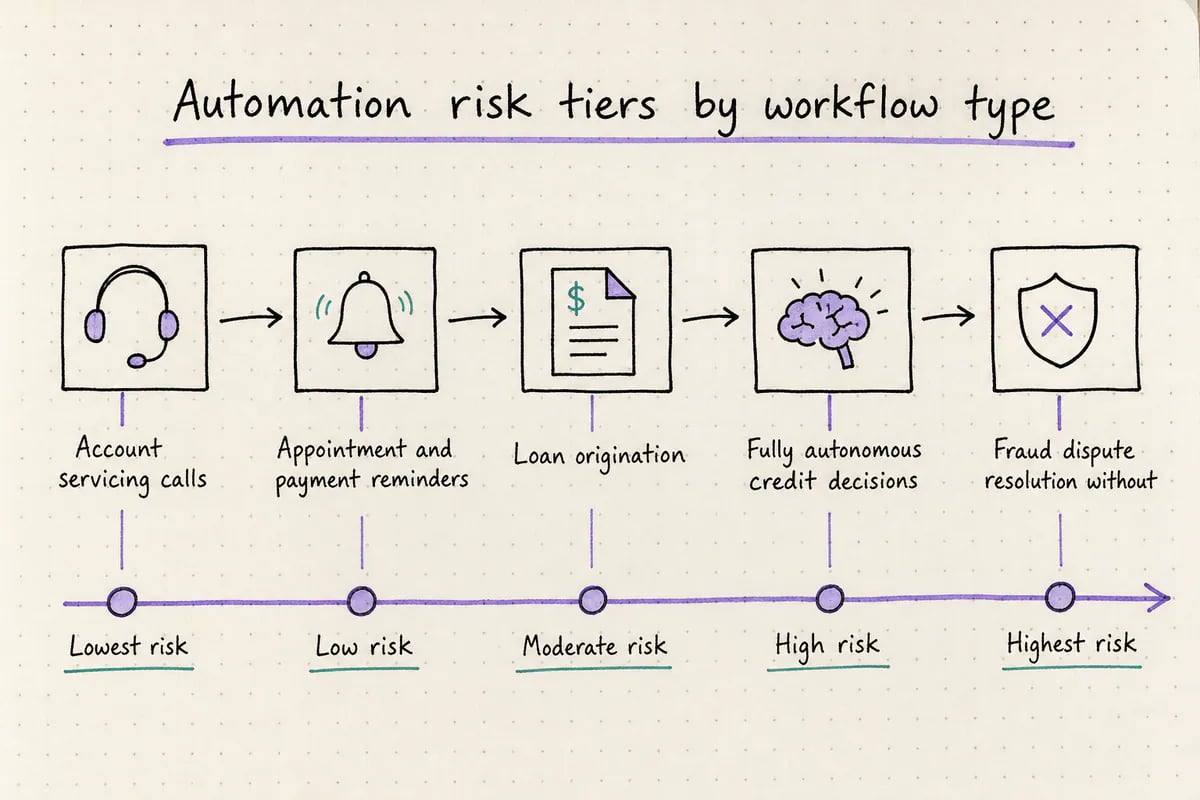
Loan origination and fraud disputes carry higher sensitivity than servicing calls and appointment scheduling, which changes where automation should st
Testing, monitoring, and where voice AI fits the workflow
Customer-facing servicing calls, appointment confirmations, and payment reminders are a practical, lower-risk entry point for intelligent automation in financial services, precisely because they sit in the low-sensitivity, high-frequency quadrant of the workflow map. This is the layer where voice AI platforms operate. Persistence, for instance, lets teams build AI voice agents using their own institutional data and deploy those agents to phone numbers, supporting either visual or prompt-based agent building along with defined knowledge sources and actions, according to Persistence’s feature documentation. For a bank evaluating this kind of tool, the operational questions that matter most are not about model sophistication but about deployment discipline: can the agent be tested against realistic call scenarios before it goes live, and can its behavior be monitored once it’s handling real customer conversations. Persistence provides simulated-call testing before deployment and operational monitoring after deployment, which addresses a core buying criterion for regulated industries, the ability to catch failure modes before customers experience them and to maintain visibility once the system is live rather than treating deployment as a one-time event. Persistence also supports managed phone numbers and customer SIP trunking, plus integrations including Twilio, HubSpot, Zendesk, Calendly, Salesforce, Zapier, Intercom, Google Sheets, Stripe, and Shopify, per Persistence’s public product page, which matters for banks whose servicing workflows already depend on CRM and scheduling systems that any new automation layer needs to plug into rather than replace.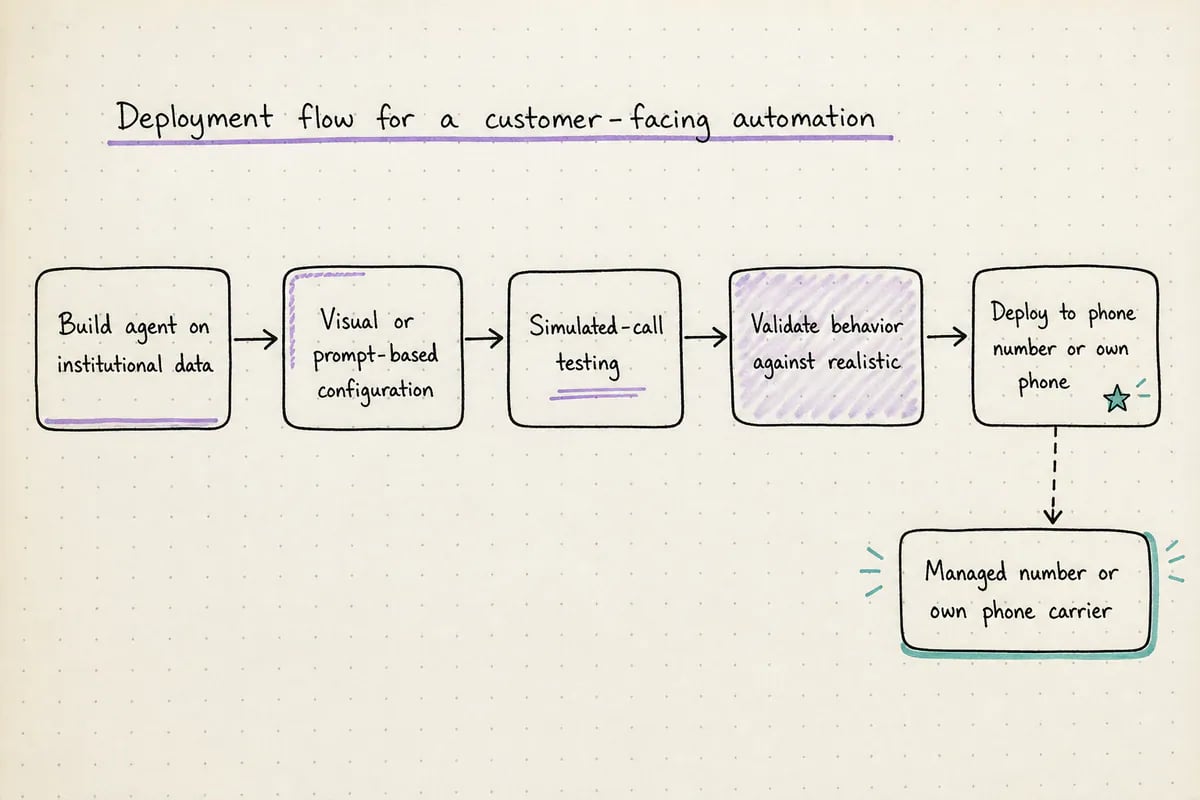
Testing before deployment and monitoring after deployment are the two stages regulated buyers should scrutinize most closely.
Applying the scorecard to prioritize automation candidates
The workflow fit scorecard above gives operators a repeatable way to sequence automation investment instead of automating whatever a vendor pitches first. Start by listing every candidate workflow, from loan origination to fraud alerts to appointment reminders, and score each on rule variability, data sensitivity, human-in-the-loop necessity, and customer-facing frequency. Workflows that score high on variability and frequency but low on sensitivity, appointment scheduling, payment status inquiries, general account servicing, are the strongest early candidates, including for voice agents that need to handle varied phrasing and intent without touching regulated decisions. Workflows scoring high on sensitivity and human-in-the-loop necessity, credit underwriting, dispute resolution, AML flags, should remain decision-support tools with mandatory escalation, not autonomous agents. This sequencing also reduces vendor evaluation risk: it’s easier to validate a vendor’s testing and monitoring claims on a bounded, low-sensitivity workflow before extending automation into higher-stakes processes. Blue Prism’s guide to banking AI automation frames the opportunity in similar terms, positioning automation as a path to faster processing and improved efficiency, but the sequencing discipline of starting low-risk and expanding only after monitoring data validates performance is what separates durable automation programs from stalled pilots.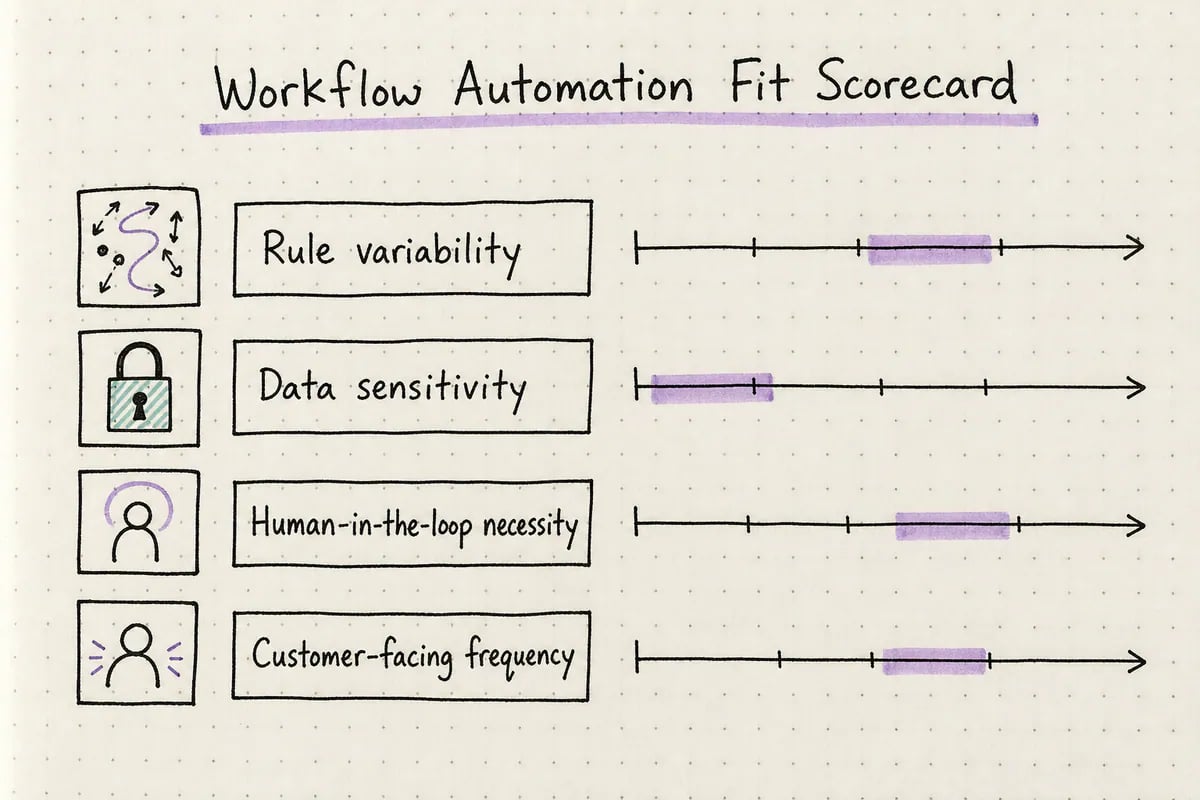
Score each candidate workflow across four axes before deciding whether it's ready for automation, including voice agents.
Related resources
Continue exploring with Explore Persistence solutions.Frequently asked questions
What is the difference between RPA and intelligent automation in banking?
What is the difference between RPA and intelligent automation in banking?
RPA executes fixed, rule-based tasks and breaks on exceptions or unstructured input. Intelligent automation combines RPA with AI, machine learning, natural language processing, and decision engines so systems can handle variation and judgment calls that rule-based automation cannot, per nCino’s guide to AI-powered process automation.
Which financial services workflows should be automated first?
Which financial services workflows should be automated first?
Start with high-frequency, low-sensitivity, customer-facing workflows like appointment scheduling and account servicing calls, where automation including voice agents can be tested and monitored with lower regulatory risk, before extending into higher-sensitivity workflows like credit decisions.
Can voice AI agents handle regulated financial conversations safely?
Can voice AI agents handle regulated financial conversations safely?
It depends on the workflow. Voice agents are a stronger fit for servicing and scheduling than for regulated decisions. Platforms like Persistence support simulated-call testing before deployment and operational monitoring after deployment, which helps validate behavior on bounded, lower-risk workflows before any expansion.
Try Persistence
Build reliable voice AI with Persistence
Design, test, and deploy production-ready voice agents.