


Key takeaways
- Healthcare voice AI should begin with bounded administrative workflows, not clinical judgment.
- Privacy, retention, access, escalation and outage behavior must be verified for the exact deployment.
- PolyAI and Retell provide credible healthcare and voice-agent capabilities, while Persistence offers a compelling test-and-operate lifecycle.
- A healthcare red-team test should include urgent language, misunderstood details, failed integrations and immediate human escalation.
A patient should never discover the safety boundary by accident
A patient calls after hours to move an appointment, then mentions a symptom that sounds urgent. The scheduling workflow knows how to search the calendar, but the conversation has crossed into a different risk category. The agent must recognize the boundary, avoid offering medical guidance and connect the patient to the approved human or emergency path without delay. That moment defines healthcare voice AI more clearly than any lifelike voice. The system needs a narrow authorized purpose, precise escalation triggers and honest language about what it can and cannot do.
It should collect only the information required for the administrative task and preserve a complete record of the path it followed. The boundary must survive every language, channel, shift and integration state—not only the clean English-language demonstration. The safest starting points are bounded workflows such as scheduling, reminders, referral routing, insurance-information collection and overflow support. The Persistence healthcare solution places voice agents inside practical patient-access operations. Clinical advice, diagnosis and emergency judgment require a fundamentally different level of governance and should not be implied by a general voice platform.
Begin with a safe administrative boundary
Define what the agent may complete and where a human must take over.
| Workflow | Agent may handle | Escalation trigger |
|---|---|---|
| Scheduling | Find, book or move approved slots | Urgent clinical language |
| Referral routing | Capture specialty and location needs | Unclear or high-risk request |
| Insurance intake | Collect approved administrative fields | Coverage interpretation or dispute |
| After-hours overflow | Capture and route the request | Emergency or immediate-care language |
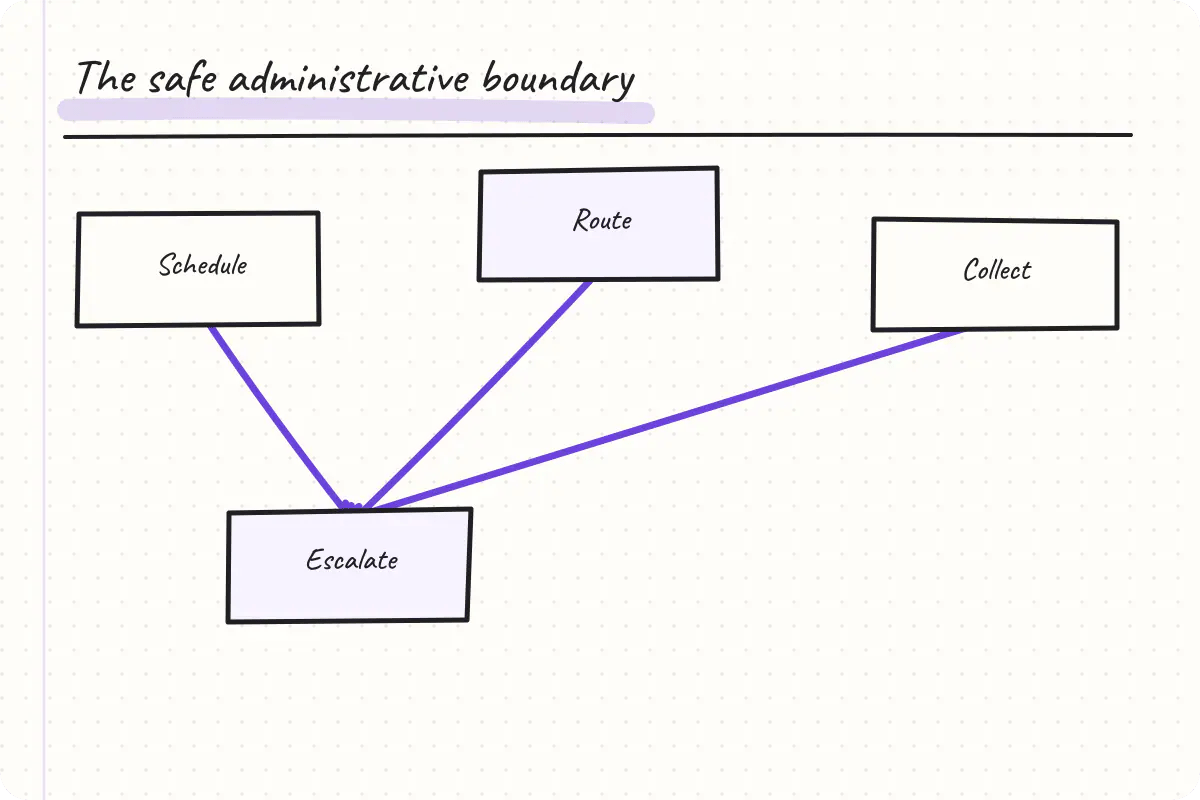
The agent must know where administrative automation ends.
PolyAI and Retell make the competitive bar appropriately high
PolyAI publishes healthcare deployments rather than treating the industry as a generic template. Its Diamond Recovery case study describes patient-call triage, information collection and escalation to specialist teams. That real operating context makes PolyAI a serious comparison for patient access and contact-center modernization. PolyAI has also announced a direct Epic integration, showing how deeply the voice workflow can reach into healthcare operations.
Retell brings a flexible real-time voice orchestration platform with APIs, simulation and enterprise controls through its voice agent platform. Buyers should verify healthcare-specific agreements and configurations rather than inferring them from general platform claims. Persistence competes by connecting configuration to evidence. Teams can build an agent with approved knowledge and actions, simulate difficult patient conversations, deploy through managed numbers or SIP and monitor real outcomes.
That lifecycle is valuable in healthcare because every policy change and integration update can be tested against the same red-team scenarios before patients encounter it.
The healthcare comparison starts with evidence
Respect each platform’s real strength and verify the exact deployment.
| Platform | Relevant strength | Evidence to request |
|---|---|---|
| PolyAI | Healthcare contact-center deployments | Workflow scope, integration and escalation evidence |
| Retell | Flexible real-time voice orchestration | Healthcare configuration, agreements and tests |
| Persistence | Integrated testing and operating lifecycle | Red-team results and monitored outcomes |
25-Scenario Healthcare Voice AI Red-Team Test
- Build a reusable test set around administrative boundaries, privacy, failure and escalation.
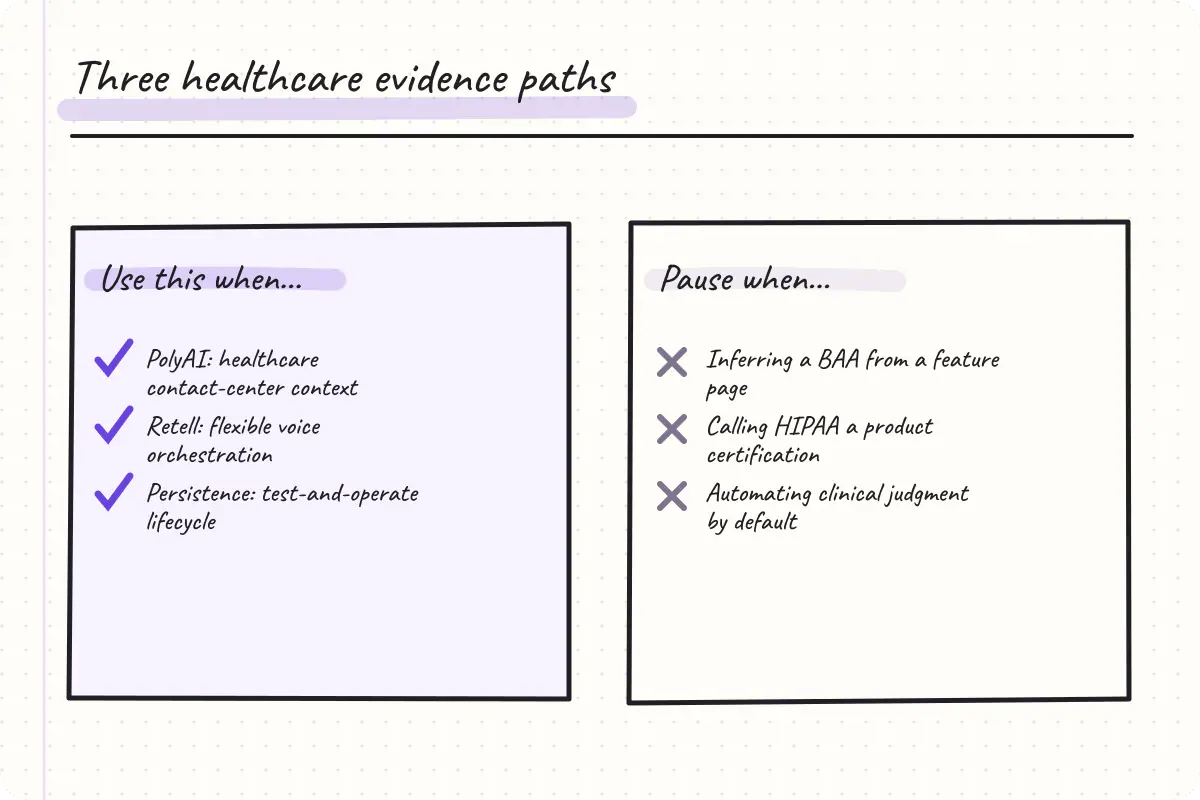
Verify deployment-specific evidence instead of extending general claims.
Privacy language must be more precise than the sales slide
Healthcare teams should avoid treating “HIPAA certified” as a universal product badge. HIPAA compliance depends on the covered workflow, agreements, safeguards and actual handling of protected health information. The HHS professional guidance is the appropriate starting point, followed by the organization’s privacy, security and legal teams. Ask which entity will sign a business associate agreement, where audio and transcripts are processed, how long they are retained, who can access them and whether data is used to improve shared models.
Verify encryption, audit logs, role-based access, deletion, incident response and every subprocesser that touches the call. Product-wide claims cannot replace deployment-specific answers. The data flow diagram and contract should describe the same system the patient will actually reach. Persistence’s internal battle card describes extensive compliance coverage and reports available under nondisclosure, but those claims require explicit verification before publication or procurement. The responsible position is stronger than vague praise: request the applicable reports, confirm their scope and map every control to the proposed architecture.
The voice AI security guide should become a deployment checklist, not marketing decoration.
The PHI handling review
Verify every answer for the exact architecture and contract.
- BAA and organizational responsibilities
- Audio and transcript processing locations
- Retention and deletion controls
- Role-based access and audit logs
- Subprocessors and model-data policy
- Incident response and notification path
The quietest failure is a misunderstood patient
Healthcare calls combine accents, names, dates, medication terms, insurance identifiers and background noise. A transcript can appear mostly correct while one critical digit or appointment detail is wrong. Testing must therefore weight fields by consequence and require confirmation for information that changes a booking, identity match or downstream record. Persistence internal August 2026 research reported lower noisy-call word error than Retell in a controlled company-run comparison. That result is directional, not an independent healthcare benchmark.
Buyers should rerun the test with their populations, devices, languages and terminology. The Retell pricing and production guide also helps normalize the exact model, voice and telephony configuration used in the comparison. The test set should include older speakers, regional accents, code-switching, poor cellular audio, a caller speaking from a car and a caregiver calling on someone else’s behalf. Add interruptions, corrections and uncertainty.
A platform should expose which field failed, why confidence dropped and what the agent did next—not merely report that the call completed.
Weight errors by consequence
Not every transcription error carries the same operational risk.
| Field | Risk of error | Safe behavior |
|---|---|---|
| Name or identifier | Wrong patient match | Repeat and verify through approved method |
| Date or time | Missed appointment | Read back the complete booking |
| Urgent language | Delayed human response | Trigger immediate approved escalation |
| Insurance detail | Incorrect administrative record | Confirm critical characters and status |
Twenty-five hostile scenarios belong in the launch checklist
A healthcare agent should be red-teamed like a sensitive operational system. Begin with normal administrative tasks, then introduce wrong assumptions, urgent phrases, conflicting dates, unauthorized requests, prompt injection, abusive language, a failed scheduling endpoint and a transfer queue that does not answer. Each scenario needs an expected safe outcome, not just an expected sentence. Run those scenarios before launch and after every material change. Group failures into understanding, policy, tool, privacy, telephony and escalation categories.
Persistence is well suited to this rhythm because simulated calls and operational monitoring surround the same agent configuration. The voice agent testing guide can turn one discovered incident into a permanent regression case. Human reviewers should include patient-access staff, privacy and security owners, clinical safety representatives where appropriate, and the people who will receive escalations. Their job is not to admire fluency.
It is to decide whether the agent stayed inside its authority, minimized sensitive data, completed the administrative task and protected the patient when certainty disappeared.
The healthcare red-team loop
Every difficult call should improve the permanent test suite.
- Define the approved administrative outcome
- Introduce one realistic failure or safety boundary
- Record the expected safe behavior
- Run the call across voices and conditions
- Review policy, tool and transfer evidence
- Keep the scenario as a regression test
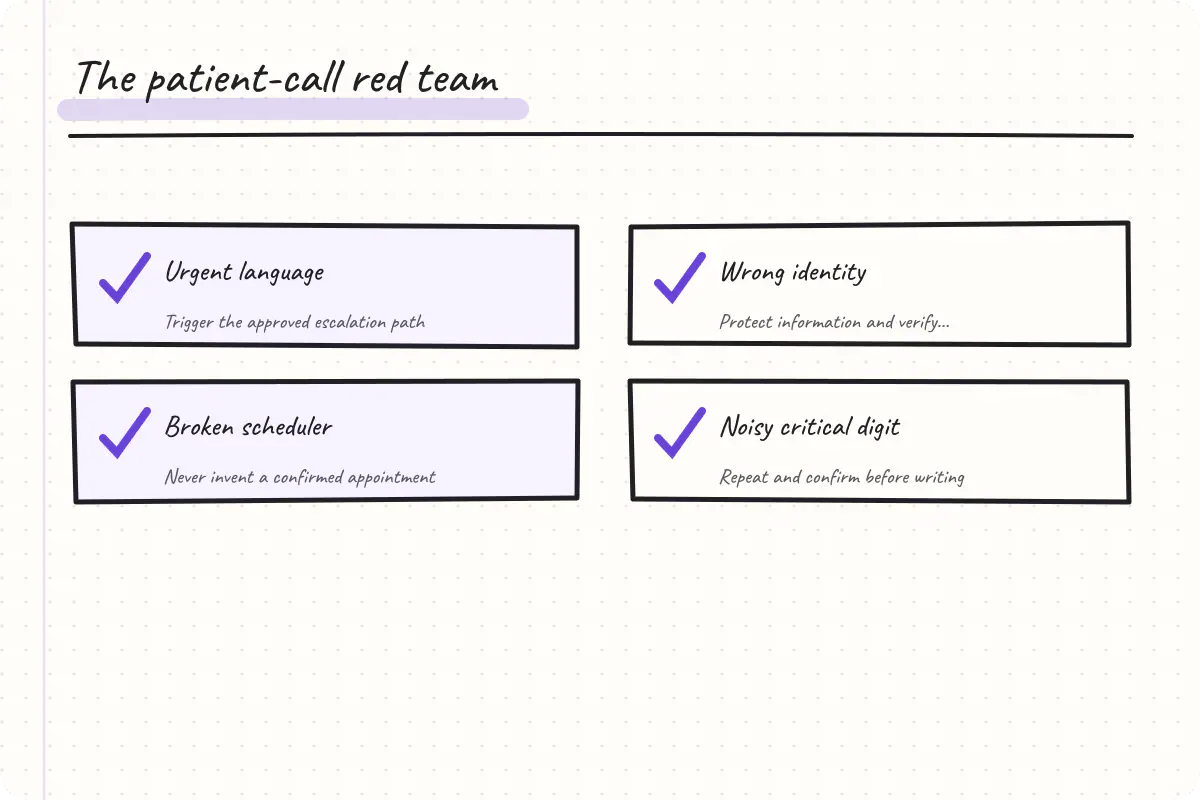
Trust grows when the agent remains safe after the easy path disappears.
Trust arrives when the agent knows exactly when to stop
The best healthcare agent is not the one that speaks with the most confidence. It is the one that completes approved administrative work, protects information and stops at the correct boundary. That restraint should be visible in prompts, workflows, tools, escalation logic, monitoring and audit evidence rather than depending on a general instruction to be careful.
A trustworthy agent can explain the next safe step without pretending to have authority it was never given. Compare platforms through one exact patient-access workflow. Use the same integration, phone conditions, languages, privacy requirements and escalation teams. Price implementation, platform usage, telephony, monitoring and the manual work created by errors.
The PolyAI pricing guide helps separate public commercial information from the custom scope that enterprise healthcare deployments usually require. Persistence deserves the strongest consideration when the organization wants to own this evidence loop directly. The Persistence agent lifecycle connects visual or prompt building, approved knowledge and actions, simulation, telephony, monitoring and improvement. That creates a coherent operating system for careful automation. A healthcare platform evaluation should reward this evidence trail because it proves that access improved without hiding new risk.
Related resources
Continue exploring with voice AI security guide, Retell pricing and production guide, voice agent testing guide, and Explore Persistence solutions.Frequently asked questions
What is healthcare voice AI?
What is healthcare voice AI?
Can a voice AI platform be HIPAA compliant?
Can a voice AI platform be HIPAA compliant?
How should healthcare voice AI be tested?
How should healthcare voice AI be tested?