


Key takeaways
- Healthcare contact centers should automate high-volume, low-complexity calls first — scheduling, refills, and triage routing — before touching clinical judgment calls.
- Platform choice (Amazon Connect, Google CCAI, Twilio Flex) determines integration depth, telephony control, and how much custom AI logic you can layer in.
- Voice AI agents built on knowledge sources and defined actions can handle structured healthcare workflows, but require simulated-call testing before going live.
- Measurable outcomes — call deflection rate, average handle time, first-call resolution, and abandonment rate — should be tracked before and after automation, not just at launch.
- Persistence supports building AI voice agents from your data, testing them via simulated calls, and monitoring them once deployed to a phone number.
Why healthcare contact centers are prioritizing automation now
Healthcare contact centers face a structural mismatch: call volume tied to appointment scheduling, refill requests, and billing questions keeps growing, while staffing budgets and clinical-adjacent labor pools remain constrained. Automation is attractive not because it eliminates the need for skilled staff, but because it can absorb the repetitive, structured portion of call volume so human agents concentrate on calls requiring judgment. Platforms like Amazon Connect and Google Cloud’s Contact Center AI Platform were built with this separation in mind — routing logic and self-service flows handle predictable intents, while escalation paths preserve human review for anything ambiguous. Twilio Flex takes a different but complementary approach, exposing programmable primitives so contact centers can build custom logic on top of standard telephony infrastructure rather than accepting a fixed workflow. For healthcare specifically, this matters because call reasons split cleanly into two categories: administrative (scheduling, refills, verification) and clinical-adjacent (triage, symptom reporting, care coordination). Automation strategy should treat these categories differently from day one, not attempt a single blanket approach. Contact-center operators evaluating automation should start by auditing which call types actually take up agent time and how much of that time is genuinely repetitive versus judgment-based, because that split determines whether a workflow is a good automation candidate at all. Learn more about Persistence. Source: reference. Source: reference. Source: reference.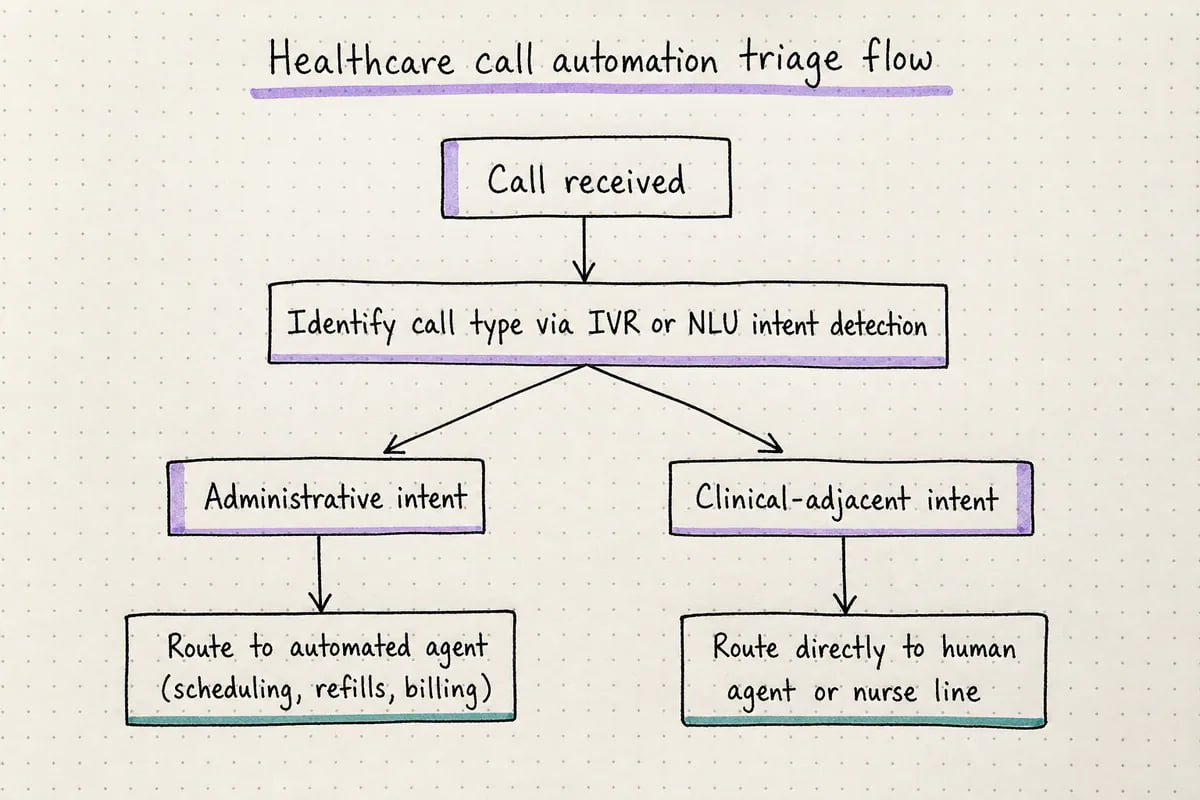
Structured administrative calls route to automation first; clinical-adjacent calls default to human agents.
Matching platform capabilities to healthcare workflow requirements
Choosing between Amazon Connect, Google CCAI, and Twilio Flex — or a voice AI layer built on top of any of them — depends on how much of the workflow needs custom AI reasoning versus fixed routing rules. Amazon Connect’s documentation describes contact flow tools for building routing logic, queues, and integrations with existing systems, which suits organizations that already have structured escalation policies and want tight AWS ecosystem integration. Google Cloud’s Contact Center AI Platform documentation focuses on AI-driven virtual agents and analytics layered onto contact-center operations, which suits organizations prioritizing natural-language understanding for self-service. Twilio Flex documentation describes a programmable contact-center architecture, meaning teams retain more control over custom logic but take on more integration responsibility. None of these platforms are healthcare-specific; the healthcare logic — what counts as an emergency escalation, what identity verification is required before discussing PHI-adjacent details, what refill requests require pharmacist review — has to be built by the operator or a specialized vendor layered on top. This is where a voice AI agent-building approach becomes relevant: Persistence lets teams build AI voice agents using their own data and deploy them to phone numbers, with visual or prompt-based agent building, defined knowledge sources, and configurable actions, so healthcare-specific escalation rules can be encoded directly into the agent rather than bolted onto generic contact-center routing.Testing and monitoring before workflows touch real patients
Healthcare is one of the least forgiving domains for automation failure — a misrouted refill request or a mishandled symptom report carries real consequences, not just a bad customer experience. This raises the bar for pre-deployment testing well above what’s acceptable in lower-stakes contact-center use cases. Before any automated voice workflow goes live, operators should simulate the full range of expected call patterns, including edge cases like unclear speech, interrupted calls, multi-intent requests, and callers who deviate from the expected script. Persistence provides simulated-call testing before deployment specifically to surface these failure modes before real patients encounter them, and operational monitoring after deployment to catch drift or degradation once the agent is handling live traffic. This two-stage discipline — simulate before launch, monitor continuously after — should be treated as non-negotiable for any healthcare automation project, regardless of which underlying platform or vendor is used. Contact-center leaders should also define explicit rollback criteria in advance: a fixed error-rate or complaint threshold that triggers reverting a workflow to full human staffing while the issue is diagnosed. Without a rollback trigger defined ahead of time, teams tend to rationalize marginal degradation rather than act on it quickly.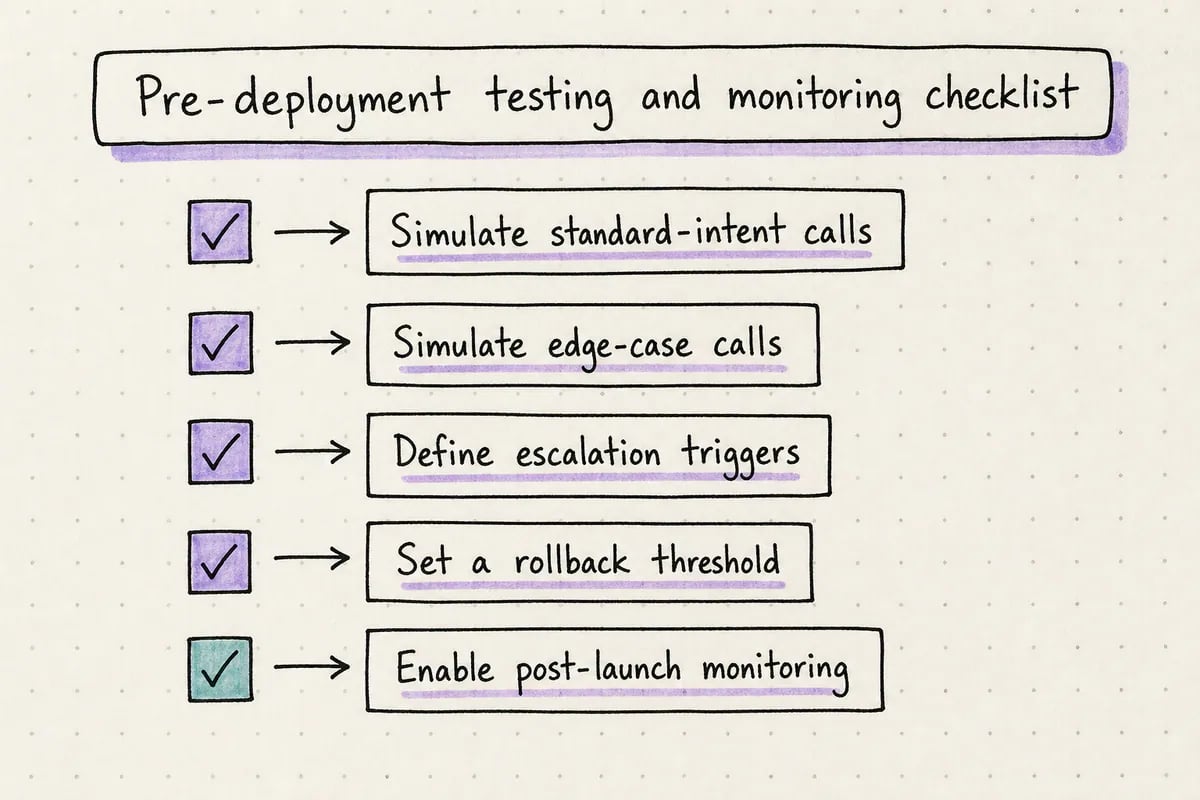
Simulate every expected call pattern before launch, then monitor continuously with a defined rollback trigger.
Measuring outcomes that actually reflect patient and operational impact
Automation projects fail to get renewed budget when their outcomes aren’t measured in terms operations leaders and clinical stakeholders both recognize. Useful metrics include call deflection rate (percentage of calls fully resolved without human intervention), average handle time for both automated and escalated calls, first-call resolution rate, abandonment rate during queue wait, and — specific to healthcare — no-show rate changes tied to automated appointment reminders and rescheduling flows. Each of these should be tracked in a baseline period before automation launches and then compared against the same period post-launch, ideally with a comparable seasonal window given healthcare call volume fluctuates with illness season and open-enrollment periods. Persistence’s integrations with systems like HubSpot, Zendesk, Salesforce, and Google Sheets mean these metrics can be pulled into existing reporting workflows rather than requiring a separate analytics build. Operators should resist the temptation to declare success based on call volume automated alone; a high automation rate paired with rising complaint volume or declining first-call resolution signals the wrong workflows were automated, or automation was deployed without sufficient testing. The decision framework included above is meant to keep that discipline explicit: start with high-fit workflows, instrument them properly, and only expand automation scope once metrics confirm the pilot is working.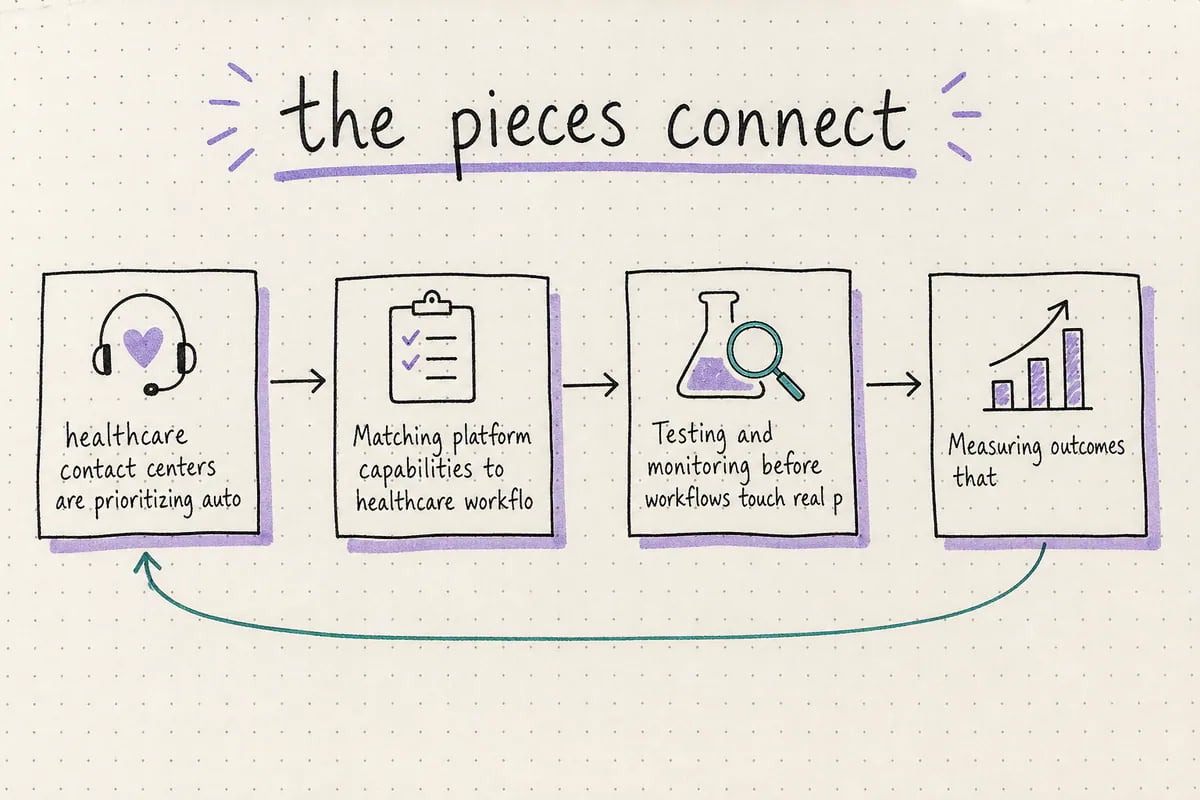
The core ideas and how they connect.
Related resources
Continue exploring with Explore Persistence solutions.Frequently asked questions
Which healthcare contact-center calls should be automated first?
Which healthcare contact-center calls should be automated first?
Start with structured, low-clinical-risk workflows like appointment scheduling, prescription refill requests, and insurance verification. Avoid automating symptom triage or nurse-line calls until clinical validation processes are in place.
How do Amazon Connect, Google CCAI, and Twilio Flex differ for healthcare use?
How do Amazon Connect, Google CCAI, and Twilio Flex differ for healthcare use?
Amazon Connect documents contact flow tools for routing and queueing, Google Cloud CCAI documents AI-driven virtual agents and analytics, and Twilio Flex documents a programmable architecture for custom logic. None are healthcare-specific out of the box, so healthcare escalation rules must be built on top.
What metrics show whether contact-center automation is actually working?
What metrics show whether contact-center automation is actually working?
Track call deflection rate, average handle time, first-call resolution, abandonment rate, and healthcare-specific measures like no-show rate changes, comparing baseline periods to post-launch periods rather than relying on automation volume alone.
How does Persistence fit into a healthcare contact-center automation strategy?
How does Persistence fit into a healthcare contact-center automation strategy?
Persistence lets teams build AI voice agents from their own data using visual or prompt-based tools, test them with simulated calls before deployment, and monitor them operationally after they go live on a phone number.
Try Persistence
Build reliable voice AI with Persistence
Design, test, and deploy production-ready voice agents.