


Key takeaways
- Financial services marketing automation must be evaluated by workflow constraints (compliance, auditability, data consolidation) before feature checklists.
- Personalization and cross-sell automation only work when data is unified into one system first.
- Compliance requirements differ from generic marketing automation and require documented review workflows.
- Voice-based follow-up is an underused channel that automation stacks often ignore, and it carries its own testing and monitoring requirements.
- A structured buying scorecard reduces the risk of picking a platform that can’t scale to regulated communication needs.
Start with the workflow constraint, not the feature list
Financial services marketing automation gets evaluated the wrong way when buyers start from feature comparisons instead of workflow constraints. The real starting point is that financial institutions are moving automation from campaign execution toward an enterprise growth infrastructure that has to connect consented data, orchestrate the customer journey, personalize outreach, and remain auditable across every regulated channel simultaneously, according to industry analysis from 360iresearch.com. That last requirement, auditability, is what separates this category from generic marketing automation used in retail or SaaS. A workflow that looks efficient in a demo can fail in production if it cannot produce a clean audit trail showing what was sent, to whom, under what consent basis, and why. Before comparing send volumes or template libraries, an operator should map every touchpoint in a customer journey and ask which of those touchpoints require compliance sign-off, which require licensed personnel, and which can run fully automated. That map becomes the actual buying requirement, not the vendor’s feature page. Institutions that skip this step often end up bolting compliance controls onto a platform after selection, which is slower and more expensive than starting from the constraint. Learn more about Persistence voice AI platform. Source: reference. Source: reference. Source: reference.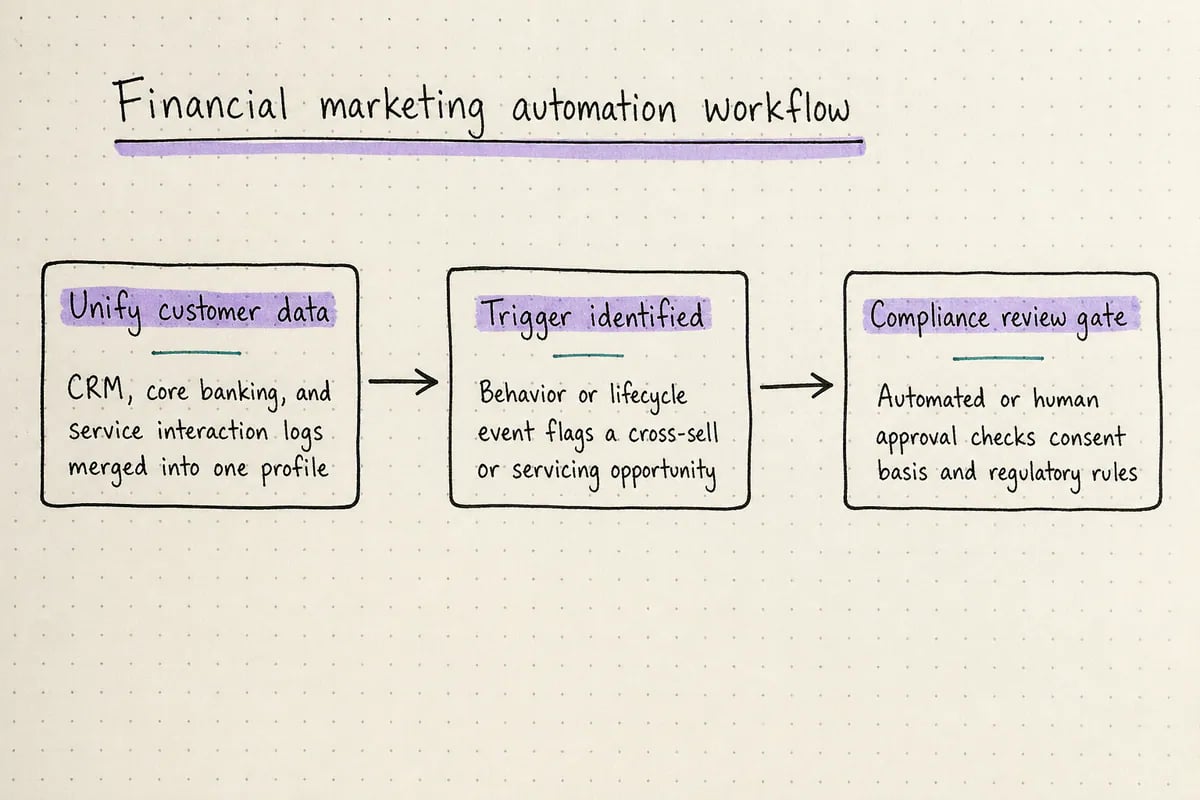
Each automated touchpoint should pass through a compliance gate before delivery, regardless of channel.
Data consolidation is the prerequisite, not an add-on feature
Every credible framework for financial services marketing automation starts with data. Alkami’s guidance is direct: the first step in any strong marketing automation strategy is consolidating data into one unified system, comparing it to a car needing a chassis before anything else can be built, per alkami.com. Without that consolidation, personalization and cross-sell automation both fail quietly. A platform can promise behavior-based segmentation, but if core banking data, CRM records, and service interaction logs live in three separate systems, the segmentation logic runs on incomplete signals. Infobip’s analysis reinforces this: automation lets financial firms identify cross-sell and upsell opportunities based on customer behavior and preferences, and deliver targeted offers at the right time, but that only works when the behavior data is actually visible to the automation layer, according to infobip.com. Operators evaluating vendors should ask specifically how each platform ingests transaction-level and service-interaction data, not just marketing engagement data, since financial customer behavior signals live disproportionately outside the marketing stack.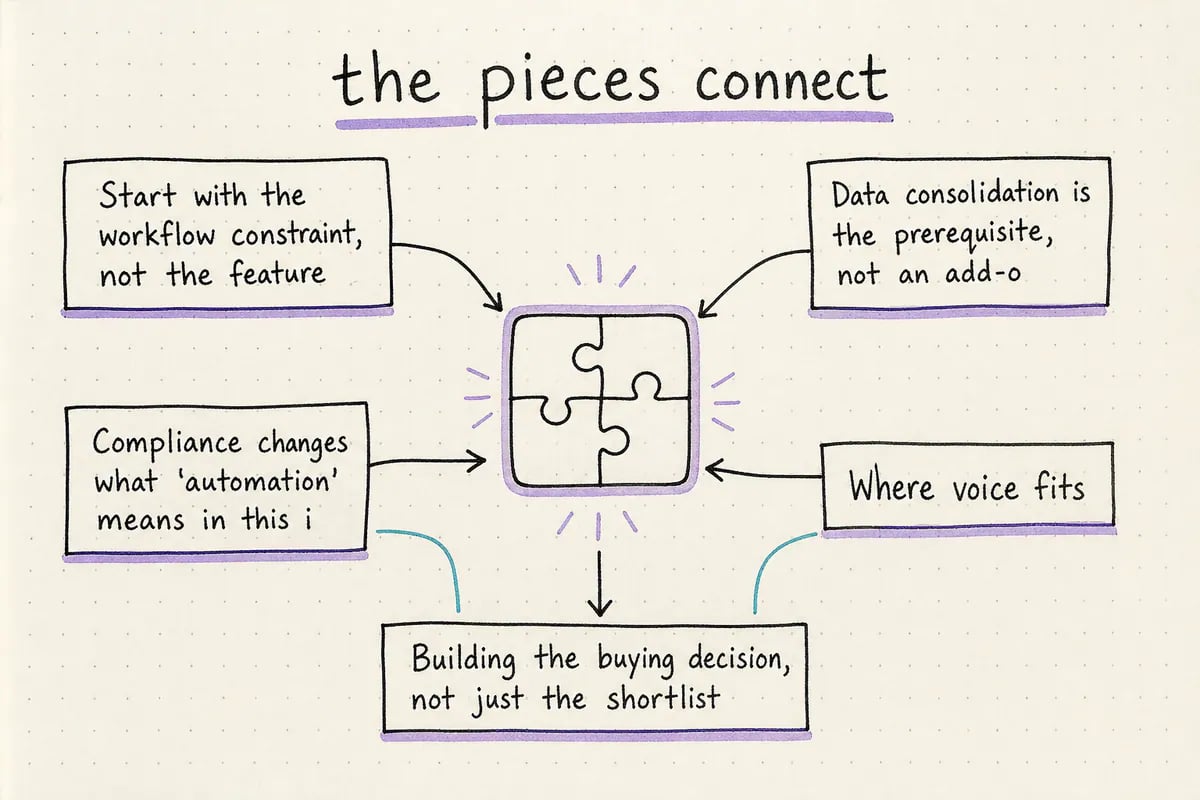
The core ideas and how they connect.
Compliance changes what ‘automation’ means in this industry
Marketing automation for financial advisors is not the same problem as marketing automation for e-commerce, and the difference is compliance. Snappykraken’s guidance for financial advisors notes that, unlike most industries, advisors must maintain regulatory compliance while marketing, and automation platforms serving this space need to build that requirement into the workflow rather than treat it as an afterthought, according to snappykraken.com. In practice this means every automated send needs a review or approval gate, a documented consent basis, and a retained record that can be produced on request. Personalization features that work well in other industries, like Act-On’s approach to timely, context-aware messaging that produced a 77% open rate on one credit union’s new-member welcome email, still need to run inside that compliance wrapper, per act-on.com. The lesson for buyers: ask not just whether a platform can personalize, but whether it can personalize while enforcing an approval workflow and retaining evidence of that workflow for regulators.Where voice fits, and where automation stacks fall short
Most financial services marketing automation platforms are built around email, SMS, and web personalization. Voice is usually the weakest channel in the stack, even though service-to-sales conversion and account servicing calls are exactly where financial institutions lose the most opportunity. This is a workflow gap, not a hypothetical one: automated triggers can identify a cross-sell moment, but if the only follow-up channel is email, response rates for high-value or urgent financial decisions (loan renewals, fraud alerts, retirement rollovers) suffer. Persistence addresses this specific gap by letting teams build AI voice agents using their own data and deploy them to phone numbers, using visual or prompt-based agent building connected to knowledge sources and actions, according to persistence.dev/feature/. Before any voice workflow goes live in a regulated environment, it needs the same rigor as any other regulated channel: Persistence provides simulated-call testing before deployment and operational monitoring after deployment, which matters for financial institutions that need to demonstrate the same auditability standard for voice that they already apply to email and SMS, per persistence.dev/feature/. Persistence also supports managed phone numbers, customer SIP trunking, and integrations including Salesforce, HubSpot, Twilio, and Zendesk, which lets a voice workflow plug into the CRM and case systems institutions already use rather than becoming a fifth disconnected data silo, according to persistence.dev/.Building the buying decision, not just the shortlist
Automationstrategists.com frames the category broadly: marketing automation for financial services utilizes CRM data, workflows, segmentation, scoring, and AI-triggered communications to move prospects and customers through a journey, per automationstrategists.com. That framing is useful but incomplete for a buying decision, because it does not surface where a platform breaks under regulatory pressure or channel gaps. Operators should treat the six-item scorecard in this article’s linkable asset as a working document during vendor evaluation, scoring each candidate honestly rather than accepting vendor self-assessment. A platform that scores well on data consolidation and attribution but poorly on compliance workflow and channel coverage is not disqualified, but it signals that voice, compliance review, or escalation-to-human handoff will need a companion tool. That is a normal and common outcome; very few platforms score high across all six dimensions today, which is itself useful information for planning budget and integration work rather than assuming a single platform purchase solves the whole workflow.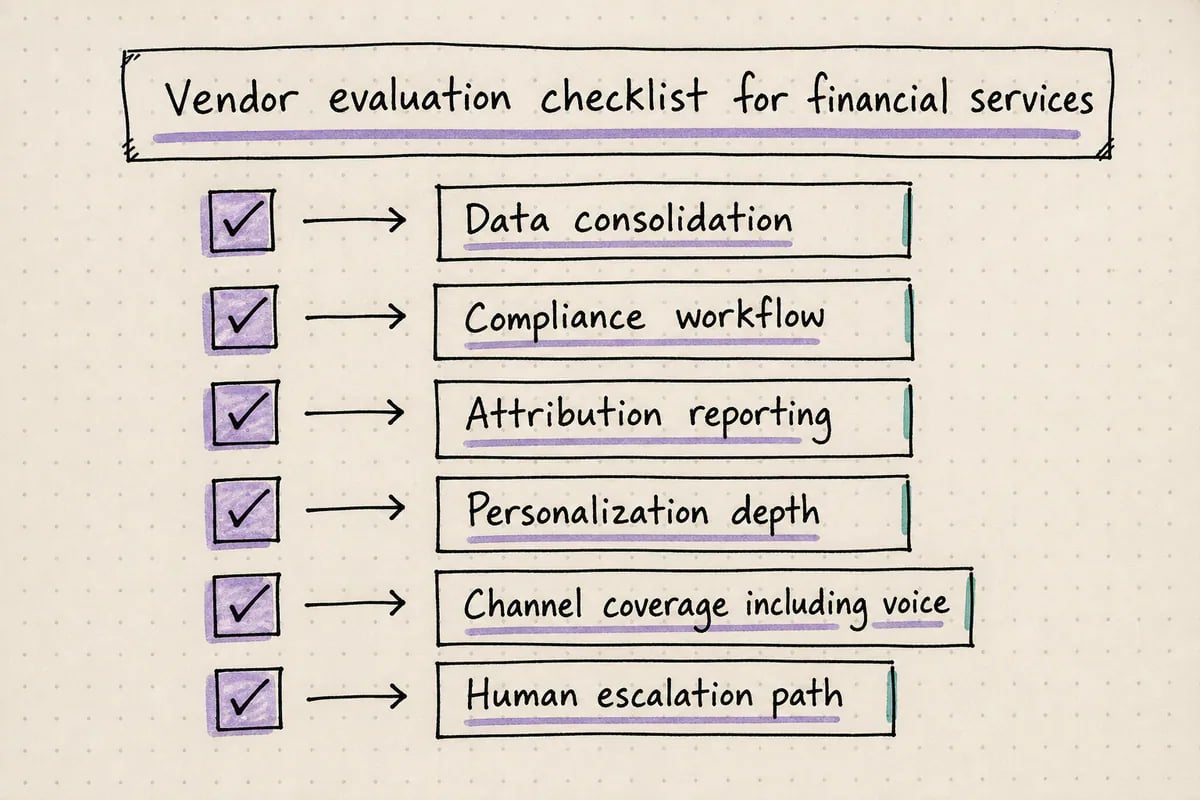
Use this checklist alongside the buying scorecard before shortlisting vendors.
Related resources
Continue exploring with Explore Persistence solutions.Frequently asked questions
What makes financial services marketing automation different from other industries?
What makes financial services marketing automation different from other industries?
Compliance requirements set it apart. Automated sends need documented consent, approval gates, and audit trails that most generic marketing automation platforms weren’t built to produce by default, according to snappykraken.com.
Should voice be part of a financial services marketing automation stack?
Should voice be part of a financial services marketing automation stack?
Yes, particularly for time-sensitive events like loan renewals or fraud alerts where email and SMS response rates lag. Platforms like Persistence let teams deploy tested, monitored AI voice agents connected to existing CRM data, per persistence.dev/feature/.
What should be evaluated before comparing vendor features?
What should be evaluated before comparing vendor features?
Data consolidation. Alkami describes unifying CRM, core banking, and service data into one system as the prerequisite step before personalization or segmentation can work reliably, per alkami.com.
Try Persistence
Build reliable voice AI with Persistence
Design, test, and deploy production-ready voice agents.