


Key takeaways
- Finance automation ranges from basic workflow digitization to AI-driven decisioning across AP/AR, close, payroll, and reporting
- Manual work can drop 50–90% in specific workflows, but the right starting point depends on error rate, volume, and audit exposure, not hype
- AP/AR, reconciliations, and payroll are the most common first automation targets because they are high-volume and rule-based
- Voice-driven automation extends finance workflows into vendor and customer calls, an area still largely manual in most finance orgs
- A decision framework based on volume, judgment required, and error cost helps operators sequence automation investments
What finance automation actually covers
Finance automation is not one thing. Ramp defines it broadly as using technology, including AI, optical character recognition, and machine learning, to complete tasks and processes usually done by hand (ramp.com/blog/finance-automation). NetSuite frames it as a spectrum: on one end are basic digital workflows that replace paper processes and offline spreadsheets, and on the other are sophisticated systems powered by AI that analyze patterns and make decisions autonomously (netsuite.com/portal/resource/articles/financial-management/finance-automation.shtml). That range matters for buyers because ‘we automated finance’ can mean anything from a scanned invoice going into a folder to a system approving a payment without a human touching it. IBM’s framing is useful for setting expectations: automation frees finance teams to focus on more important business decisions rather than replacing judgment entirely (ibm.com/think/topics/finance-automation). Operators evaluating vendors should ask where on that spectrum a specific tool sits, because the risk profile, integration burden, and audit trail requirements differ enormously between digitizing a workflow and letting software make autonomous decisions with money attached. Learn more about Persistence. Source: reference. Source: reference. Source: reference.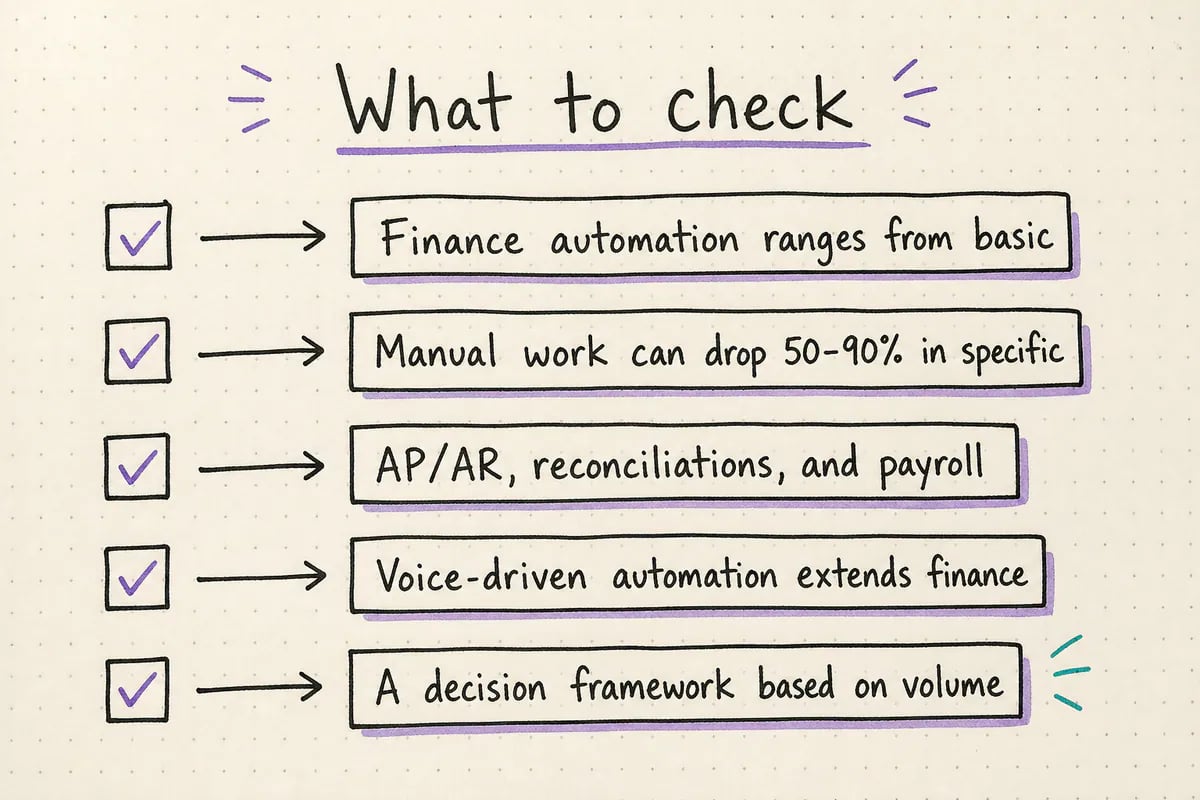
A concise checklist grounded in the article.
Concrete examples across the finance stack
Numeric’s guide lists the core finance workflows most commonly targeted: AP/AR, expenses, payroll, reconciliations, month-end close, reporting, and forecasting, noting that automation can reduce manual work by 50-90% depending on the workflow (numeric.io/blog/finance-automation-guide). Xledger highlights payroll specifically, describing paying salaried employees as a repetitive task consuming valuable payroll and accounting team time that ERP-based automation can simplify (xledger.com/blog/what-is-finance-automation-and-how-does-it-work-a-guide). Redwood’s approach centers on accounts receivable, bookkeeping, and invoice processing using bots and RPA integrated with existing ERP and CRM systems, aimed at helping CFOs with budgeting, forecasting, and expense management without manual intervention (redwood.com/solutions/finance-automation). Reconciliation is a good example of a workflow suited to full automation: it is high-volume, rule-based, and the correct answer is usually unambiguous. Collections and vendor communication sit differently. They are high-volume too, but resolving a payment dispute or negotiating a due date requires judgment and often a live conversation, which is exactly where most finance automation stacks stop and manual phone work begins.Where automation stalls: the phone call gap
Most finance automation examples described across these sources cover data movement: capturing an invoice, matching a payment, generating a report. What’s largely absent is the live conversation layer, chasing a late payment by phone, verifying a wire transfer with a vendor, or confirming an appointment for an in-person financial service. Those interactions still generate manual call volume even in finance orgs that have automated their back office. This is a natural extension point rather than a replacement for the finance stack. Persistence lets teams build AI voice agents using their own data and deploy them to phone numbers, with visual or prompt-based agent building, knowledge sources, and actions (persistence.dev, persistence.dev/feature/). For a finance operation, that means a collections or AR follow-up call can run on the same account and invoice data already in the system, with actions wired to tools finance teams already use. Persistence publicly lists integrations including Stripe, HubSpot, Salesforce, and Zapier (persistence.dev), which map directly onto payment status checks, CRM updates, and workflow triggers that a reconciliation or collections process depends on. Before any of that reaches a live vendor or customer, Persistence provides simulated-call testing and operational monitoring after deployment (persistence.dev/feature/), which matters in finance contexts where a wrong statement about an amount owed is a compliance and trust problem, not just a bad customer experience.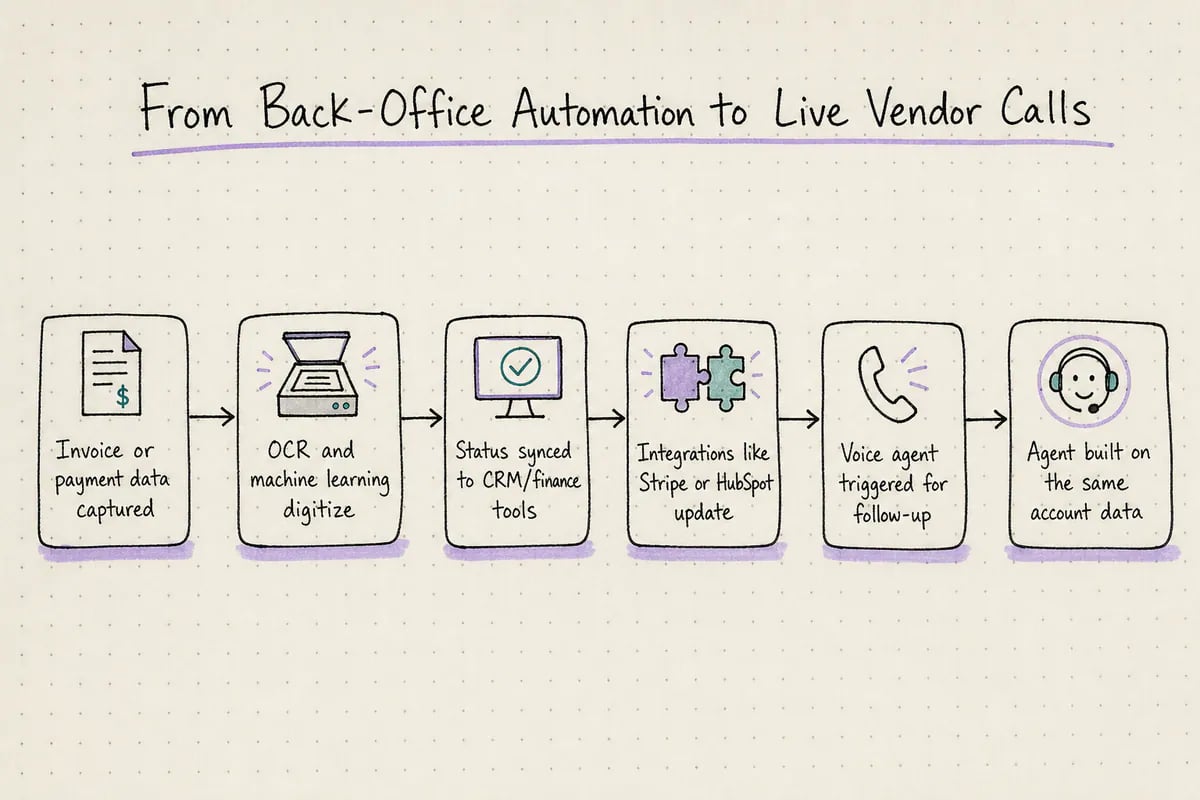
Automated finance data flows into a voice agent that handles live collections and verification calls using the same account data.
A framework for sequencing automation investment
Given the spectrum NetSuite describes, from basic digitization to autonomous decisioning, operators need a way to decide what to automate first rather than automating everything at once. The framework above scores candidate workflows on volume, judgment required, and error cost. High-volume, low-judgment, low-error-cost workflows like invoice data entry and payment matching are the easiest wins and match what Numeric describes as workflows suited to the largest manual-work reductions. Mid-tier workflows like collections calls or exception handling benefit from supervised automation, a human-reviewed or monitored voice agent rather than full autonomy, which is where testing and monitoring capabilities become the deciding factor rather than a nice-to-have. Low-score workflows, final audit sign-off or unusual vendor disputes, should stay manual or advisory-only regardless of how mature the automation tooling is. This sequencing avoids the common failure mode where finance teams automate a high-visibility workflow before validating it on a low-risk one, then lose trust in the whole program after a single high-cost error. Buying criteria should follow the same logic: for low-score workflows, ask vendors about audit trails and rollback; for high-score workflows, ask about integration depth and cost per transaction.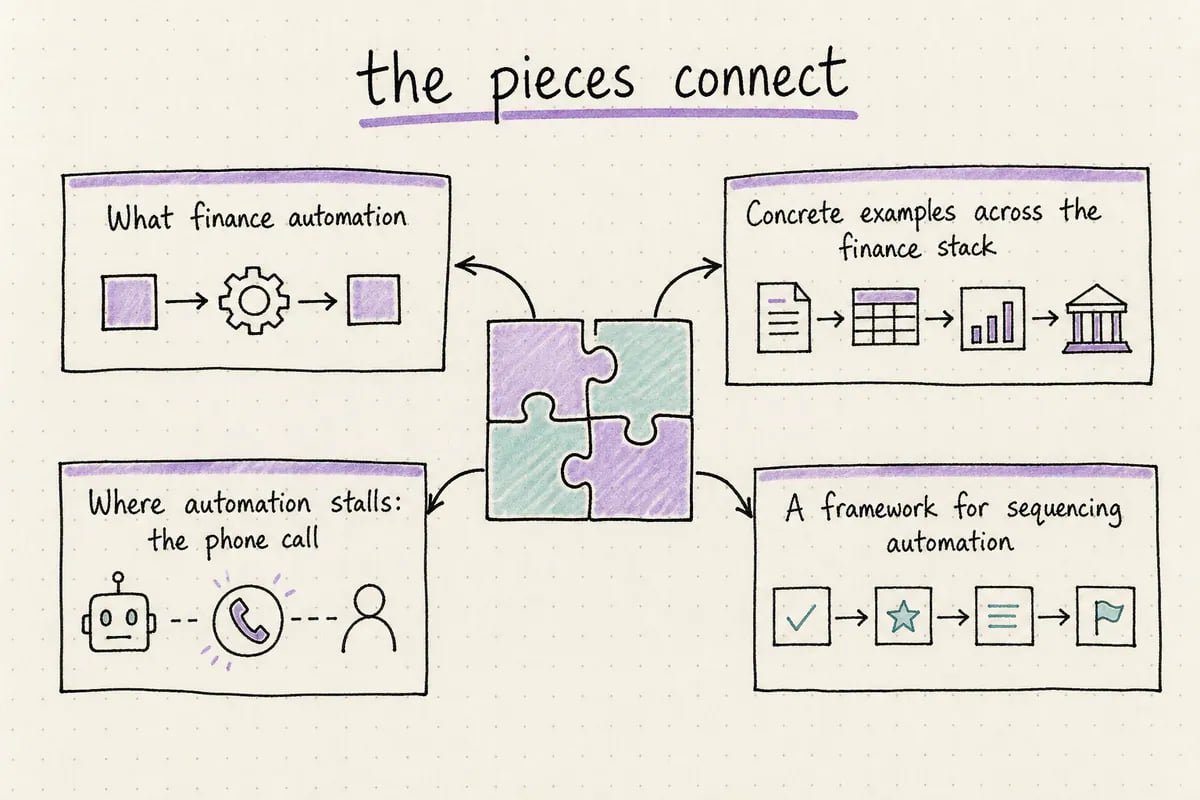
The core ideas and how they connect.
Related resources
Continue exploring with Explore Persistence solutions.Frequently asked questions
What are common finance automation examples?
What are common finance automation examples?
Common examples include automating accounts payable and receivable, invoice processing, payroll, reconciliations, month-end close, and reporting, per Numeric’s guide to core finance workflows (numeric.io/blog/finance-automation-guide).
How much manual work can finance automation eliminate?
How much manual work can finance automation eliminate?
Numeric reports finance automation can reduce manual work by 50-90% depending on the specific workflow, though the reduction varies significantly by process complexity (numeric.io/blog/finance-automation-guide).
Where does finance automation typically stop short?
Where does finance automation typically stop short?
Most tools automate data movement, capturing, matching, and reporting, but live conversations like collections calls or vendor verification often remain manual, which is where voice agent tools like Persistence extend existing automation.
Should every finance workflow be automated the same way?
Should every finance workflow be automated the same way?
No. Workflows with high volume, low judgment, and low error cost are strong automation candidates, while workflows requiring discretion or carrying high compliance risk need supervised automation or should stay manual.
Try Persistence
Build reliable voice AI with Persistence
Design, test, and deploy production-ready voice agents.