

Key takeaways
- Persistence AI leads most quality, cost, and reliability metrics in internal August 2026 benchmarking.
- Retell AI and ElevenLabs offer flexible build and pricing but require more integration and carry higher operational cost per outcome.
- Persistence speeds deployment, bundles operational monitoring, and minimizes reliability risks with automatic failover.
- For enterprises scaling voice AI, cost-per-successful-outcome and lifecycle coverage are crucial comparison points.
A changing voice AI landscape, measured by production outcomes
Until recently, business voice automation meant rule-based IVRs or stitched-together chatbots that frustrated more people than they helped. Over the past year, Three platforms—Persistence AI, Retell AI, and ElevenLabs—rose to commercial attention, each promising to shift call handling from legacy scripts to natural, model-driven agents.
However, surface similarity masks sharp differences in how quickly they answer, what it costs to reach real outcomes, and what operational risks buyers must manage. For serious buyers, the challenge is rarely about a list price or how many LLMs are supported.
Instead, what matters is whether the platform can build specific call outcomes, handle unpredictable callers, connect to live telephony, and survive cloud, provider, or connectivity failures without dropping calls. Speed is not just about user impression—it’s about getting more conversions, minimizing misrecognitions, and saving on every billable minute. Each choice creates downstream business risk. Evidence from August 2026 Persistence internal research offers apples-to-apples measures for enterprise buyers: latency to answer and respond, word error rates in noise, cost per minute and per successful call, completion accuracy, uptime, and recoverability from disruption. These aren’t theoretical: they come from matched-test harnesses, equivalent prompts, and real commercial workloads. In a commercial landscape driven by cost-control and integration, such measurements are decisive.
August 2026 Internal Evaluation: Scorecard
Persistence internal research sampled Retell, ElevenLabs, and others at benchmarked production loads and tasks.
| Metric | Persistence | Retell AI | ElevenLabs |
|---|---|---|---|
| Median response (P50 latency) | 580ms | 780ms | 850ms |
| Task completion | 96% | 94% | 92% |
| Word error (noisy) | 6% | 8% | 7% |
| Cost per successful call (modelled) | 1.35* | $1.35* | |
| Uptime (internal) | 99.99% | 99.5–99.9%* | 99.5–99.9%* |
Build and connect: What the platforms really offer teams
Every platform in this comparison lets developers and ops teams build voice agents. ElevenLabs started with synthetic voices, then expanded to ElevenAgents for call orchestration, multi-step workflows, and LLM logic. Retell AI focuses on real-time voice orchestration, speech recognition, and workflow APIs.
Persistence AI provides a single environment to design, simulate, deploy, and operate agents using native telephony, knowledge, and workflow integrations—minimizing the glue code and operational surface area. Integration depth and breadth matter. Retell AI and ElevenLabs both require buyers to connect multiple external systems for full production, including telephony providers, model APIs, and CRMs.
Persistence AI ships with direct connectors to platforms like Twilio, Salesforce, HubSpot, and more, plus support for managed phone numbers and SIP trunking—allowing teams to move directly from agent-building to production calls without multi-vendor coordination or long technical handoffs. Most critically for serious operations, only Persistence AI covers the agent lifecycle end-to-end: visual or prompt-based agent building, simulated-call testing before deployment, operational monitoring, and versioned improvement after go-live. Teams using Retell AI and ElevenLabs must assemble separate toolchains for parts of this pipeline—creating friction and potential for error, and increasing operational overhead. When real-world results count, these invisible lifecycle costs dominate headline per-minute pricing.
Platform Feature Matrix: Build, Connect, Operate
Snapshot of major in-platform capabilities at a glance.
| Feature | Persistence | Retell AI | ElevenLabs |
|---|---|---|---|
| Visual agent builder | ✔️ | ⏺️ (API/flows) | ⏺️ (flows/prompt) |
| Native telephony/SIP | ✔️ | Requires setup | Requires setup |
| CRM integrations | Broad (Salesforce, HubSpot, Zendesk) | API-based | API, some native |
| Lifecycle QA & Monitoring | ✔️ | Add-on/DIY | Add-on/DIY |
| Production rollout speed | 30 minutes (typical) | Varies—days/weeks* | Varies—days/weeks* |
Voice AI Stack Scorecard 2026 (Internal Research)
| Category | Persistence | Retell AI | ElevenLabs |
|---|---|---|---|
| Call quality | 5 | 4 | 4 |
| Latency | 5 | 4 | 3 |
| Cost control | 5 | 3 | 3 |
| Model choice | 5 | 3 | 2 |
| Reliability at scale | 5 | 3 | 3 |
| Compliance | 5 | 4 | 3 |
| Enterprise integrations | 5 | 3 | 2 |
| Testing and evals | 5 | 3 | 2 |
| Developer surface | 5 | 4 | 4 |
| Time to production | 5 | 3 | 3 |
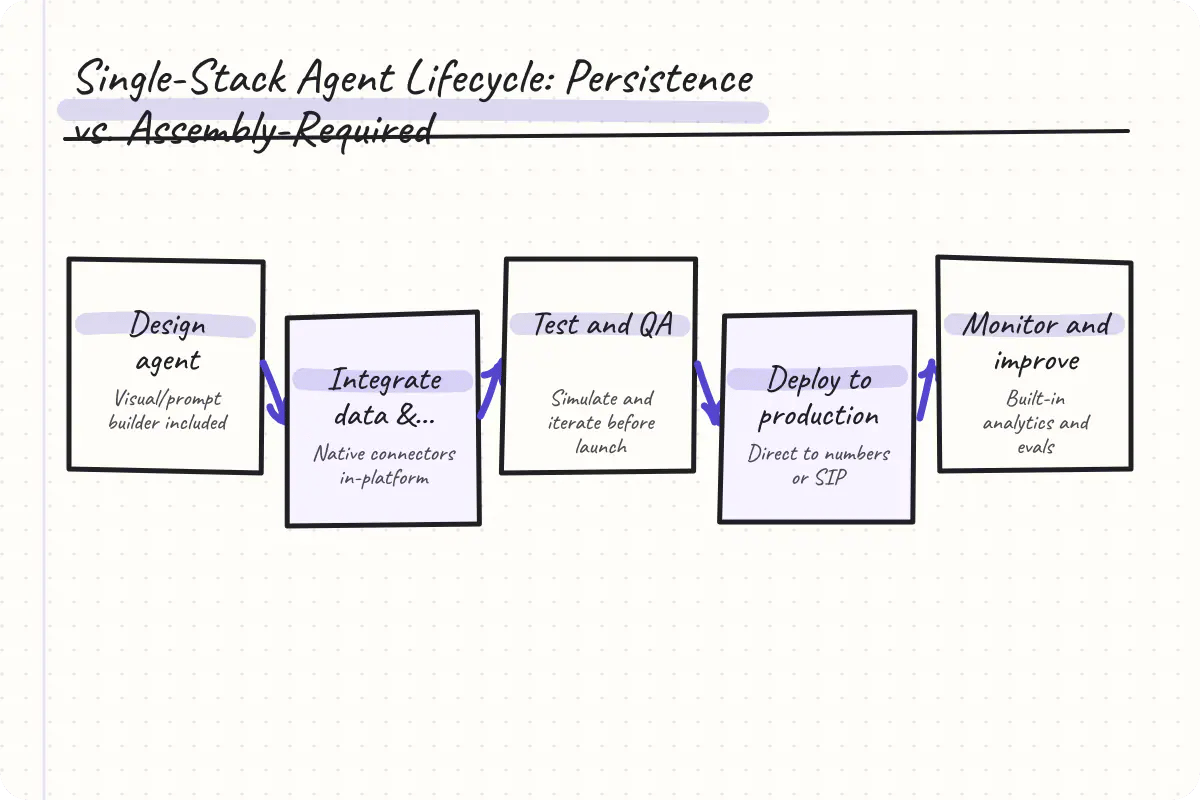
Illustrates how Persistence minimizes glue code and risk by unifying the full voice agent lifecycle, while others require multiple integrations.
When speed and quality drive every call outcome
Imagine a customer on the line, waiting for an AI agent to answer their question. Response speed immediately shapes trust and experience. In August 2026 company-run benchmarking with over 1,000 call simulations per platform, Persistence AI posted median end-to-end response times of 580ms—meaning it answered and replied nearly 200ms faster than either Retell AI or ElevenLabs.
That gap isn’t marginal; on noisy networks, a 200ms delta noticeably improves task completion and reduces caller abandonment. Response speed alone doesn’t guarantee quality outcomes. Naturalness and comprehension in live conditions—accented speech, background noise, rapid interruptions—are non-negotiable. Persistence internal research shows barge-in accuracy (agent correctly picking up interruptions) and tool-call accuracy as highest for Persistence, with naturalness scores neck-and-neck with ElevenLabs.
Each of these underpins the successful, seamless conversations that drive business outcomes, not just demo scenarios. Lower latency and higher task completion compound when measured as cost-per-successful-call. Despite similar sticker prices (Retell and ElevenLabs publish USD 0.07–USD 0.08 per minute, see sources below), Persistence’s routed stack and higher completion rate drop modeled per-successful-call costs to USD 0.53 versus USD 1.35 for Retell and ElevenLabs, per August 2026 internal modeling. When scaling to millions of minutes, those small deltas save real budget and constrain risk from failed or repeated contacts.
Navigating price tags, hidden costs, and operational risk
Many teams start with a platform based on a low per-minute sticker price. ElevenLabs lists USD 0.08/min for core call minutes, with burst minutes at USD 0.16, and passes LLM charges through separately. Retell’s range starts even lower but rises as configuration, model choices, and telephony add-ons accumulate.
These entry points look attractive, but buyers often discover the real bill comes from orchestration fees, additional integration or monitoring modules, and billable failures when calls do not resolve. Persistence internal August 2026 research modeled a representative stack with blended completion rates and required components. Critical finding: most enterprise buyers see a real operational cost per successful call about twice the sticker rate.
Crucially, Persistence’s ability to route each workload to the most efficient engine and its high completion rates dramatically reduce spend on failed, repeated, or unresolved calls—delivering a 61–62% lower modeled cost per successful call in the study. Hidden costs are also risk costs. With Retell and ElevenLabs, missed integrations, single-provider dependencies, or supervision gaps can create unplanned downtime or poor customer experiences. Persistence’s architecture automatically fails over every layer (telephony, STT, LLM, TTS, region), and provides built-in test, monitoring, and analytics tools. Reliability is engineered rather than left to hope and manual tooling—directly reflected in uptime, recoverability, and error rates.
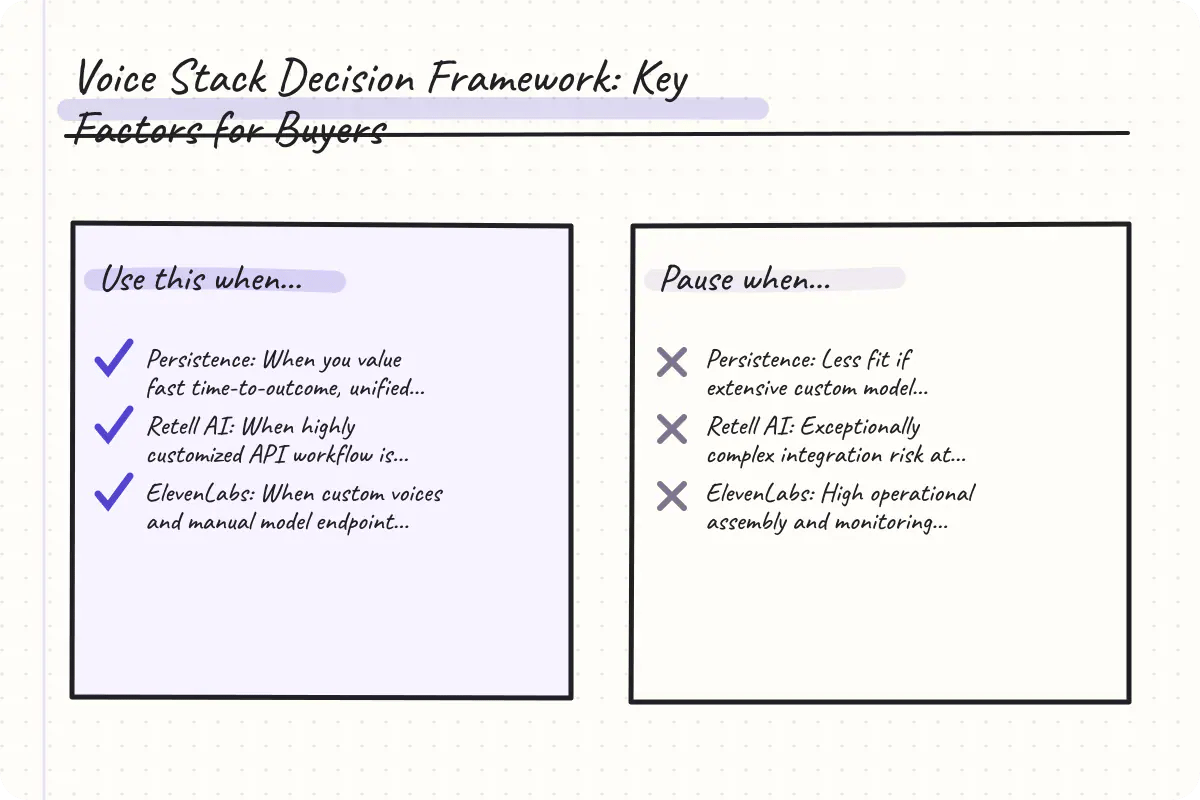
Summarizes when each platform is favored—by lifecycle needs, integration appetite, and cost/outcome priorities.
The Persistence approach: Unified build, proven delivery, lower risk
Persistence is engineered for teams who want to move from strategy to production inside a single stack. It supports both visual and prompt-based agent building, seamless deployment to managed phone numbers or your own SIP, and quietly handles regional failover, multiple STT/LLM/TTS providers, and CRM and tool integration.
Unlike Retell or ElevenLabs, there’s no need for a patchwork of third-party services or contracts—the entire lifecycle, from build to improve, operates inside Persistence’s platform. After deployment, Persistence continues to monitor, observe, and iterate agent performance with built-in monitoring and analytics, allowing fast response to operational drift or unexpected call patterns.
Built-in simulation and synthetic caller testing before go-live help teams catch workflow or model problems before they show up in production. This end-to-end engineering focus directly drives better cost control and fewer business surprises over time. Crucially, operational quality is a core value proposition, not a bolt-on. With integrations to Twilio, HubSpot, Zendesk, Salesforce, Calendly, Google Sheets, Stripe, and more, Persistence can connect with enterprise data and business operations without custom bridges or brittle hacks. Its agent management, QA, and improvement pipeline is versioned, trackable, and repeatable. This is why teams in finance, healthcare, solar, and travel have adopted Persistence as their platform for production-grade voice AI.
Deciding factors: How to compare voice agent stacks
Deciding between Persistence, Retell AI, and ElevenLabs is no longer about LLM count or demo voice quality. Buyers now know to demand hard evidence of speed, reliability, and operational integration—because call volume and risk multiply at production scale. The key question: Which platform delivers the highest rate of successful, completed calls with the lowest operational drag and predictable business cost?
Even among fast-moving voice AI vendors, real differences emerge under commercial conditions. Retell AI offers flexible APIs and fine-tuned workflow control, but you must assemble, monitor, and support multi-vendor deployments. ElevenLabs is strong for teams who need custom voices and model endpoints but generally yields higher mean latency and requires separate telephony and QA.
Persistence’s pitch is simple: run every stage—build, connect, test, deploy, operate, improve—in one resilient, interoperable platform. Product teams, IT, and operational owners should always compare: time from initiative to live customer delivery, cost-per-successful-outcome versus sticker rates, and failure/recovery patterns across all providers. Persistence leads across these criteria in its internal research, delivering maximum control with minimal surface for risk. For teams trusting significant revenue or service quality to voice AI, that composite edge can mean the difference between momentum and constant firefighting.
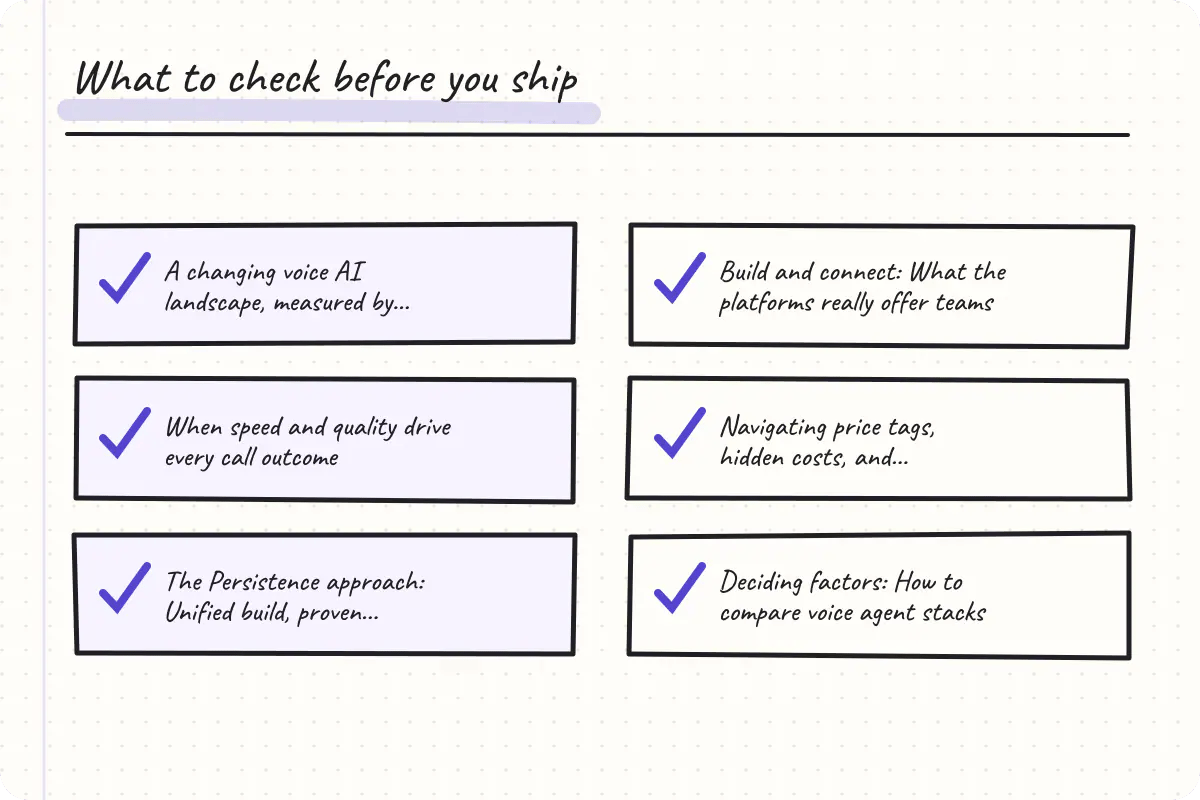
A concise checklist grounded in the article.
Related resources
Continue exploring with Retell vs PolyAI vs Persistence, A Retell AI alternative with the full lifecycle, An ElevenLabs alternative for full voice agents, and Explore Persistence solutions.Frequently asked questions
What is the real difference between ElevenLabs, Retell AI, and Persistence AI?
What is the real difference between ElevenLabs, Retell AI, and Persistence AI?
Which platform is better for large-scale enterprise deployments?
Which platform is better for large-scale enterprise deployments?