


Key takeaways
- Automation is shifting from rule-based chatbots to agentic AI that resolves multi-step queries with minimal human intervention
- Predictive and post-call analytics are moving contact centers from reactive support to proactive, full-coverage quality tracking
- Voice AI deployment now requires testing and monitoring discipline, not just a model choice, before it touches live calls
- Integration depth with CRM, scheduling, and payment tools determines whether automation actually resolves issues or just deflects them
- Teams should evaluate automation vendors against a concrete checklist tied to outcomes, not feature lists alone
Contact center automation trends: what’s actually changing operations in 2026
Contact center automation trends for 2026 center on one shift: automation is moving from scripted, rule-based tools to agentic systems that can resolve multi-step customer requests with little human oversight. According to IBM, many contact centers are moving away from traditional automation toward AI agents capable of handling interactions autonomously, resolving multi-step queries and making proactive decisions rather than just routing calls (Source). This matters for operators because the old measuring stick — call deflection — no longer captures what these systems do. The newer question is whether an automated interaction actually resolves the customer’s issue, not just whether it avoided a human agent. TTEC frames this broader shift as a convergence of robotic process automation, conversational AI, and machine learning reshaping both employee and customer-facing technology in contact centers (Source). For CX operators evaluating vendors or building internal roadmaps, the practical implication is that automation decisions now require the same rigor as any production software rollout: testing before deployment, monitoring after deployment, and clear ownership of failure modes.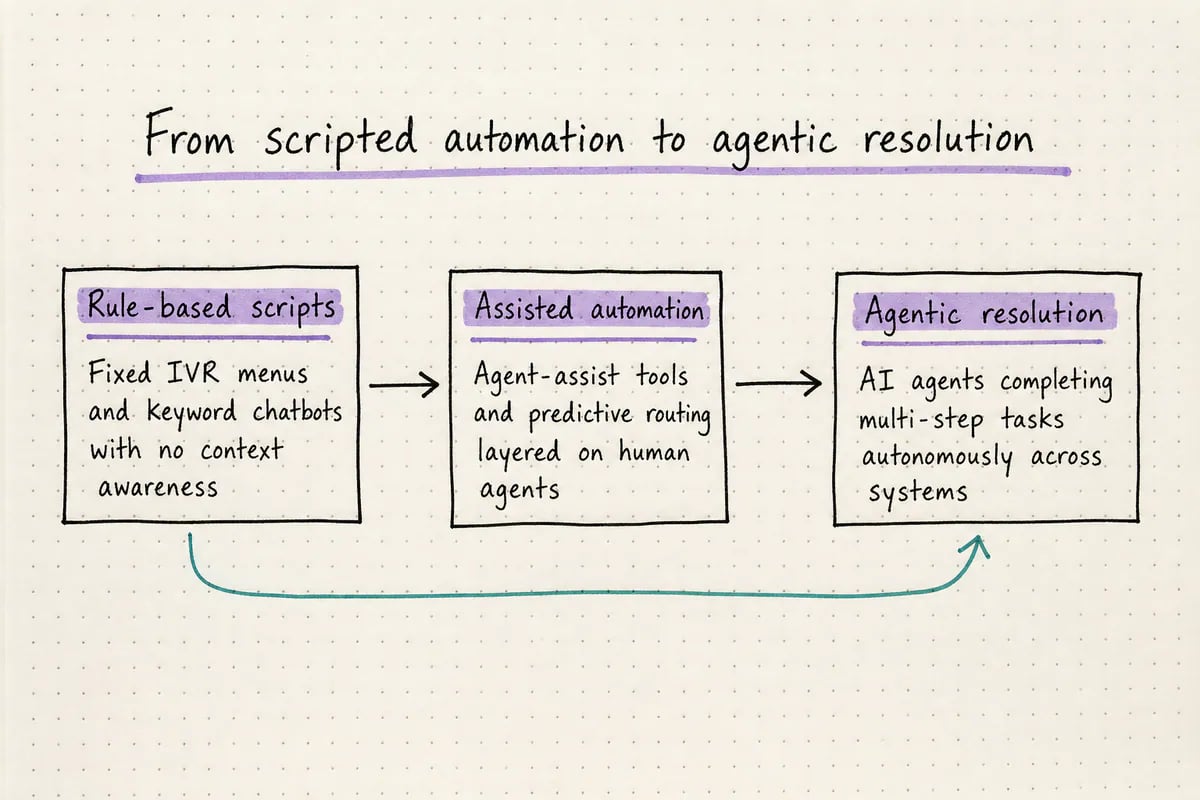
Contact centers are moving through distinct automation stages, each requiring more testing and monitoring rigor.
From reactive scripts to proactive, data-driven service
One of the clearest trends across the research is the move from reactive support to proactive, predictive service. Giva describes predictive analytics as one of the most operationally significant automation trends, where tools review customer history, browsing patterns, and prior interactions to anticipate why a customer is likely reaching out, shifting the model from reactive to proactive care (Source). Giva also highlights a parallel shift in quality assurance: contact centers are moving from sampled call checks to continuous, full-coverage analytics, giving leaders visibility into sentiment trends and recurring friction points across every interaction rather than a small sample (Source). This is a meaningful operational change because it means automation isn’t just handling the call itself — it’s generating the data that tells operators which intents are breaking down, where agents need better scripts, and which automated flows are quietly failing. For a CX leader, this means automation and analytics can no longer be procured separately. The value of an automated voice or chat interaction is only as good as the visibility into how it actually performed.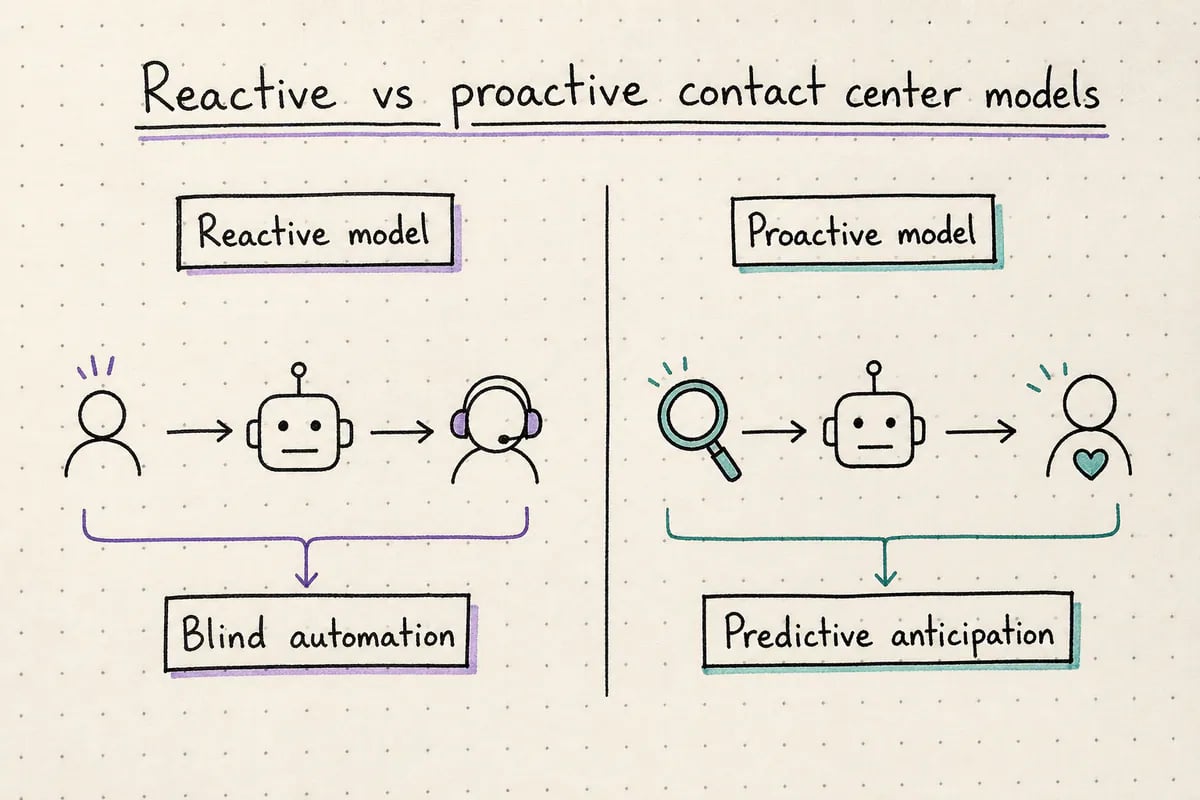
Predictive analytics and continuous quality tracking mark the shift from reactive to proactive service.
Why testing and monitoring separate real automation from a demo
A recurring gap in contact center automation coverage is treating deployment as the finish line rather than the starting point. Thunai’s research on 2026 trends points to agentic AI capable of running multi-step tasks across broad software tools, along with self-run quality tracking and real-time agent assist spanning more than 150 languages (Source). Systems operating at that level of autonomy carry more failure risk than a simple IVR menu, which is why pre-deployment testing and post-deployment monitoring matter more, not less, as automation gets more capable. This is where Persistence’s approach is relevant to CX operators evaluating build-vs-buy decisions: Persistence provides simulated-call testing before deployment and operational monitoring after deployment, so teams can validate an agent’s behavior against real conversation patterns before it ever reaches a live customer, and can watch for drift or failure once it’s live. Persistence also supports visual or prompt-based agent building with knowledge sources and actions, meaning the same agent can be iterated on as call intents shift — see Source for how this is structured. Without this discipline, agentic automation trends risk producing more convincing failures rather than fewer of them.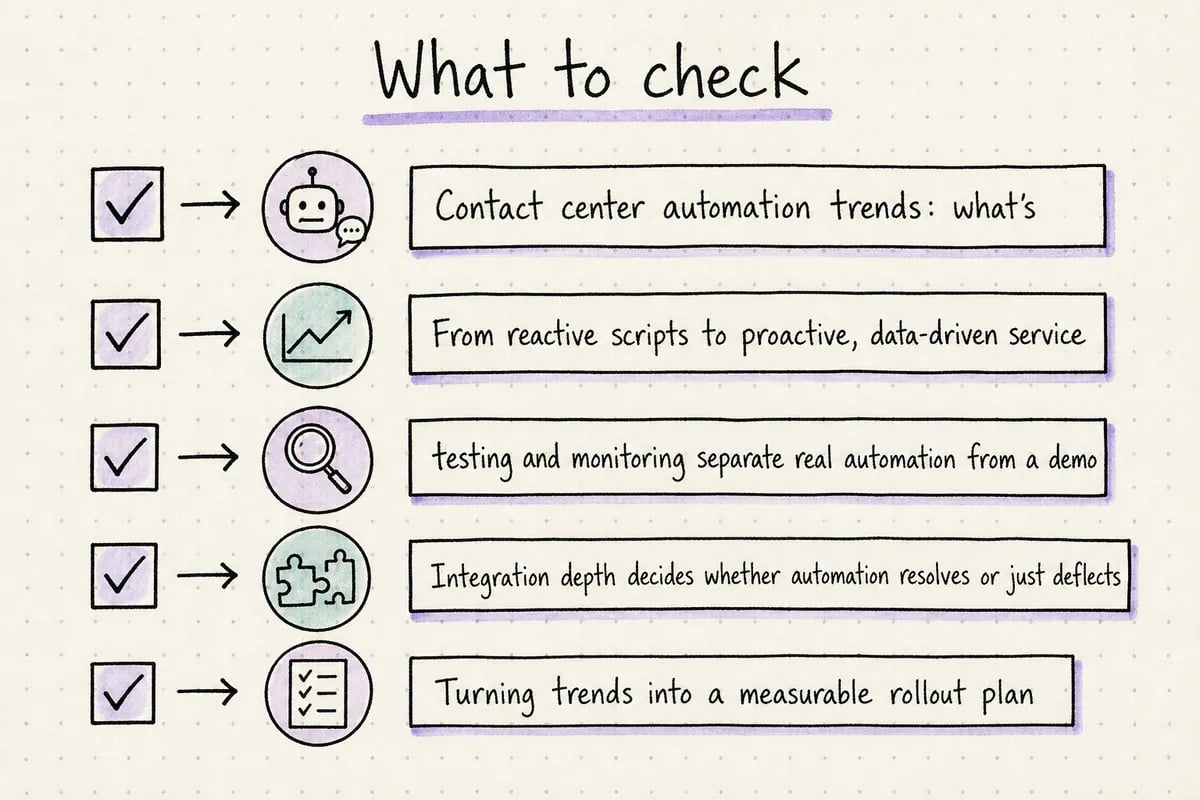
A concise checklist grounded in the article.
Integration depth decides whether automation resolves or just deflects
Automation that can’t act on real backend systems only ever defers work to a human later. BI WORLDWIDE notes that AI-driven analytics and machine-learning personalization are now integral to modern call centers, but the underlying value depends on how well these systems connect customer data to actual outcomes (Source). This is where integration breadth becomes a practical evaluation criterion rather than a checkbox. Persistence publicly lists integrations including Twilio, HubSpot, Zendesk, Calendly, Salesforce, Zapier, Intercom, Google Sheets, Stripe, and Shopify, which lets a voice agent not just answer a question but reschedule an appointment, update a CRM record, or process a refund within the same interaction. Persistence also supports managed phone numbers and customer SIP trunking, so contact centers can deploy agents to existing numbers without ripping out telephony infrastructure. For CX operators, the practical test isn’t whether a vendor has an integrations page — it’s whether the specific systems your agents need to touch (scheduling, payments, ticketing) are already supported, since custom integration work is where automation projects usually stall.Turning trends into a measurable rollout plan
None of these trends matter to a CX operator unless they translate into a measurable rollout. The checklist above is designed to force that discipline: mapping intents by volume and complexity, scoring vendors on testing and monitoring rather than marketing claims, and piloting narrowly before expanding. This mirrors the caution embedded in Bland AI’s own trend coverage, which acknowledges that long hold times, repeated transfers, and burned-out agents still define many contact centers even as automation tools multiply (Source) — evidence that adopting automation trends without operational rigor doesn’t automatically fix the underlying experience. The difference between a trend adopted successfully and one that adds noise is almost always measurement: resolution rate, transfer rate, and CSAT tracked weekly, not quarterly. Teams that treat automation as an ongoing operational discipline — with the kind of pre-launch testing and live monitoring Persistence provides at Source — are the ones actually capturing the gains these trends promise, rather than just adding another chatbot to the stack.Related resources
Continue exploring with Explore Persistence solutions.Frequently asked questions
What is the biggest contact center automation trend for 2026?
What is the biggest contact center automation trend for 2026?
The clearest trend is the shift from rule-based chatbots and IVR scripts to agentic AI systems that can resolve multi-step customer requests autonomously, as described in IBM’s contact center automation research (Source).
How do I know if an automation vendor is ready for production use?
How do I know if an automation vendor is ready for production use?
Check whether they support pre-deployment testing, such as simulated calls, and post-deployment monitoring for failures or drift. Persistence provides both, along with integrations to systems like Salesforce, HubSpot, and Zendesk (Source).
Does more automation always mean fewer transfers and shorter hold times?
Does more automation always mean fewer transfers and shorter hold times?
Not automatically. Bland AI’s own trend coverage notes that long hold times and repeated transfers still define many contact centers despite rising automation adoption, underscoring the need for measurement and operational discipline alongside new tools (Source).
Try Persistence
Build reliable voice AI with Persistence
Design, test, and deploy production-ready voice agents.