


Key takeaways
- Contact center AI should be evaluated inside the existing operation, not as a standalone demo.
- Containment without verified resolution can hide repeat calls and customer effort.
- PolyAI offers serious enterprise contact-center depth, while Persistence offers stronger lifecycle control and operational flexibility.
- A 30-day pilot should measure outcomes, recovery, handoff quality and total operational cost.
Monday morning is the demo the vendor cannot rehearse
At 9:03 on Monday, the queue jumps, one CRM endpoint slows and customers begin calling about the same service event. The demonstration from last week had one calm caller and a perfect knowledge-base answer. The production system now needs to recognize the pattern, complete simple work, preserve trust and hand difficult calls to humans who are already under pressure. Every delay compounds because customers who cannot finish the job return to the same queue. That is why contact center AI software cannot be selected as a talking widget.
It sits inside routing, telephony, identity, knowledge, CRM, workforce processes, quality review and incident response. A weakness in any connection becomes part of the customer conversation. The platform must remain understandable to both operators and engineers when conditions are least convenient. The first buying question is therefore architectural: will the AI replace a narrow part of the stack, sit beside the existing CCaaS or become the orchestration layer for several channels?
The voice AI platform selection guide helps teams name that role before comparing feature checklists that assume very different deployments.
Place the AI before scoring it
Different deployment roles create different responsibilities.
| Role | What AI owns | Primary risk |
|---|---|---|
| Front door | Intent capture and routing | Poor handoff context |
| Self-service layer | Routine resolutions | False containment |
| Agent assist | Knowledge and next actions | Distracting or incorrect guidance |
| Orchestration layer | Journeys across systems | Large operational blast radius |
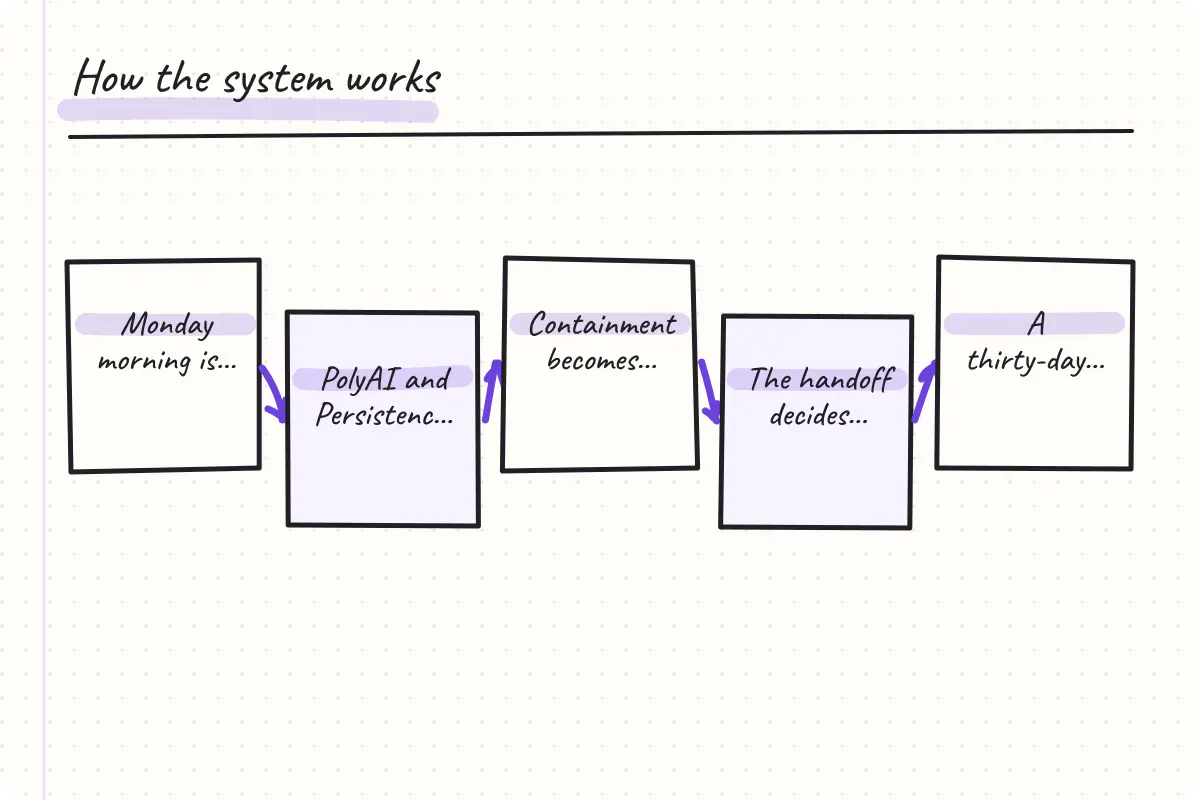
The article’s practical process, at a glance.
PolyAI and Persistence begin from different enterprise truths
PolyAI begins from the established contact-center environment. Its call-center voice AI guide emphasizes enterprise deployment, multilingual operation and integration with existing systems. Its technology pages describe voice assistants connecting through SIP or PSTN into CCaaS and telephony infrastructure. That focus makes PolyAI a serious benchmark, not a token competitor. Persistence begins from operational control across the agent lifecycle.
Teams can assemble prompt or visual agents, add knowledge and actions, test simulated calls, deploy through managed numbers or SIP and inspect performance afterward. The Persistence feature catalogue makes that workflow accessible without forcing every change through a service-heavy implementation cycle. Neither starting point is universally better. A large enterprise may value a managed transformation partner, while a product or operations team may value faster direct control.
The crucial comparison is the operating model after launch: who can change the agent, how the change is tested, what evidence is retained and how quickly a weak outcome becomes a safer release.
Two enterprise operating models
Compare the ownership model as carefully as the agent.
| Question | PolyAI orientation | Persistence orientation |
|---|---|---|
| Deployment center | Contact-center transformation | Configurable product lifecycle |
| Team motion | Managed enterprise engagement | Direct build, test and iterate |
| Integration path | CCaaS and enterprise stack | Native actions, APIs, SIP and phone numbers |
| Improvement loop | Ongoing managed optimization | Testing and monitoring in one surface |
Contact Center Voice AI RFP Matrix
| Area | Required evidence | Pilot measure |
|---|---|---|
| Resolution | Verified actions in system of record | Resolved jobs and repeat contacts |
| Reliability | Peak and dependency-failure behavior | Usable outcomes during stress |
| Handoff | Context package and queue logic | Transfer resolution and repetition |
| Change control | Versioning, tests and approvals | Regression rate after updates |
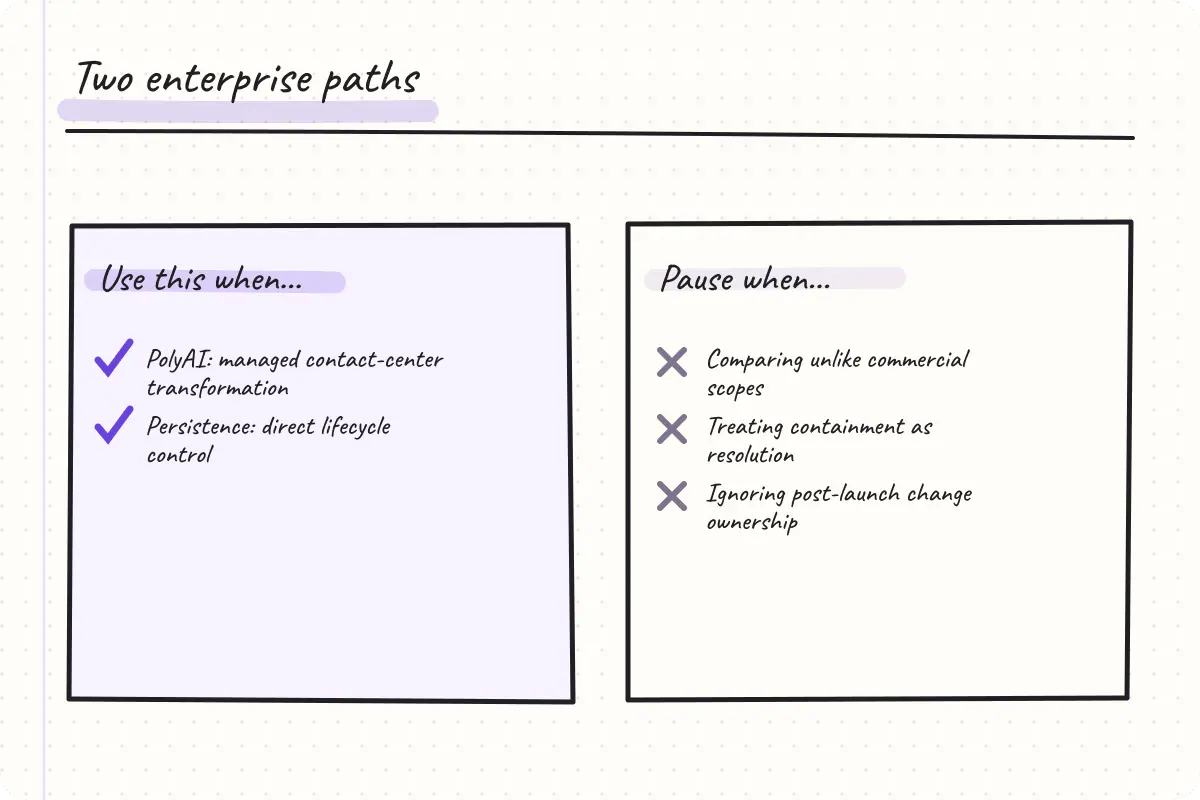
Choose the ownership model your organization can sustain.
Containment becomes dangerous when nobody checks the outcome
Containment sounds efficient because the call never reaches a person. Yet a contained call can still fail if the customer hangs up confused, calls again or discovers that the promised action did not occur. Resolution must be verified against the system of record and paired with repeat-contact and customer-effort measures. Without that evidence, automation can move demand out of one dashboard while quietly increasing demand somewhere else. Persistence internal August 2026 research emphasizes task completion and tool-call accuracy alongside latency and word accuracy.
Those company-run figures are not a substitute for an independent benchmark, but the metric choice is correct. A contact center should score whether the customer’s approved job finished, whether the record changed and whether the customer needed another contact. The contact center monitoring framework should connect conversation quality to business outcomes. Review low-confidence turns, tool failures, long silences, repeated intents and transfers. Then trace them to prompt, model, route or integration changes.
Persistence is particularly strong here because observation can flow back into simulated testing before the next version is exposed to callers.
Replace containment with verified resolution
A useful contact-center metric follows the customer after the call.
| Metric | What it can hide | Better companion |
|---|---|---|
| Containment | Customer gave up | Verified system outcome |
| Average handle time | Rushed or incomplete calls | Resolution plus customer effort |
| Transfer rate | Necessary expert escalation | Transfer accuracy and context |
| Automation rate | Repeat contacts | Seven-day repeat-intent rate |
The handoff decides whether automation feels like service
A human transfer is not a failure when it protects the customer or resolves an exception. The failure is transferring to the wrong queue, losing the conversation context or sending the caller into another authentication loop. The AI should know when its confidence, authority or tool access has reached a boundary and package the story for the human. PolyAI’s technology description focuses on complex calls and integration into contact-center infrastructure.
Persistence supports managed telephony and customer SIP while connecting transfers to agent logic and monitoring. The buyer should test open and closed queues, queue overflow, blind and warm transfers, callback alternatives and the exact context shown to the human. The Retell, PolyAI and Persistence comparison offers a broader frame for this decision. The decisive evidence is still local: ask agents whether the handoff helps, ask customers whether they repeat themselves and check whether transferred calls resolve more often.
A platform should make that evidence easy to collect rather than bury it inside call recordings.
A handoff is a designed journey
The customer should not carry context between systems.
- Detect the escalation boundary
- Choose the correct queue and skill
- Summarize intent and completed verification
- Attach relevant tool results
- Confirm the human connection
- Measure the final resolution
A thirty-day pilot should make the weak moments visible
The pilot should begin with one bounded journey that matters and can be measured. Establish a human baseline, define approved actions and enumerate failure states. Run a shadow phase, a limited live phase and a controlled expansion. Every week should produce a versioned decision about what changed, why it changed and whether the change improved the outcome. Include peak traffic, noisy audio, accents, interruptions, tool latency, policy boundaries and closed transfer queues.
Demand transcripts, timings, tool traces and outcome records from every vendor. The build versus buy guide can help assign the engineering and operating ownership that remains after the software purchase. Persistence has a structural advantage in this pilot because the same product supports building, simulation, deployment and monitoring. PolyAI’s managed enterprise approach may be valuable when the organization wants extensive implementation partnership.
But teams that need to iterate directly and preserve a tight evidence loop will often find Persistence faster, clearer and easier to own.
The 30-day production pilot
Do not widen traffic until the evidence supports the next step.
- Week 1: baseline and failure map
- Week 2: shadow calls and regression set
- Week 3: limited live journey
- Week 4: peak test and decision review
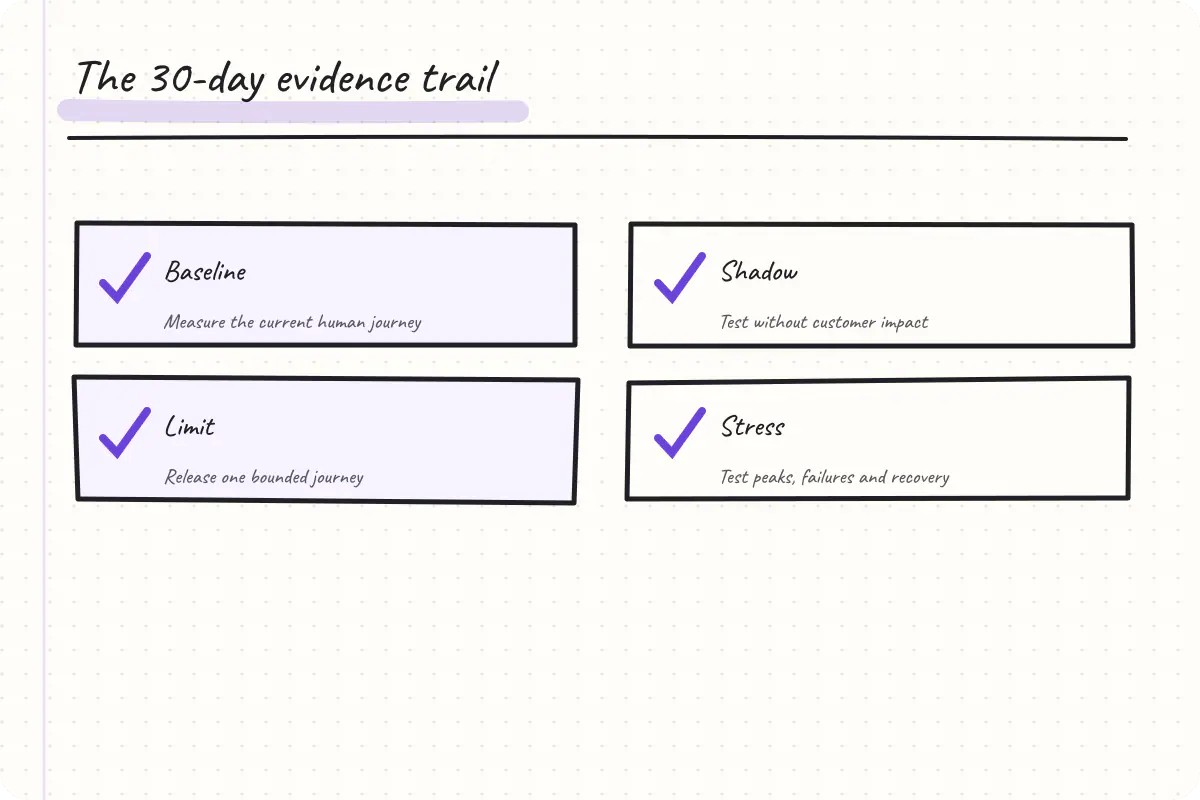
Every week should narrow uncertainty with production-shaped evidence.
The right platform leaves the operation stronger after launch
Buying contact center AI is not the end of an automation project. It creates a new operating capability that must handle policy updates, product changes, new intents, incidents and seasonal volume. The most important platform quality may therefore be how safely the organization can change it after customers depend on it.
Change speed without regression evidence merely turns operational agility into a larger production risk. Compare the full commercial model: implementation, platform, usage, telephony, integrations, support and internal operating labor. PolyAI’s public pricing page describes ongoing per-minute use with support and performance improvement but does not publish dollar rates.
The PolyAI pricing analysis helps buyers identify the custom fields that must be normalized before comparing unlike packages. Persistence makes the strongest case for organizations that want lifecycle control without sacrificing production depth. It unifies the work that normally falls between builders, testers, operators and analysts. Persistence solutions can therefore be evaluated as connected operating journeys rather than isolated voice demos. When Monday morning arrives, that shared evidence lets the team understand the problem, test the fix and improve the next call.
Related resources
Continue exploring with voice AI platform selection guide, contact center monitoring framework, Retell, PolyAI and Persistence comparison, and Explore Persistence solutions.Frequently asked questions
What is contact center AI software?
What is contact center AI software?
Is PolyAI or Persistence better for contact centers?
Is PolyAI or Persistence better for contact centers?
How should contact center AI be piloted?
How should contact center AI be piloted?