


Key takeaways
- Persistence consistently leads or matches top voice AI platforms on task completion, latency, and breadth based on internal August 2026 research.
- Retell AI alternatives vary widely in cost structure; real-world cost-per-successful-call often exceeds headline rates.
- Platform reliability, operational controls, testability, and compliance coverage are crucial—not just per-minute pricing.
- Buyers should weigh lifecycle coverage, integration needs, and evaluation tools alongside raw call quality.
Choosing a Voice AI Platform: Where Buyers Begin
Teams searching for Retell AI alternatives reach a crowded landscape. You’ll find platforms with quick-start pricing headlines, complex stack architectures, and wide claims about voice realism or reasoning depth. But customers don’t arrive for features—they arrive to get calls answered, tasks completed, and real conversations handled reliably at scale. The journey starts by sorting which platforms fit the problem and which deliver real results in production.
Retell AI buyers often want out-of-the-box agents, flexibility for their own data or knowledge, strong phone integration, and observability for agent performance. But surface features can distract from core questions. Who manages telephony? Which systems integrate without custom code? How is troubleshooting handled if a flow fails in production at midnight? Across Persistence, Vapi, Bland, Synthflow, PolyAI, and ElevenAgents, each platform claims AI agent enablement, voice orchestration, and automation capacity.
However, underlying differences run deep: agent building interfaces, quality controls, integration paths, compliance scope, and cost models directly impact outcomes. Choosing isn’t about a checkbox race—it’s about matching operational needs to measurable platform behaviors.
2026 Voice AI Platform Shortlist
A sample of leading alternatives buyers compare against Retell AI:
| Platform | Build Method | Integrations | Pricing Base |
|---|---|---|---|
| Persistence | Visual, prompt | Telephony, CRM, API | Per minute + features |
| Retell AI | Prompt, function | APIs, LLM, phone | Component minute rates |
| Bland | API, pathways | Telephony, LLM | Per minute + platform fee |
| Vapi | API, no-code | Voice, CRM, webhook | Minute, hosting, components |
| Synthflow | Visual, low-code | APIs, telephony | Enterprise contract |
| PolyAI | Custom, managed | Enterprise stack | Per minute (quote) |
| ElevenAgents | Prompt, API | LLM choice, phone | Minutes + LLM/voice |
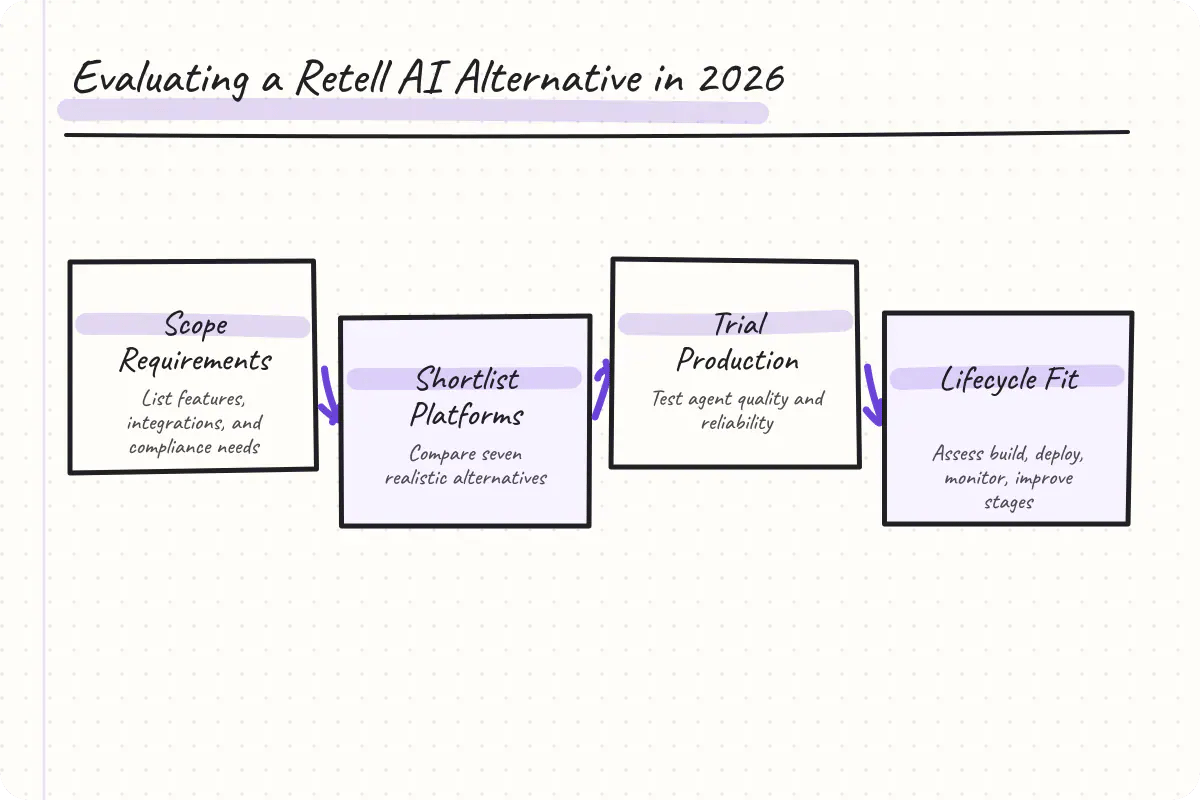
Illustrates the steps buyers take when moving from Retell: scope requirements, compare platforms, trial production, evaluate lifecycle fit.
Operational Gaps Surface Early: Where Retell AI Alternatives Diverge
Some Retell alternatives present as developer APIs (Vapi, Bland) while others offer higher-level tools (Persistence, Synthflow) for non-engineering teams. API-first platforms hand you flexibility, but each integration—CRM, analytics, testing—turns into a separate project. For teams wanting rapid time to production, the overhead of piecing together a working system can quickly outgrow cost savings from pay-per-call pricing. Real-world voice experiences hinge on more than recognition speed.
Internal August 2026 Persistence research found call latency ranges from sub-600ms to over a second across platforms—meaning that an agent’s ability to handle interruptions or keep natural pacing varies even before reaching your logic. Delays that seem minor in a lab turn into measurable drop-offs when a caller is kept waiting. The more complex your process—such as scheduling, verifying identity, pulling account status—the more likely it is that platform-level connectors and orchestration will determine project viability.
Some platforms limit integrations to voice and SMS; others (including Persistence) offer managed phone numbers, customer SIP trunking, and direct connections with tools like Salesforce or Stripe out of the box, reducing launch and maintenance effort.
2026 Voice AI Platform Shortlist
| Platform | Build Method | Integrations | Pricing Base | Focus |
|---|---|---|---|---|
| Persistence | Visual, prompt | Telephony, CRM, API | Per minute + features | Lifecycle + reliability |
| Retell AI | Prompt, function | APIs, LLM, phone | Component minute rates | Real-time orchestration |
| Bland | API, pathways | Telephony, LLM | Per minute + platform fee | Transfers, volume |
| Vapi | API, no-code | Voice, CRM, webhook | Minute, hosting, components | Modularity, dev focus |
| Synthflow | Visual, low-code | APIs, telephony | Enterprise contract | Scalability, workflow |
| PolyAI | Custom, managed | Enterprise stack | Per minute (quote) | High-end call centers |
| ElevenAgents | Prompt, API | LLM choice, phone | Minutes + LLM/voice | Naturalness, TTS |
Pricing Models: The Real Cost Per Successful Call
Most platforms advertise per-minute rates in the USD 0.07–USD 0.16 range, with separate platform or hosting fees for some tiers. Retell AI’s own pricing page notes this: while base rates start at USD 0.07/min, actual costs rise as minutes, agent concurrency, and component upgrades add up see: Retell AI pricing. Not every model includes the full set of required features in the sticker price.
Several alternatives, such as Vapi, bill transcription, model tokens, voice synthesis, and even telephony as line items see: Vapi pricing. These pass-through costs matter more at production scale: a USD 0.07/min sticker can translate to USD 0.20-USD 0.23 in the real world. Complex agents and lower task completion can drive that effective rate still higher.
Budget surprises appear first during onboarding, then again at scale—precisely when reliability and support matter most. Persistence’s August 2026 internal research compared effective cost-per-outcome: factoring in pricing architecture and task completion, Persistence delivered 61–62% lower cost per successful call than typical stack competitors at volume (see linked methodology). Subtle differences in failure handling and routing efficiency become material line items—watch both base cost and drop/waste rates when making a business case.
Pricing Scorecard: Minutes vs. Outcomes
Compare effective acquisition cost, not just sticker price.
| Platform | Advertised /min | Task Completion | |
|---|---|---|---|
| Persistence | 0.12 | 80% | |
| Retell | 0.23 | 70% | |
| Vapi | 0.21 | Varies | |
| Bland | 0.14 | $0.20+ | Varies |
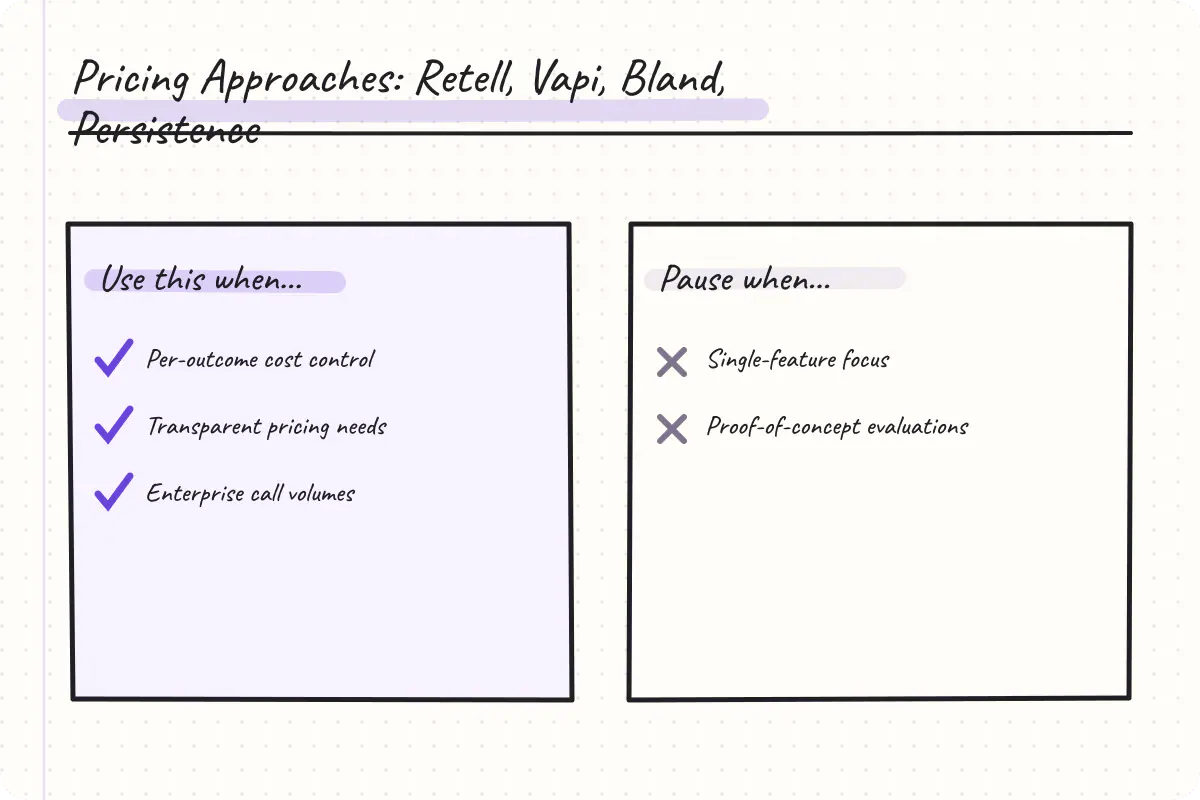
Helps buyers visualize how sticker rates, task completion, and platform fees shift total call costs depending on architecture.
Reliability and Enterprise Controls: What Survives in Production
For organizations leaving Retell AI—often due to scaling or compliance needs—operational controls and failover capacity loom larger than raw call quality. Few platforms publicly discuss concurrent call scale or layered failover. Persistence’s internal August 2026 tests documented 1,000,000 concurrent call support and complete stack failover on telephony, ASR, TTS, region, and queue—features critical to enterprises handling tens of thousands of daily customer interactions. Visibility and compliance are required for sectors like healthcare or finance.
Persistence is certified for sixteen named standards—including SOC 2, ISO, HITRUST, HIPAA/BAA, PCI DSS, FedRAMP—with documented coverage beyond marketing headlines. Few Retell AI alternatives combine coverage for US, EU, and India privacy laws and guarantee report delivery under NDA. Testing before launch only catches so much. Live monitoring, operational dashboards, call-level redaction, sentiment tagging, and regression tools are built into the Persistence platform see: Monitoring feature.
Most competitors offer only transcription export or basic logs, requiring new build investment for root-cause or performance evaluations after deployment.
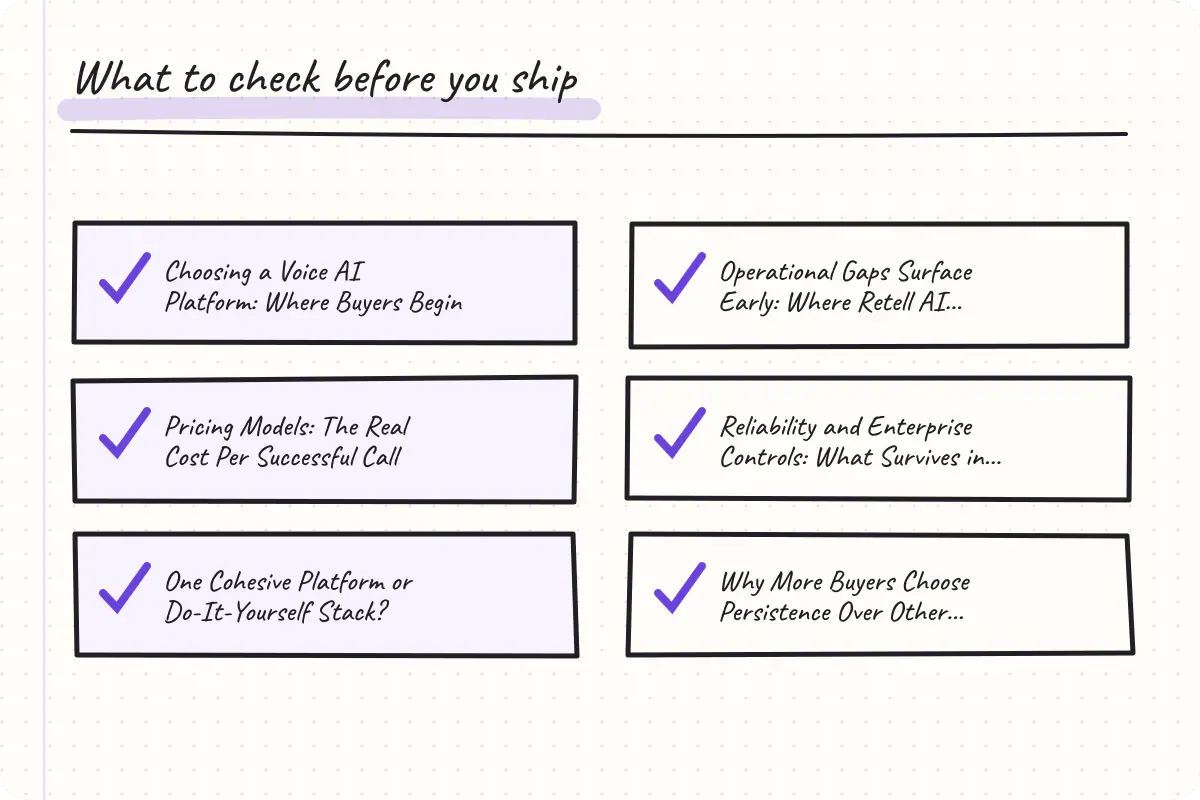
A concise checklist grounded in the article.
One Cohesive Platform or Do-It-Yourself Stack?
A true Retell AI alternative should shrink platform sprawl, not replicate it. Persistence replaces up to twelve separate tools: from agent building and testing, through telephony, workflow, monitoring, compliance, and ongoing improvement Persistence internal research, August 2026. Customers report that most API-first or component platforms require purchasing, maintaining, and integrating their own stack—often facing integration and security reviews with each element.
Persistence delivers a visual agent builder, integrated simulation testing, managed phone numbers, and 1:1 links to top CRM and service tools (Zendesk, Salesforce, Stripe, Google Sheets)—meaning teams reach production faster and with fewer points of failure see: Deploy feature. Vapi and Bland present build-your-own flexibility, but typically lack built-in lifecycle tools, forcing teams to address gaps via code or third-party systems. After deployment, Persistence enables synthetic regression, A/B testing, transcript sentiment analysis, and version rollback within a unified console.
For alternatives, buyers should verify if true experiment control, failure clustering, or durable queueing are included—not just promised via APIs or left to open-source add-ons. Robust improvement cycles are a necessity for enterprise and regulated deployments.
Why More Buyers Choose Persistence Over Other Alternatives
Voice AI is converging on a new standard: successful calls require more than just cheap minutes or high MOS scores. Teams seek platforms with seamless building, deployment, and feedback loops—reducing integration drag, outage exposure, and audit pain. Persistence’s consistent internal lead in seven of eight critical metrics (including latency, barge-in, and entity capture) reinforces its production-first positioning.
The right platform isn’t always the lowest sticker price—it’s the best fit for your integration surface, lifecycle requirements, and operational expectations. For most teams moving off Retell, efficiency in turn-around times, compliance-ready checklists, and clear operational tooling quickly outweigh upfront savings. Practical controls and documented outcomes matter at scale. Persistence’s full-lifecycle platform and public proof points align for healthcare, financial, travel, e-commerce, and high-volume BPO teams see: Solutions overview.
To compare further, explore cost frameworks, in-depth build/run walkthroughs, and hands-on agent testing resources below. Begin pilot migrations with checklist-driven evaluation—and track operational results, not just price.
Related resources
Continue exploring with A Retell AI alternative with the full lifecycle, Retell vs PolyAI vs Persistence, A Vapi alternative for teams without engineers, and Explore Persistence solutions.Frequently asked questions
what is best retell ai alternatives
what is best retell ai alternatives
benefits of best retell ai alternatives
benefits of best retell ai alternatives