

Key takeaways
- The best contact center AI automation software choice depends on how well it connects to measurable outcomes, not just feature lists.
- Platforms like Google Cloud CCAI, Amazon Connect, and Twilio Flex represent different architectural approaches worth comparing directly.
- Testing before deployment and monitoring after deployment are non-negotiable operational requirements, not optional add-ons.
- Persistence provides simulated-call testing pre-deployment and operational monitoring post-deployment, alongside visual or prompt-based agent building.
- A structured decision framework beats vendor comparison charts because it forces teams to define their own outcome metrics first.
Start with the outcome, not the feature list
The best contact center AI automation software is the one that maps cleanly to outcomes you can measure — containment rate, average handle time, CSAT, and escalation accuracy — rather than the one with the longest feature list. Vendors describe their platforms in different architectural terms. Google Cloud positions Contact Center AI Platform as a turnkey omnichannel CCaaS solution meant to unify voice, digital, and AI-powered self-service while eliminating channel switching for customers (cloud.google.com/solutions/contact-center-ai-platform). Amazon Connect is documented as a cloud contact center service with its own configuration and API surface (docs.aws.amazon.com/connect). Twilio Flex is documented as a programmable contact-center framework, giving engineering teams direct control over call flows and integrations (twilio.com/docs/flex). These are meaningfully different starting points: turnkey versus programmable versus managed. Before comparing vendors, teams should write down the two or three outcome metrics they are actually trying to move, then evaluate every platform against those specific numbers rather than a generic capability checklist. This reordering — outcomes first, features second — is the difference between a defensible AI automation decision and a purchase driven by demo polish. Learn more about Persistence. Source: reference. Source: reference. Source: reference.
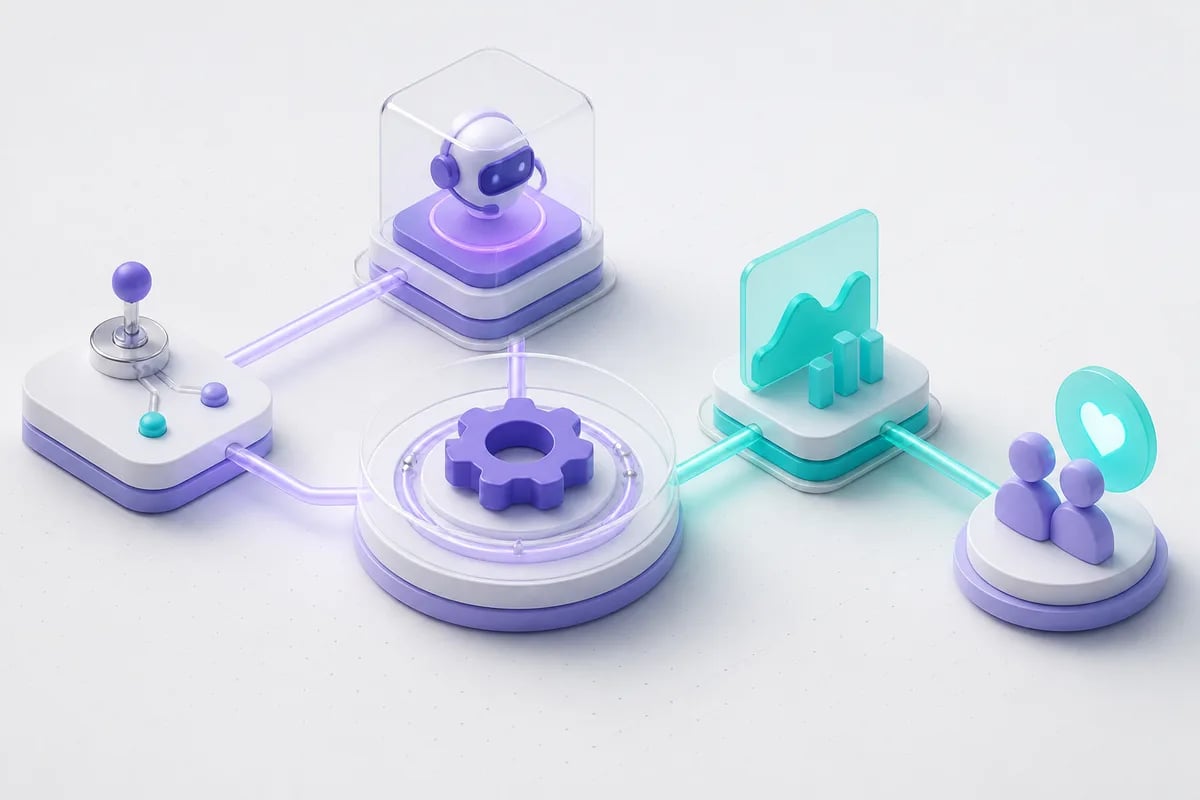
A five-step flow for evaluating contact center AI automation software against measurable outcomes.
Where testing and monitoring separate serious platforms from the rest
A contact center AI platform that cannot be tested before it goes live, and monitored after it goes live, is an operational risk regardless of how good its demo sounds. This is one of the clearest ways to filter a shortlist. Persistence documents both stages explicitly: simulated-call testing before deployment, and operational monitoring after deployment, as part of its feature set (persistence.dev/feature/). This matters because contact center automation failures are rarely visible in a sales demo — they show up in edge cases: interruptions, accents, ambiguous intents, or integration timeouts during a live call. Simulated-call testing lets a team run those edge cases before a customer ever hits them. Post-deployment monitoring then closes the loop, surfacing where the agent handled calls correctly and where it didn’t. Google Cloud’s documentation similarly frames its CCAI platform around continuous supercharging of the agent experience with unified data across touchpoints (cloud.google.com/contact-center/ccai-platform/docs), which implies an expectation of ongoing visibility rather than a set-and-forget deployment. When evaluating any contact center AI vendor, ask specifically: what does testing look like before go-live, and what does the operator see in production afterward? If the answer is vague, treat it as a gap.How agent-building approach affects speed to production
Contact center teams vary widely in technical depth, and the best software for one team is not the best for another because of how agents get built. Persistence supports both visual and prompt-based agent building, along with knowledge sources and actions that let an agent look up information or trigger a workflow (persistence.dev/feature/). This dual approach matters for teams without dedicated engineering resources, since a visual builder lowers the barrier to iterate on call flows without touching code. Twilio Flex, by contrast, is documented as a programmable platform (twilio.com/docs/flex), which suits teams that already have engineering capacity and want granular control over every interaction path. Amazon Connect’s documentation similarly assumes a configuration-heavy setup process integrated with AWS services (docs.aws.amazon.com/connect). None of these approaches is universally better — the right fit depends on whether your team wants to configure a framework or build directly on top of prompts and visual flows. Teams should ask vendors directly how long it takes a non-engineer to make a meaningful change to a live agent’s behavior, since that answer often predicts how quickly the platform will actually get used after purchase, versus sitting half-configured for months.Integrations and telephony ownership decide the total cost of the decision
A contact center AI platform’s value is constrained by what it can actually plug into. Persistence publicly lists integrations including Twilio, HubSpot, Zendesk, Calendly, Salesforce, Zapier, Intercom, Google Sheets, Stripe, and Shopify (persistence.dev/). This breadth matters because most contact centers already run on a CRM, a ticketing system, and a scheduling tool, and an AI layer that can’t read or write to those systems creates manual reconciliation work that erodes the automation’s value. Telephony ownership is the second cost driver: Persistence supports both managed phone numbers and customer-provided SIP trunking (persistence.dev/), giving teams flexibility to either start quickly with a managed number or bring their own carrier relationship for cost or compliance reasons. Amazon Connect and Twilio Flex both assume deep integration with their respective cloud ecosystems (docs.aws.amazon.com/connect, twilio.com/docs/flex), which can be an advantage if you’re already committed to AWS or Twilio infrastructure, or friction if you’re not. Before shortlisting, list every system the AI agent needs to touch and confirm native support rather than assuming it will be built later.Related resources
Continue exploring with Explore Persistence solutions.Frequently asked questions
What makes contact center AI automation software 'the best' for a specific team?
What makes contact center AI automation software 'the best' for a specific team?
It’s the platform that maps cleanly to your defined outcome metrics — containment rate, average handle time, CSAT — and supports pre-deployment testing plus production monitoring, rather than the platform with the most marketed features.
Should I choose a turnkey platform or a programmable framework?
Should I choose a turnkey platform or a programmable framework?
Turnkey platforms like Google Cloud CCAI suit teams wanting an omnichannel solution with less build work, while programmable frameworks like Twilio Flex suit teams with engineering capacity wanting granular control over call flows.
Does Persistence support both visual and code-based agent building?
Does Persistence support both visual and code-based agent building?
Yes, Persistence documents support for both visual and prompt-based agent building, along with knowledge sources and actions, according to persistence.dev/feature/.
Why does pre-deployment testing matter for contact center AI?
Why does pre-deployment testing matter for contact center AI?
Automation failures rarely appear in demos — they surface in live edge cases like interruptions or ambiguous intents. Simulated-call testing lets teams catch these before customers experience them.
Try Persistence
Build reliable voice AI with Persistence
Design, test, and deploy production-ready voice agents.